

 Maths for Pilots
 Science for Pilots
 English Language for Pilots
 Verbal Reasoning for Pilots
 Numerical Reasoning for Pilots
 Mechanical Reasoning for Pilots
 ATPL Knowledge for Pilots
 WhatsApp
 Facebook Chat
 Email
Email










































If you don't have time to read this article but would like to know whether our software can help - it can. You can buy access to our software and get started immediately, 365 days-a-year.
Buy Preparation SoftwareMathematics describes the ability to apply numerical reasoning, arithmetic computation and mathematical concepts to solve problems accurately and efficiently. In pilot aptitude testing, Mathematics is assessed as the candidate's capacity to perform calculations and apply mathematical principles to practical scenarios, typically under strict time constraints and without the aid of a calculator. Mathematics is one of the most widely assessed competencies in pilot aptitude testing, appearing in some form in nearly every major test system. The specific content varies between assessments, but collectively the mathematical sub-topics assessed across pilot aptitude tests include:
Some assessments present these topics as written word problems, whilst others deliver questions audibly, requiring the candidate to process numerical information through listening and perform calculations mentally. Mathematics is distinct from Numerical Reasoning, which is assessed as a separate skill in several test systems. Whilst Mathematics focuses on computation, Numerical Reasoning focuses on the ability to interpret, analyse and draw conclusions from quantitative data presented in charts, tables and graphs.
Further Reading on Mathematical Ability and Cognitive Performance
Number Sense and Mental Arithmetic
Research in cognitive psychology distinguishes between number sense (an intuitive understanding of numerical magnitudes and relationships) and procedural mathematical ability (the capacity to execute learned algorithms and operations). Both contribute to performance on pilot aptitude tests. Number sense allows the candidate to estimate answers quickly and check whether a computed result is plausible, whilst procedural ability allows them to execute the calculation accurately [1].
Mental arithmetic, which is assessed directly in several pilot aptitude tests, places particular demands on working memory. The candidate must hold the numbers in mind, retrieve the appropriate operation, execute the calculation step by step, and retain intermediate results, all without external aids. Research has shown that individuals differ significantly in their working memory capacity for numerical information, and that this capacity is a strong predictor of mental arithmetic performance [2].
Mathematical Anxiety
A well-documented phenomenon in educational and occupational testing is mathematical anxiety: a feeling of apprehension, tension or discomfort that interferes with mathematical performance. Research has shown that mathematical anxiety can reduce working memory capacity by diverting cognitive resources to anxiety-related processing, resulting in lower performance than the individual's actual mathematical ability would predict [3].
For pilot aptitude test candidates, the practical implication is that familiarity with the test format and regular practice under timed conditions can significantly reduce mathematical anxiety and improve performance. Candidates who approach mathematical modules having already practised the specific question types and time pressures of their assessment are less likely to experience the working memory disruption that anxiety causes.
Mathematics in pilot aptitude testing draws on the same numerical skills that are used in everyday practical problem-solving. The following examples illustrate the types of mathematical thinking that are assessed, and how they relate to broader cognitive abilities.
- Calculating whether a budget will cover expenses:
- Working out whether a monthly salary will cover rent, bills, food and other expenses requires addition, subtraction, and often percentages (tax, discounts, interest). The same arithmetic operations are assessed in pilot aptitude tests, where candidates must perform multi-step calculations quickly and accurately. In aviation, this type of budgeting translates directly to fuel planning: calculating whether the fuel on board will cover the planned route, reserves, alternates and contingencies.
- Converting between units of measurement:
- Converting between metric and imperial measurements (kilometres to miles, litres to gallons, kilograms to pounds) is a routine mathematical skill that becomes critical in aviation. Different countries and different aircraft systems may use different units, and the pilot must convert fluently and accurately. Pilot aptitude tests frequently include conversion questions because errors in unit conversion have been identified as a factor in aviation incidents.
- Splitting a bill proportionally:
- Dividing a restaurant bill between several people, accounting for different orders and tips, requires ratio and proportion calculations. In aviation, the same mathematical principles are applied when calculating weight distribution across cargo compartments, determining fuel splits between tanks, or apportioning flight time between crew members for duty hour tracking.
- Estimating travel time from distance and speed:
- Calculating how long a journey will take at a given speed is a speed-distance-time problem, one of the most commonly tested mathematical concepts in pilot aptitude assessments. Pilots use these calculations continuously: estimating time to a waypoint, calculating ground speed from headwind or tailwind components, determining the time available before reaching a fuel endurance limit, and planning descent profiles.
The everyday examples above involve the same mathematical operations (arithmetic, percentages, ratios, conversions, speed-distance-time) that pilots use throughout every phase of flight. In aviation, however, the calculations must be performed quickly, accurately, and often simultaneously with other tasks.
- Fuel planning and management:
- Fuel calculations are among the most safety-critical mathematical tasks in aviation. Before departure, the pilot calculates the fuel required for each phase of flight (taxi, climb, cruise, descent, approach), plus mandatory reserves, alternate fuel and contingency. During flight, the pilot monitors actual fuel consumption against planned consumption, calculates remaining endurance, and determines whether the fuel state permits continuation to the destination or requires a diversion. These calculations involve multiplication, division, unit conversion (kilograms to litres, pounds to gallons) and time-based computation.
- Weight and balance calculations:
- Before every flight, pilots must verify that the aircraft's total weight is within limits and that the centre of gravity falls within the permitted range. This requires calculating the weight of passengers, baggage, cargo and fuel, multiplying each by its arm (distance from a reference datum), and summing the resulting moments to determine the centre of gravity position. An error in these calculations can result in an aircraft that is dangerously tail-heavy or nose-heavy, with potentially catastrophic consequences during flight.
- Performance planning:
- Takeoff and landing performance calculations require the pilot to account for runway length, elevation, temperature, wind, slope, and surface condition. Each variable affects the required distance, and the pilot must compute or verify that the available runway length exceeds the calculated requirement by a defined safety margin. These calculations involve percentages (corrections for slope and wind), addition and subtraction (adjustments for conditions), and comparison against published performance limits.
- Descent planning and vertical navigation:
- Planning a descent from cruise altitude to approach altitude requires the pilot to calculate the distance required, the rate of descent needed, and the point at which the descent should begin. The standard rule of thumb (multiply altitude to lose in thousands of feet by three to get the distance in nautical miles) is a mental arithmetic shortcut, but more precise calculations are often needed when constraints such as speed restrictions, crossing altitudes, or traffic requirements are in play.
Rotary-wing operations present additional mathematical demands:
- WAT limit and performance planning:
- Before every flight, helicopter pilots must determine the maximum permissible takeoff weight for the current conditions using Weight, Altitude and Temperature (WAT) charts. This involves reading ambient temperature, calculating pressure altitude from the QNH and airfield elevation, interpolating between published values on the performance chart, and subtracting the result from the maximum structural weight to determine the useful load available. If the aircraft is too heavy, the pilot must calculate how much fuel or payload to offload.
- Hover performance and density altitude:
- Helicopter operations are uniquely sensitive to density altitude because hover flight demands the highest power output. Pilots must calculate density altitude from pressure altitude and temperature, then cross-reference this against hover ceiling charts to determine whether the aircraft can hover in ground effect (IGE) or out of ground effect (OGE) at the planned weight. At marginal sites such as elevated helipads or confined areas on warm days, even small errors in these calculations can mean the difference between a safe departure and a loss of control.
- Fuel planning with variable mission profiles:
- Helicopter missions frequently involve multiple segments flown at very different fuel consumption rates. A typical HEMS (air ambulance) sortie might include a high-speed transit, a period of hovering at scene, a slower transit to hospital, and a return leg. The pilot must calculate the fuel required for each segment at its specific consumption rate, add mandatory reserves and contingency, and compare the total against fuel on board. This requires multiplication across several segments and careful summation under time pressure.
- Weight and balance calculations:
- Helicopters are particularly sensitive to centre of gravity position, and the range of permissible loading is narrower than in most fixed-wing aircraft. Pilots must calculate the moment (weight multiplied by arm) for each item of payload and fuel, sum the total moments, divide by total weight to find the centre of gravity position, and verify it falls within the permitted envelope. For operations involving variable loads such as underslung cargo or winch operations, these calculations may need to be repeated in flight as weight and balance shift.
Mathematics is assessed in virtually every major pilot aptitude test system because numerical ability is a non-negotiable requirement of the professional pilot role. From the earliest days of flight training through to a pilot's final operating flight, mathematical calculations are performed daily, and errors can have immediate safety consequences.
Professional pilot training is mathematically intensive. Ground school subjects including General Navigation, Mass and Balance, Flight Planning, Meteorology, and Aircraft Performance all require fluent mathematical ability. Candidates who enter training with strong numerical skills are able to focus on learning the aviation-specific applications of those skills, rather than struggling with the underlying mathematical operations.
Training organisations have found that mathematical ability at entry is one of the strongest predictors of performance in ATPL ground school examinations [5]. Screening for this ability at the selection stage reduces the risk of candidates failing or requiring additional remedial support during the most expensive phase of their training programme.
Mathematical errors in aviation can have direct safety consequences. Fuel calculations that underestimate consumption can lead to fuel exhaustion. Weight and balance calculations that place the centre of gravity outside limits can lead to loss of control. Performance calculations that overestimate available runway length can result in overrun or rejected takeoff incidents.
The ability to perform these calculations accurately, and equally importantly, to recognise when a calculated result is unreasonable, is a fundamental safety competency. Pilot aptitude tests assess not only computational accuracy but also the speed and confidence with which calculations are performed, because in the cockpit, slow or hesitant mathematical performance can lead to delayed decision-making during time-critical phases of flight.
Mathematics is one of the most broadly assessed competencies across pilot aptitude test systems. It features in the Aon (Cut-e), COMPASS, Advanced COMPASS, DLR, Vienna Test System, ADAPT and TestAir360 assessments. Some test systems include multiple mathematics modules that assess different facets of numerical ability: the DLR, for example, includes both a written word problems module and a separate audio-based mental arithmetic module, each testing a distinct aspect of mathematical competency.
This breadth of assessment reflects the breadth of mathematical demand in professional aviation. A pilot needs both the ability to solve structured word problems (fuel planning, performance calculations) and the ability to perform rapid mental arithmetic (verifying ATC-assigned altitudes, calculating descent rates, cross-checking automated outputs). Test systems that assess both facets provide a more complete picture of the candidate's numerical readiness for training.
Further Reading on Mathematical Predictors of Pilot Training Success
Numerical Ability as a Predictor
Meta-analyses of pilot selection research have consistently identified numerical/mathematical ability as a significant predictor of pilot training performance. Hunter and Burke's (1994) meta-analysis found that cognitive ability measures (including mathematical tests) contributed meaningfully to the prediction of training outcomes across multiple studies and selection systems [6].
Martinussen's (1996) European meta-analysis reported similar findings, with numerical tests demonstrating predictive validity for both ground school performance and overall training success [7]. Importantly, mathematical ability was found to be predictive even when controlling for educational background, suggesting that the tests are measuring a cognitive capacity that goes beyond what formal education alone develops.
Speed and Accuracy
Research into mathematical cognition has demonstrated that both speed and accuracy contribute independently to performance in time-pressured environments. Fast but inaccurate computation leads to errors; accurate but slow computation leads to missed opportunities and delayed decisions. The most effective performers combine speed with accuracy, a capacity that is sometimes referred to as mathematical fluency [8].
Pilot aptitude tests assess mathematical fluency by imposing strict time limits on mathematical modules. The DLR Mental Arithmetic module, for example, allows only 10 to 30 seconds per question, requiring the candidate to compute answers rapidly. The COMPASS Mathematics module allows 18 minutes for 24 questions across diverse mathematical topics, requiring both breadth of knowledge and efficient computation. These time pressures are designed to identify candidates who can perform the kind of fast, confident mathematical processing that cockpit operations demand.
Computerised pilot aptitude tests evaluate Mathematics using tasks that require candidates to perform calculations and demonstrate computational accuracy under time pressure. All mathematics modules share the common demand of performing mathematical operations without a calculator, but the answer format, delivery method, and specific mathematical content vary between test systems.
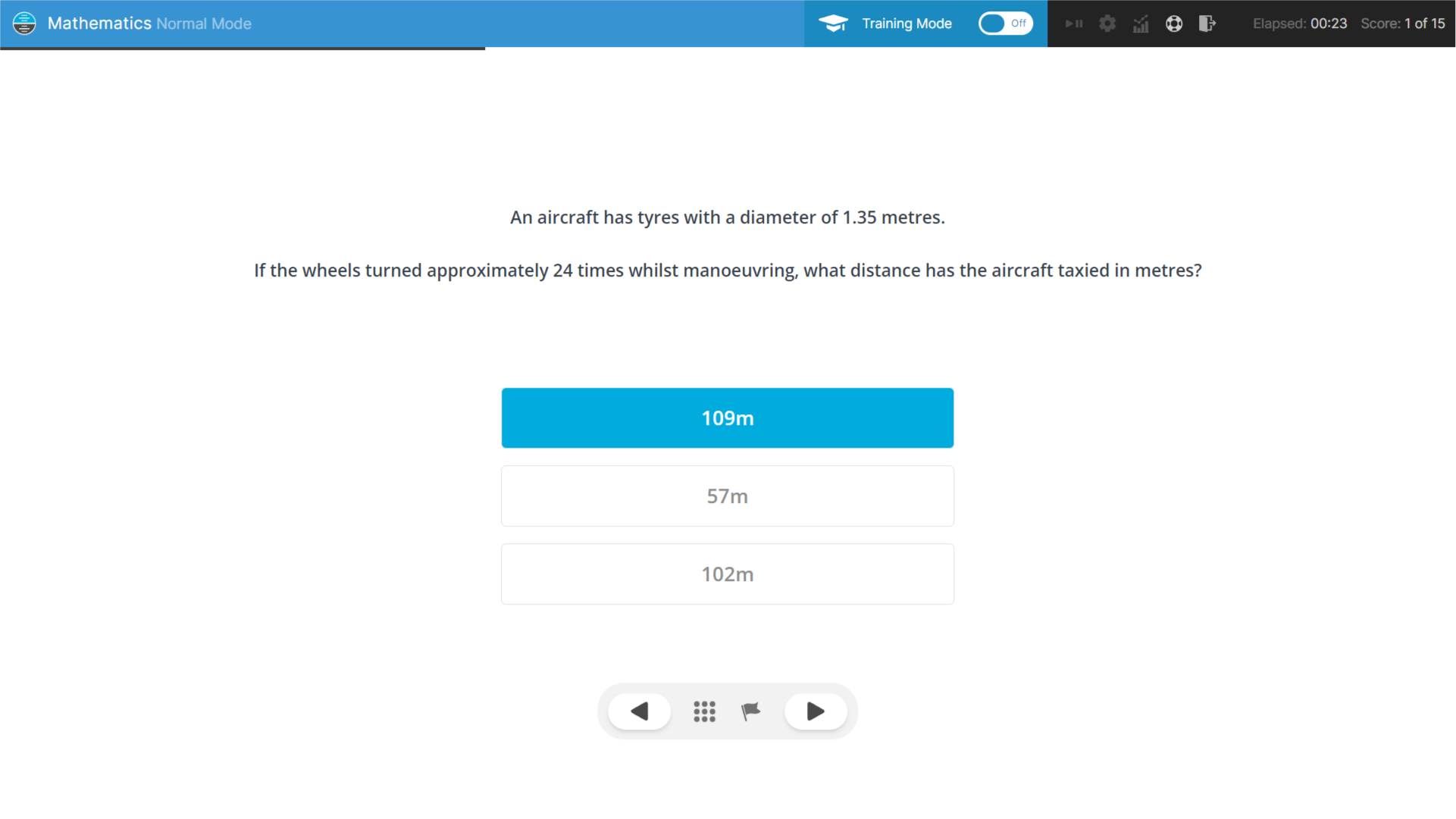
Multiple-choice mathematics tasks present the candidate with a mathematical question and a set of possible answers from which they must select the correct one. Questions may be presented as straightforward calculations, as word problems embedded in practical scenarios, or as a combination of both.
This format permits estimation and elimination strategies: if the candidate can quickly approximate the answer, they may be able to rule out implausible options without completing the full calculation. However, some assessments apply negative marking (deducting points for incorrect answers), which penalises guessing and rewards accuracy over speed. Candidates should establish whether their assessment uses negative marking, as this directly affects whether an educated guess is worthwhile or whether it is better to leave a question unanswered.
Multiple choice is the most common answer format across pilot aptitude mathematics modules, used in the COMPASS, Advanced COMPASS, DLR Math Word Problems (RAG), VTS, Aon and other test systems.
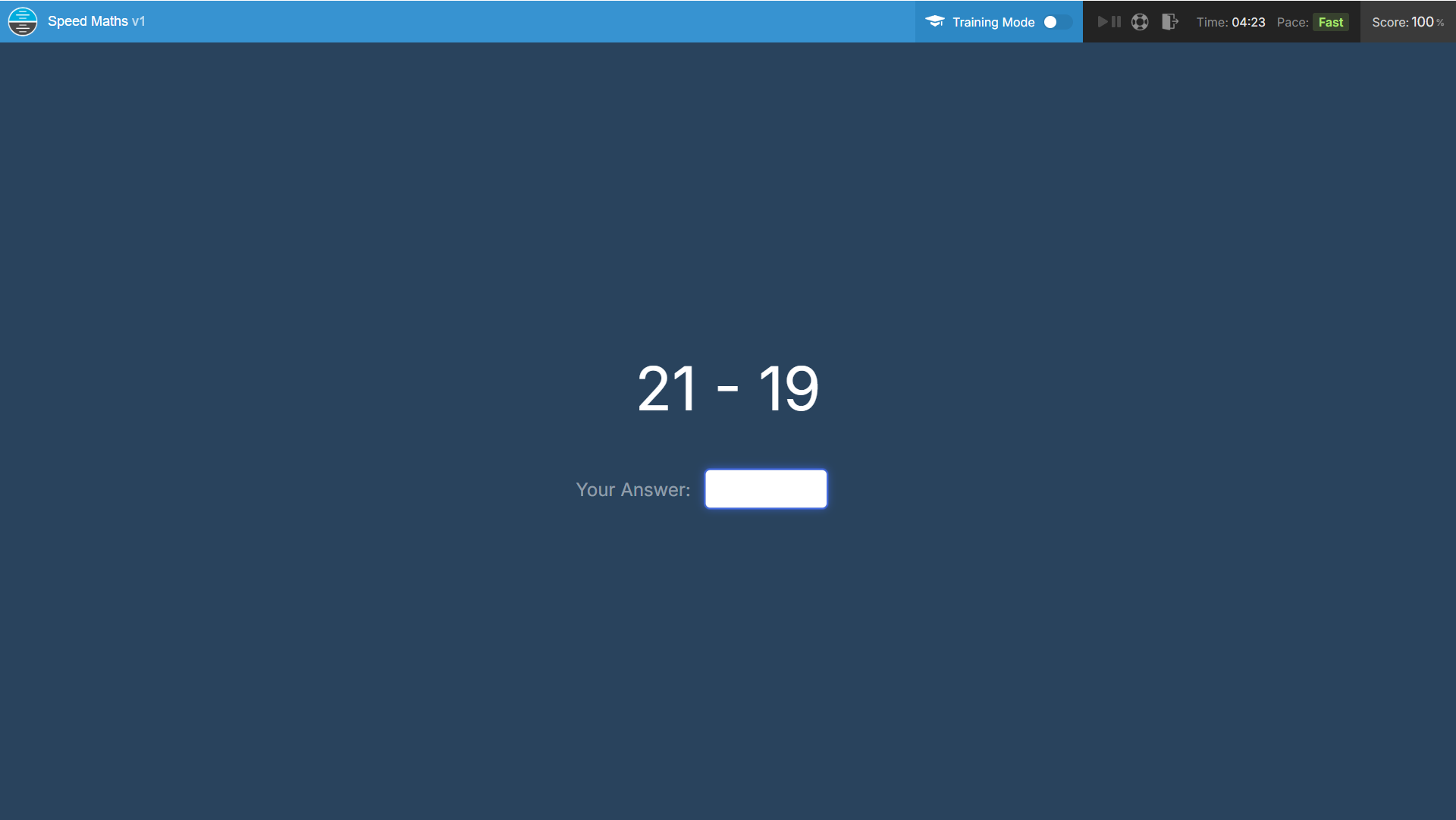
Free-input mathematics tasks require the candidate to type their calculated answer directly into an input field. There are no options to eliminate or use as cues; the candidate must arrive at the correct answer through calculation alone.
This format is considerably more demanding than multiple choice because it removes any possibility of working backwards from the available options, making an educated guess, or using estimation to narrow the field. The candidate must perform the full calculation and produce the exact answer. Free-input formats test the candidate's genuine computational ability without any of the strategic shortcuts that multiple-choice formats allow.
Free input is used in modules such as the CBAT Numerical Operations Test, where candidates must type answers to rapid-fire arithmetic questions, and the DLR Mental Arithmetic (KRN) module, where candidates must type their answers within strict per-question time limits.
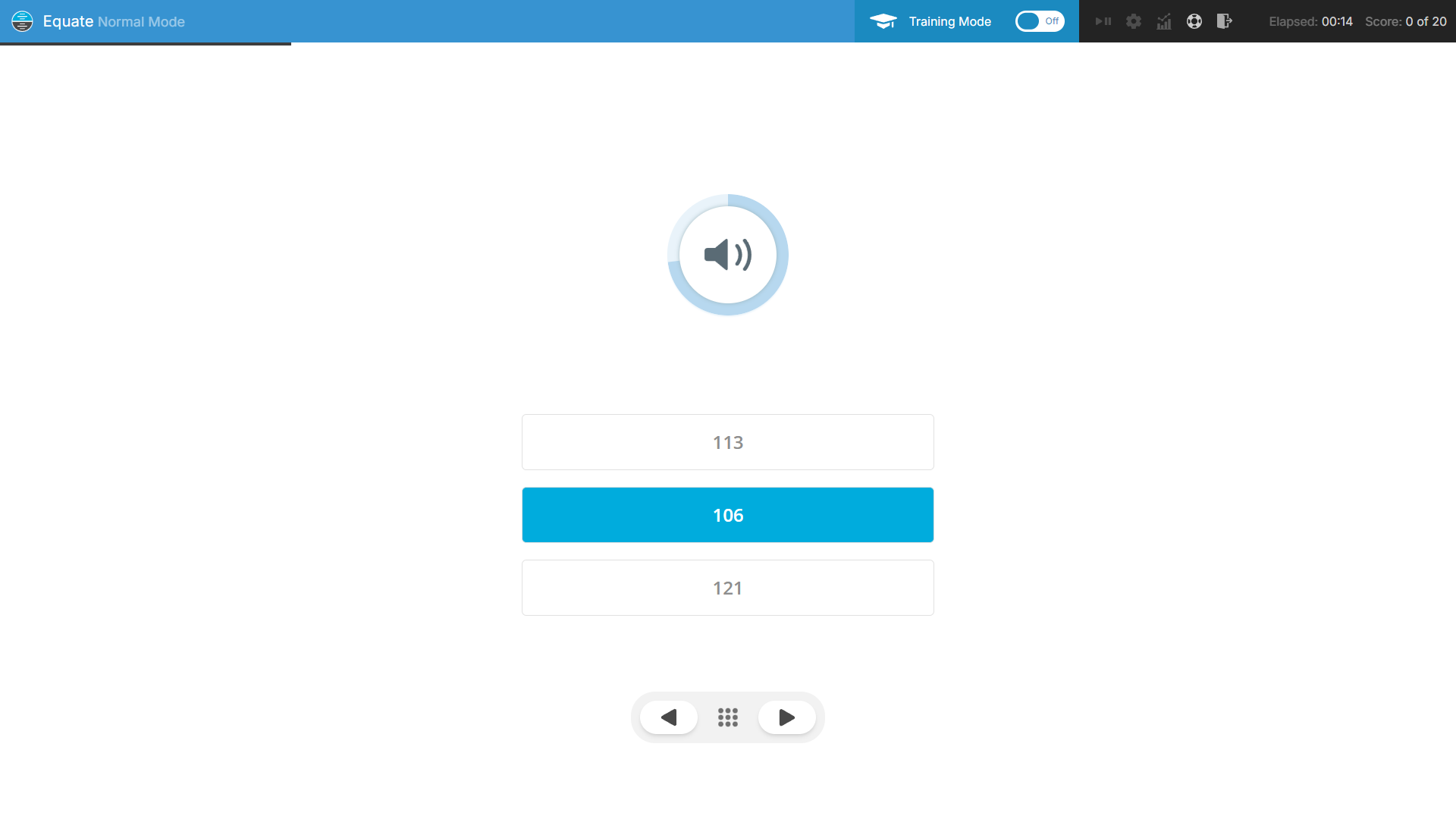
Some mathematics modules add a further layer of difficulty by delivering questions audibly rather than visually. Instead of reading the question on screen, the candidate hears it narrated through headphones and must retain the numbers and operations in working memory whilst performing the calculation mentally.
Audio-based delivery removes the ability to re-read the question. The candidate must process the numerical information in real time, exactly as a pilot must process numerical information delivered verbally by ATC (altitudes, headings, speeds, frequencies). A moment of inattention means the question is lost.
Audio-based delivery is combined with the free-input answer format in the DLR Mental Arithmetic (KRN) module, making it one of the most demanding mathematics modules in any pilot aptitude test: the candidate hears the question once, must calculate the answer mentally, and must type the correct result within 10 to 30 seconds. There are no written prompts and no answer options to fall back on.
Candidates should be aware that Mathematics is not always labelled as "Mathematics" across pilot aptitude test systems. The Aon (Cut-e) assessment refers to its mathematics module as Applied Numeracy, the DLR uses the names Math Word Problems and Mental Arithmetic for its two modules, and the Vienna Test System uses Mathematics in Practice.
These different names can cause confusion, but the underlying competency being assessed is the same: the candidate's ability to perform mathematical calculations accurately and efficiently under time pressure. Regardless of what the module is called, the preparation approach is consistent: practise the specific mathematical topics and question formats used in your assessment.
An important feature of Mathematics assessment in pilot aptitude testing is that the specific mathematical topics differ between test systems. This means that effective preparation requires engagement with materials that reflect the content of the candidate's own assessment, not just general mathematical practice. Our software addresses this directly through dedicated, assessment-specific mathematics activities, each designed to cover the exact topics, difficulty levels and question formats used in the corresponding test system.
For example, in an Aon (Cut-e) test of mathematics, known as Applied Numeracy, the following topics of assessment are included:
Prepare for Aon Applied Numeracy using our Maths for Aon activity.
Whereas, when undertaking a DLR pilot assessment, these topics of assessment are included across the Math Word Problems (RAG) and Mental Arithmetic (KRN) modules:
Prepare for DLR Mathematics using our Maths for DLR, Word Problems and Equate activities.
Likewise, when engaging in a COMPASS or Advanced COMPASS pilot assessment, you can expect the following topics of assessment:
Prepare for COMPASS Mathematics using our Maths for COMPASS activity.
The Vienna Test System Mathematics in Practice (MIP) module focuses on the application of basic mathematical operations to real-world scenarios, covering addition, subtraction, multiplication and division. Prepare using our Word Problems activity.
Both the ADAPT and TestAir360 assessments also include dedicated mathematics modules. Prepare using our Maths for ADAPT and Maths for TestAir360 activities respectively.
Mathematics and Numerical Reasoning both involve working with numbers but assess different competencies. Mathematics modules require the candidate to compute: to perform calculations and produce numerical answers. Numerical Reasoning modules require the candidate to interpret: to extract information from data displays (charts, tables, graphs) and draw analytical conclusions.
Candidates preparing for assessments that include both Mathematics and Numerical Reasoning modules will benefit from developing both computational skills and data interpretation skills. For a full breakdown of Numerical Reasoning modules, see our dedicated Numerical Reasoning Knowledgebase Article.
Further Reading on Why Calculators Are Not Permitted
The Importance of Mental Computation
A common question from candidates is why calculators are not permitted during mathematics modules. The answer is that pilot aptitude tests are assessing mental computation ability, not the ability to use a calculator. In the cockpit, pilots frequently need to perform quick calculations without the time or opportunity to reach for a calculator: estimating fuel burn rates, calculating crosswind components, adjusting approach speeds, and verifying that automated calculations are reasonable.
The ability to perform these calculations mentally is not just a convenience; it is a safety competency. Research into automation-related incidents has identified situations in which crews accepted incorrect automated calculations because they lacked the mental arithmetic ability to recognise that the output was unreasonable [4]. A pilot who can quickly estimate that "this number does not look right" provides a vital safety check on the automated systems that modern aircraft depend upon.
Whilst the underlying mathematical principles are consistent, each pilot aptitude assessment assesses different topics, at different difficulty levels, using different question formats. Effective preparation requires engagement with materials that match the specific mathematical content of your assessment.
Our software includes dedicated, assessment-specific mathematics activities for each major test system, ensuring that your preparation covers the exact topics and formats you will encounter.
Mathematics is one of the most broadly assessed competencies in pilot aptitude testing. It features as a dedicated module in the majority of major test systems, and our software includes tailored mathematics activities for each.
Select an assessment above to view its dedicated Knowledgebase Article for a full breakdown of all modules, not just those evaluating Mathematics.
Once you know which assessment you will be undertaking, use the table below to identify the specific modules within that assessment that evaluate Mathematics.
Each module targets particular mathematical topics, presented in a specific format. The final column indicates which activity or activities within our software correspond to each module. Note that our software includes dedicated, assessment-specific mathematics activities for each test system, ensuring that the topics, difficulty levels and question formats match your assessment precisely.
| Assessment | Module | Task Type | Format | Activity |
|---|---|---|---|---|
| Aon (Cut-e) | Applied Numeracy | Written Computation | Assessment-Specific Mathematical Topics | Maths for Aon |
| COMPASS | Mathematics | Written Word Problems | Conversions, Percentages, SDT, Probability, Areas | Maths for COMPASS |
| Adv. COMPASS | Mathematics | Written Word Problems | Conversions, Percentages, SDT, Probability, Areas | Maths for COMPASS |
| DLR | Math Word Problems (RAG) | Written Word Problems | Complex Operations, Percentages, Rule of Three, SDT | Word Problems, Maths for DLR |
| DLR | Mental Arithmetic (KRN) | Audio Mental Arithmetic | Narrated Equations / Free-Text Input | Equate |
| Vienna Test System | Mathematics in Practice (MIP) | Applied Scenarios | Real-World Scenario Word Problems | Word Problems |
| ADAPT | Mathematics | Written Computation | Assessment-Specific Format | Maths for ADAPT |
| TestAir360 | Mathematics | Written Computation | Assessment-Specific Format | Maths for TestAir360 |
Candidates preparing for assessments that also include a Numerical Reasoning module (which focuses on data interpretation rather than computation) will find that Mathematics preparation strengthens numerical confidence across both types of assessment.
Having identified the modules relevant to your assessment, you can navigate directly to the corresponding activities within our software.
Our software includes dedicated mathematics activities for each test system, each containing a comprehensive database of questions covering the specific topics, difficulty levels and formats used in the corresponding assessment. This means that a candidate preparing for the COMPASS Mathematics module will practise questions that match the COMPASS format and content precisely, whilst a candidate preparing for the DLR will engage with questions tailored to the DLR's mathematical demands.
In addition to the activities listed in the table above, we also offer a dedicated Maths for Pilots resource, freely available on our website, which provides additional mathematical practice for candidates who wish to supplement their preparation.
To find the activities relevant to you, navigate to one of the following within the software:
- Activities by Aptitude Test
- If you know which test system your assessment uses. For example, to find Mathematics activities for the COMPASS, navigate to Activities by Aptitude Test and select COMPASS.
- Activities by Skill
- If you want to focus specifically on Mathematics across all test systems. Navigate to Activities by Skill and select Mathematics to see every relevant activity, including all assessment-specific versions.
- Activities by Airline, Flying School or Cadet Scheme
- If you know where you are applying but not which test system is used. Navigate to Activities by Airline or Activities by Flying School and select your chosen organisation. The software will include the appropriate Mathematics activities alongside all other relevant preparation.
If you have created a Preparation Strategy, the relevant Mathematics activities will already appear in your Focus Activities; no additional navigation is required.
Mathematics is closely associated with several other competencies assessed in pilot aptitude testing. Candidates preparing for Mathematics modules may also benefit from developing the following related skills:
Academic Sources referenced in this KB Article
The following academic sources were consulted in the preparation of this article:
[1] Dehaene, S. (2011). The Number Sense: How the Mind Creates Mathematics (Revised ed.). Oxford University Press.
[2] DeStefano, D. & LeFevre, J. (2004). The Role of Working Memory in Mental Arithmetic. European Journal of Cognitive Psychology, 16(3), 353-386.
[3] Ashcraft, M.H. & Kirk, E.P. (2001). The Relationships Among Working Memory, Math Anxiety, and Performance. Journal of Experimental Psychology: General, 130(2), 224-237.
[4] Parasuraman, R. & Manzey, D.H. (2010). Complacency and Bias in Human Use of Automation: An Attentional Integration. Human Factors, 52(3), 381-410.
[5] Carretta, T.R. & Ree, M.J. (2003). Pilot Selection Methods. In P.S. Tsang & M.A. Vidulich (Eds.), Principles and Practice of Aviation Psychology (pp. 357-396). Lawrence Erlbaum Associates.
[6] Hunter, D.R. & Burke, E.F. (1994). Predicting Aircraft Pilot Training Success: A Meta-Analysis of Published Research. International Journal of Aviation Psychology, 4(4), 297-313.
[7] Martinussen, M. (1996). Psychological Measures as Predictors of Pilot Performance: A Meta-Analysis. International Journal of Aviation Psychology, 6(1), 1-20.
[8] Kilpatrick, J., Swafford, J. & Findell, B. (Eds.) (2001). Adding It Up: Helping Children Learn Mathematics. National Academy Press.
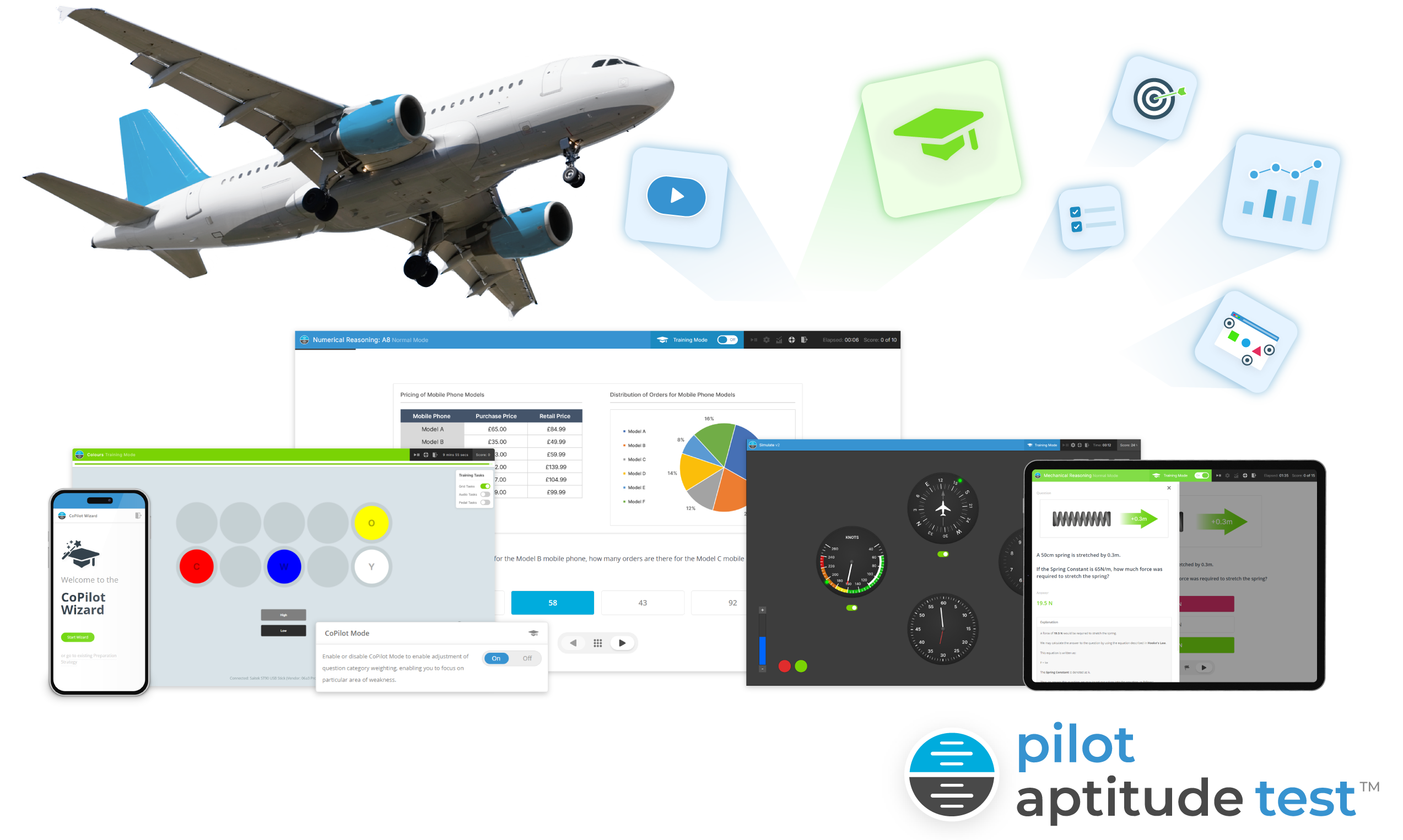
With a section dedicated to Mathematics, our one-of-a-kind software represents the ultimate way for you to get prepared.
By leveraging our cutting-edge software, including those unique features and extensive guidance not offered elsewhere, you can immerse yourself in realistic simulations, master those competencies assessed, and familiarise yourself with the methods and mechanisms of assessment.
Our software is backed by our meticulous attention to detail and deep expertise as experienced commercial pilots, empowering pilot applicants to approach their assessments with confidence and helping to propel them to supersonic levels of success.
Start using our incredible preparation software immediately on PC, Mac, iOS and Android by purchasing a subscription:
Buy Preparation SoftwareWith increasing prevalence and awareness of computerised pilot aptitude testing in pilot assessments, it's never been more important to ensure that you can fly past the competition. This is made easy with features unique to our software:












Discover the key advantages of using our cutting-edge software:
How can I prepare for my Mathematics pilot assessment?
The best way to prepare for your Mathematics pilot assessment is with our latest industry-leading software, developed over 5 years by experienced airline pilots. With realistic exam simulations, personalised Preparation Strategies which guide you through your preparation, immersive Explainer Videos, customisable Training Modes that manipulate your simulation environments, comprehensive Instruction and Guidance, and extensive performance feedback which incorporates unique features such as Predictive Scoring, a Strength & Weakness Map and Colour Coding, our unique software will help you to accelerate improvement of your problem areas and fly through each part of the Mathematics assessment. The software runs in a web browser, is compatible with laptop, desktop, tablet and smartphone, and is complimented with extensive support, provided from 9AM to 9PM GMT. To purchase a subscription to our software and start preparing for your Mathematics pilot assessment, click here!
What is the pass mark for the Mathematics pilot assessment?
Many pilot aptitude tests do not have a fixed threshold (or pass mark), but rather indicate the pilot candidate's overall performance and suitability using a variety of different methods - many of which are emulated within our software. Rather than worrying about a specific pass mark, the better approach is to focus on comprehensive preparation that maximizes your chances of success within each part of the Mathematics pilot assessment. Our industry-leading pilot preparation software provides that comprehensive preparation, helping you to develop the essential sklls, familiarity with assessment and confidence needed to perform at your best. If you have any questions about the Mathematics pilot assessment, please contact us.
How often is your Mathematics assessment preparation software updated?
Our pilot assessment preparation software is continuously updated, with daily improvements based on feedback from hundreds of monthly users. Developed by experienced airline pilots, the simulations provided within our unique software faithfully reflect the Mathematics pilot assessment, ensuring that you have the most current and comprehensive preparation. To see the recent updates to our preparation software, please visit our Updates page.
What support is available with your Mathematics assessment preparation software?
With our own industry experiences, we understand the pressures and stresses that come with preparing for pilot assessments. When you use our software to prepare for your Mathematics pilot assessment, you'll have access to exceptional support and guidance from our team of experienced airline pilots, provided between 9AM and 9PM GMT. This support sets us apart, helping you to develop the skills, knowledge, and confidence needed to approach your assessment feeling completely ready to demonstrate your true potential and fly past the competition at every stage of the Mathematics pilot assessment.
How quickly can I prepare for my Mathematics pilot assessment with this software?
If you'd like to start preparing for the Mathematics assessment, you may start using our software within as little as a few minutes. We offer access to our preparation software for 7 days, 1 month or 3 months, and provide the opportunity to purchase additional time. This ensures you can work through the comprehensive simulations, and benefit from our guidance at your own pace, with support available whenever you need it. To get started, choose a subscription duration to our preparation software, create an account and complete your purchase - then, login and begin your preparation. The entire process typically takes between 2-3 minutes, with secure payment by credit or debit card securely processed with Stripe or PayPal.
Feature-packed and one-of-a kind preparation software for your assessment.
Regularly updated, realistic and infinite simulations of aptitude tests.
Instant activation, fast support and uniquely in-depth guidance.