

 Maths for Pilots
 Science for Pilots
 English Language for Pilots
 Verbal Reasoning for Pilots
 Numerical Reasoning for Pilots
 Mechanical Reasoning for Pilots
 ATPL Knowledge for Pilots
 WhatsApp
 Facebook Chat
 Email
Email










































If you don't have time to read this article but would like to know whether our software can help - it can. You can buy access to our software and get started immediately, 365 days-a-year.
Buy Preparation SoftwareMemory Recall describes the ability to encode, retain and accurately retrieve information over short periods of time. In pilot aptitude testing, Memory Recall is assessed as the candidate's capacity to memorise and reproduce information that has been briefly presented, whether that information is a sequence of positions, a set of numbers, a collection of visual elements, or a block of aviation-relevant data such as headings, altitudes and radio frequencies. Memory Recall is one of the most widely assessed competencies in pilot aptitude testing, appearing across nearly every major test system. The specific memory demands vary between modules, but collectively the types of memory assessed include:
What distinguishes Memory Recall from other cognitive skills assessed in pilot aptitude testing is that the information to be remembered has no inherent logic or pattern to exploit. Unlike Logic or Mathematics, where the correct answer can be derived through reasoning, Memory Recall requires the candidate to hold information in mind through encoding and rehearsal alone. The challenge is one of pure retention under time pressure.
Further Reading on Short-Term and Working Memory
The Distinction Between Short-Term Memory and Working Memory
In cognitive psychology, a distinction is drawn between short-term memory (the passive holding of information for a brief period) and working memory (the active manipulation of information while holding it in mind) [1]. Pilot aptitude tests assess both. A module that requires the candidate to observe a sequence and reproduce it in the same order is primarily assessing short-term memory. A module that requires the candidate to recall a sequence in reverse order, or to continuously update their memory as new items appear (as in an n-back task), is assessing working memory.
Baddeley's model of working memory proposes several components: the phonological loop (for verbal and auditory information), the visuospatial sketchpad (for visual and spatial information), and the central executive (which coordinates attention and manages the other components) [2]. The variety of memory modules across pilot aptitude tests reflects this model: auditory number recall tasks engage the phonological loop, spatial sequence tasks engage the visuospatial sketchpad, and complex tasks (such as n-back or dual-task modules) place demands on the central executive.
Memory Recall is exercised constantly in daily life. When someone tells you a phone number and you hold it in mind long enough to dial, you are using auditory short-term memory. When you remember where you parked your car in a multi-storey car park, you are using spatial memory. When you glance at a shopping list and then walk through the shop recalling items without looking again, you are using visual memory with rehearsal.
Working memory, the more demanding form, is engaged whenever you must hold information in mind whilst simultaneously doing something else. Following spoken directions while driving (holding the next instruction in mind whilst navigating the current one), keeping track of a conversation involving multiple people, or remembering the first part of a long sentence while reading the rest all require working memory. These everyday demands mirror the memory challenges presented in pilot aptitude tests, where the candidate must encode information quickly, retain it through a period of distraction or competing task demands, and then retrieve it accurately on request.
Professional flying places continuous and varied demands on memory. Pilots must retain clearances, recall procedures, hold navigational information in mind, and maintain situational awareness across multiple systems simultaneously. Memory failures in the cockpit have been identified as a contributing factor in aviation incidents, making Memory Recall a safety-critical competency [3].
- ATC clearances and readback:
- Air Traffic Control clearances routinely contain multiple pieces of information delivered in a single transmission: a heading to fly, an altitude to climb or descend to, a speed restriction, and a frequency to contact next. The pilot must listen to the entire clearance, retain all elements, read them back correctly, and then execute them in sequence. A missed element can result in a level bust, an incorrect heading, or a loss of communication with the controlling authority. This is a direct application of auditory short-term memory under time pressure.
- Approach briefings and procedures:
- Before commencing an instrument approach, the crew briefs the procedure: the inbound course, the decision altitude or minimum descent altitude, the missed approach procedure (including the heading to fly, the altitude to climb to, and the hold or routing to follow), and any relevant NOTAMs or restrictions. This information must be retained in working memory and recalled accurately if a go-around is required, often at a moment of high workload when there is no time to re-read the chart.
- Memory items in emergency procedures:
- Certain emergency procedures must be performed from memory before the crew has time to consult a checklist. These are known as "memory items" and typically cover the most time-critical actions: for example, the initial response to an engine fire, a rapid decompression, or a rejected takeoff. The ability to recall and execute these actions accurately under stress is a direct function of long-term memory retrieval, but the initial learning and rehearsal of these items relies on the same encoding and retention skills assessed in Memory Recall modules.
- Situational awareness and state tracking:
- Throughout a flight, the pilot must maintain an ongoing mental picture of the aircraft's state: the current altitude, heading, speed, fuel state, active frequency, selected navigation aids, and the position of other traffic. This continuous updating of information in working memory is the foundation of situational awareness. When workload increases (for example, during weather diversions or holding procedures), the demands on working memory increase correspondingly, and the risk of forgetting or confusing information rises.
Rotary-wing operations present additional memory demands:
- Power checks and performance figures:
- Before departure, helicopter pilots calculate and commit to memory a set of performance figures: the maximum permitted torque for the current conditions, the expected hover torque, the go-around torque margin, and the minimum single-engine climb speed if applicable. These figures must be retained throughout the departure phase and recalled instantly if performance is below expectations or if an engine fails during a critical phase of flight.
- HEMS and SAR mission briefings:
- Helicopter Emergency Medical Service (HEMS) and Search and Rescue (SAR) crews receive mission briefings that may include grid references, casualty information, hazard warnings, radio frequencies, hospital details and weather limitations. These briefings are often received whilst the crew is preparing the aircraft for departure, requiring them to encode and retain mission-critical information under time pressure and competing task demands.
- Low-level navigation and waypoint tracking:
- During low-level helicopter operations, particularly in military contexts, pilots navigate between waypoints using memorised headings, distances and timings. The pilot must hold the current leg's details in working memory whilst simultaneously flying the aircraft, monitoring instruments, and scanning for obstacles. Forgetting a waypoint heading or timing during a low-level sortie can result in a significant navigational error in a high-risk environment.
Memory failures in the cockpit are a well-documented source of operational risk. Forgotten clearances, missed checklist items, and lost situational awareness have all been identified as contributing factors in aviation incidents and accidents [3]. By assessing Memory Recall during selection, test designers are evaluating a candidate's baseline capacity for the kind of information retention that professional flying demands every day.
The variety of memory tasks used across different test systems (spatial sequences, auditory recall, visual association, n-back updating) reflects the variety of memory demands encountered in the cockpit. A pilot must be able to remember what they hear (ATC clearances), what they see (instrument readings, chart information), and what they do (procedure sequences), often simultaneously. Testing multiple types of memory provides a more comprehensive picture of the candidate's readiness for these demands.
Working memory capacity, the amount of information a person can hold and manipulate at one time, is a strong predictor of performance under high workload conditions [4]. In aviation, workload peaks during departure, arrival, approach, and any abnormal or emergency situation. During these phases, the pilot must retain and process multiple streams of information concurrently. A candidate with greater working memory capacity is better equipped to manage these demands without shedding important information.
Modules that assess working memory specifically (such as the DLR's n-back Visual Memory task or the reverse-order recall in Tracked Memory) are particularly diagnostic of this capacity. These tasks require the candidate not just to remember information, but to actively manipulate it, which is precisely the cognitive demand that increases during high-workload phases of flight.
Memory Recall is one of the most broadly assessed skills in pilot aptitude testing, with dedicated modules appearing in the Aon, COMPASS, Advanced COMPASS, DLR, Vienna Test System and Arctic Shores assessments. The DLR assessment alone includes three separate memory modules (Tracked Memory, Visual Memory MEK, and Visual Memory VMC), each targeting a different aspect of memory. This breadth of assessment reflects the central importance of memory to safe and effective pilot performance.
Further Reading on Memory and Pilot Performance
The Role of Memory in Expert Performance
Research into expert performance has shown that skilled practitioners in complex domains develop strategies for encoding and retrieving information more efficiently than novices [5]. Experienced pilots, for example, tend to "chunk" related information together (grouping a clearance into heading-altitude-speed rather than treating each digit individually), use meaningful associations (recognising that a given altitude corresponds to a specific segment of an approach), and prioritise information based on operational relevance.
These strategies are not innate; they develop through training and practice. However, the baseline working memory capacity assessed in pilot aptitude tests determines how much raw capacity a candidate has available for this kind of strategic encoding. A candidate with stronger baseline memory will have more cognitive resources available to develop and apply efficient memory strategies during training and operational flying.
Computerised pilot aptitude tests evaluate Memory Recall using a variety of task formats, each designed to assess a different aspect of memory. The common thread across all formats is the encode-retain-retrieve cycle: the candidate is shown or told something, must hold it in memory (often through a period of distraction), and must then reproduce it accurately.
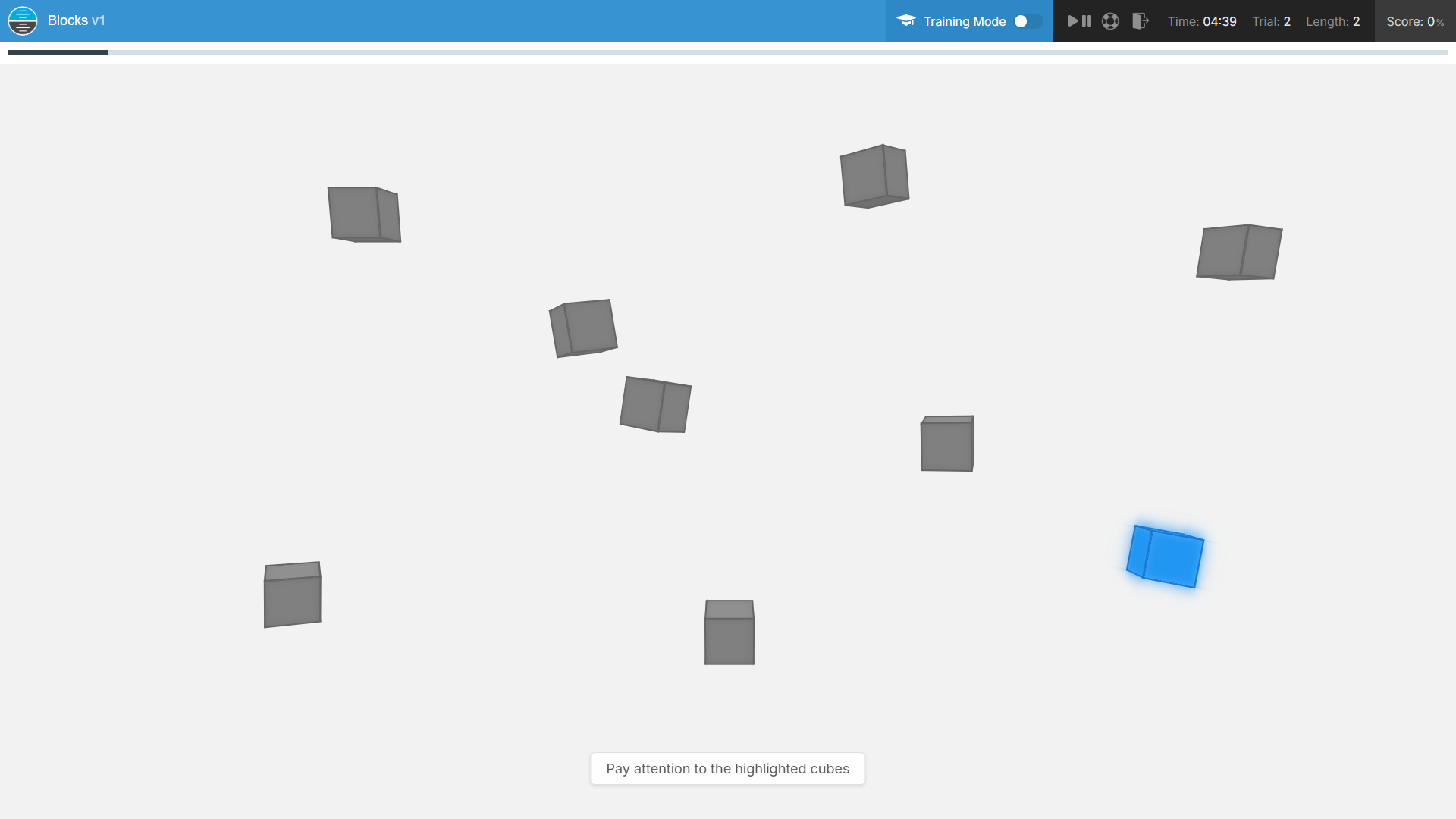
In spatial sequence tasks, the candidate observes a series of positions highlighted in sequence on a grid or arrangement of blocks, and must then reproduce that sequence from memory. The VTS Corsi Block-Tapping (CORSI) module uses nine irregularly placed blocks, with sequences that increase in length and include a requirement to recall sequences in reverse order. The Arctic Shores Tiles module presents sequences of coloured tiles that increase in length, with distraction tiles introduced in later stages.
These tasks assess visuospatial short-term and working memory: the ability to remember where things appeared and in what order. The reverse-recall component of the CORSI module adds a working memory demand, requiring the candidate to mentally reverse the sequence before responding.
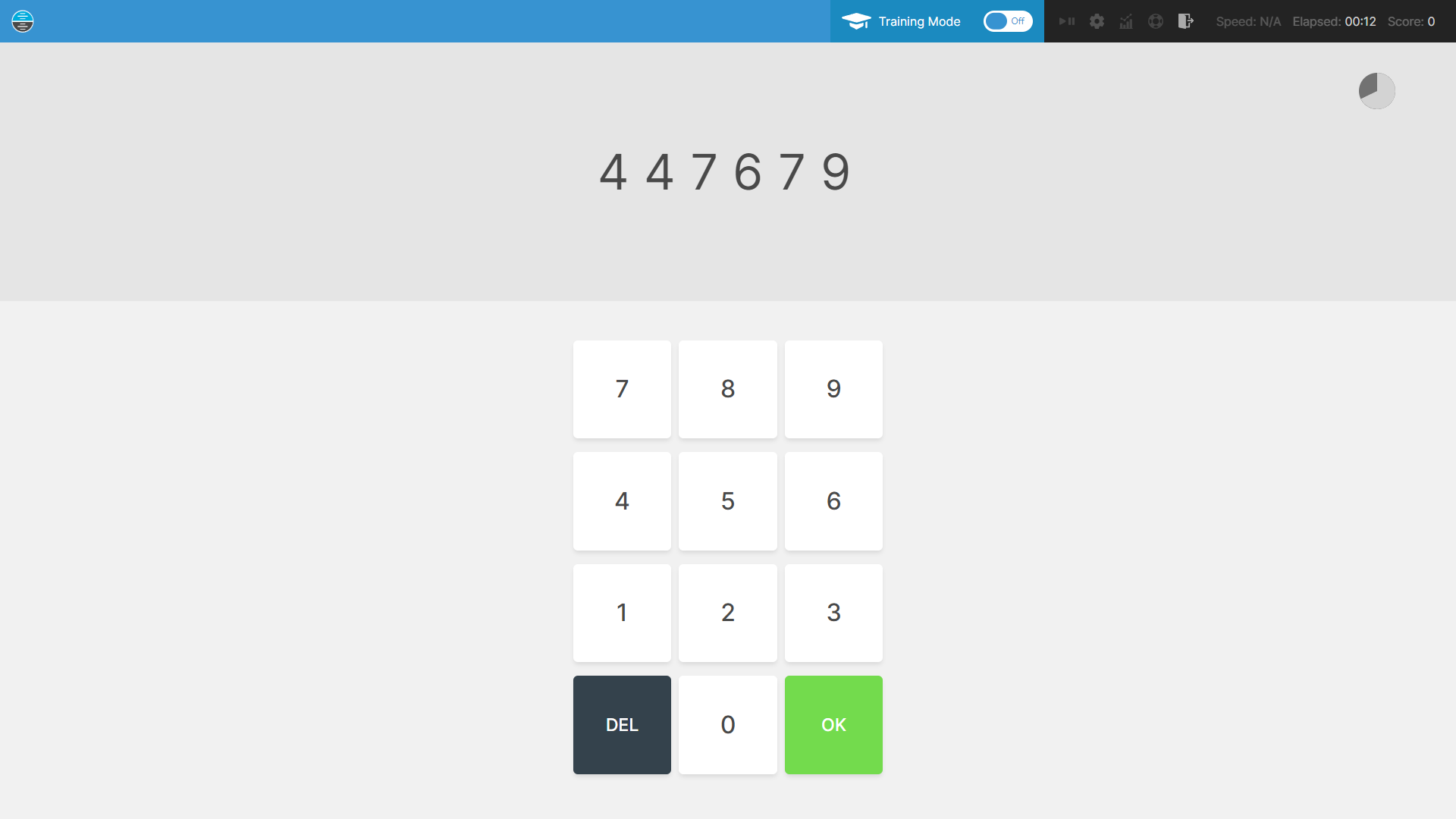
In auditory recall tasks, the candidate listens to a sequence of numbers read aloud by the computer and must recall them, typically in reverse order. The DLR Tracked Memory (RMS) module presents 25 tasks in which randomly generated numbers are spoken, and the candidate must recall them in reverse order.
This format assesses the phonological loop component of working memory and places additional demand on the central executive through the requirement to reverse the sequence. The auditory delivery removes the option of re-reading the information, mirroring the real-world challenge of retaining spoken ATC clearances.
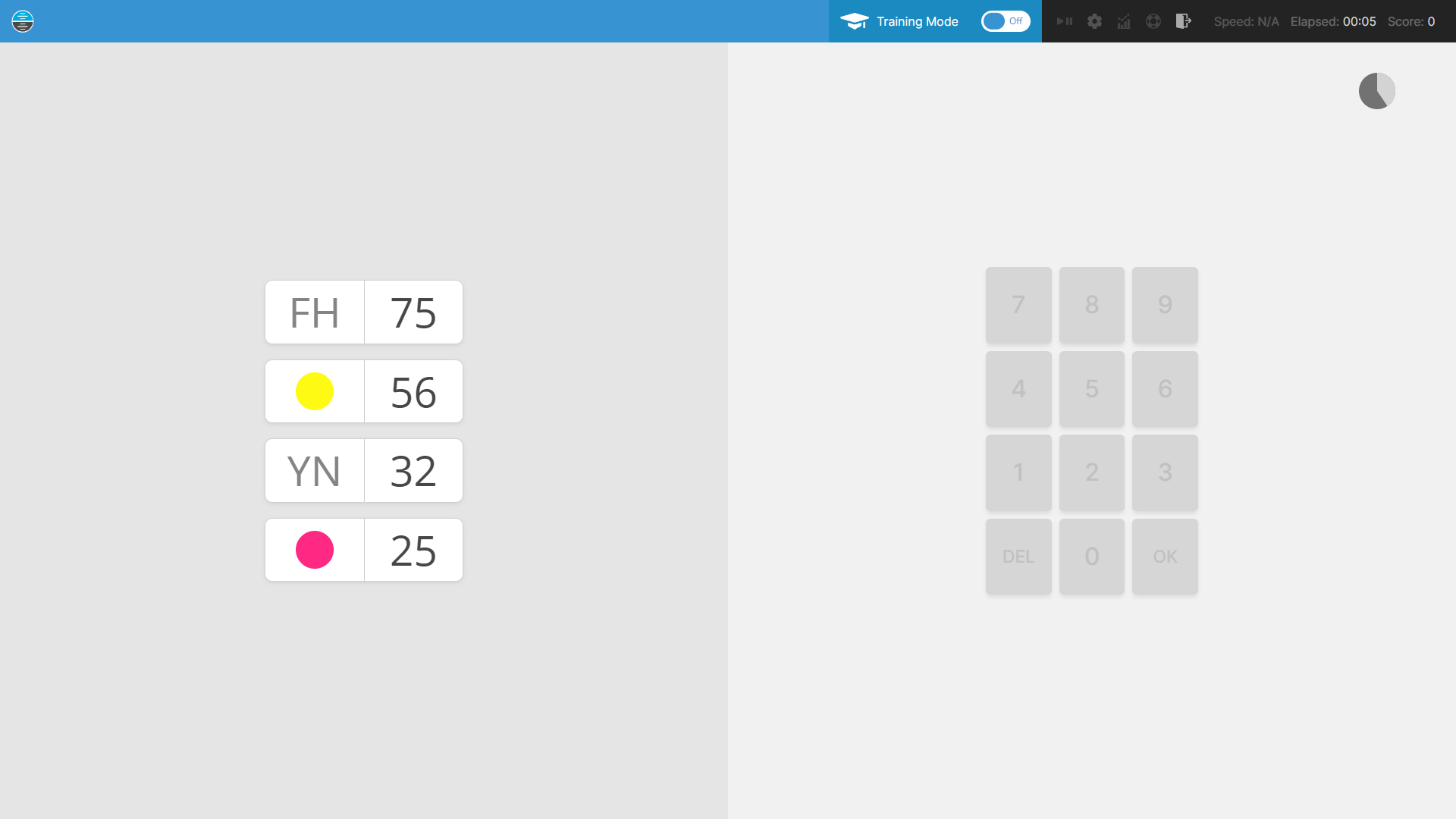
In visual associative tasks, the candidate must memorise pairings between visual elements and identifiers, and then recall the correct element when prompted with its identifier. The DLR Visual Memory (MEK) module presents 40 elements (which may include coloured shapes, text or numbers) each paired with a randomly generated number. The candidate must memorise these pairings and reproduce them on request.
This format assesses the ability to form and retrieve associations between items, a type of memory that is directly relevant to cockpit operations where the pilot must remember which instrument shows which parameter, which frequency belongs to which station, and which checklist action relates to which system.
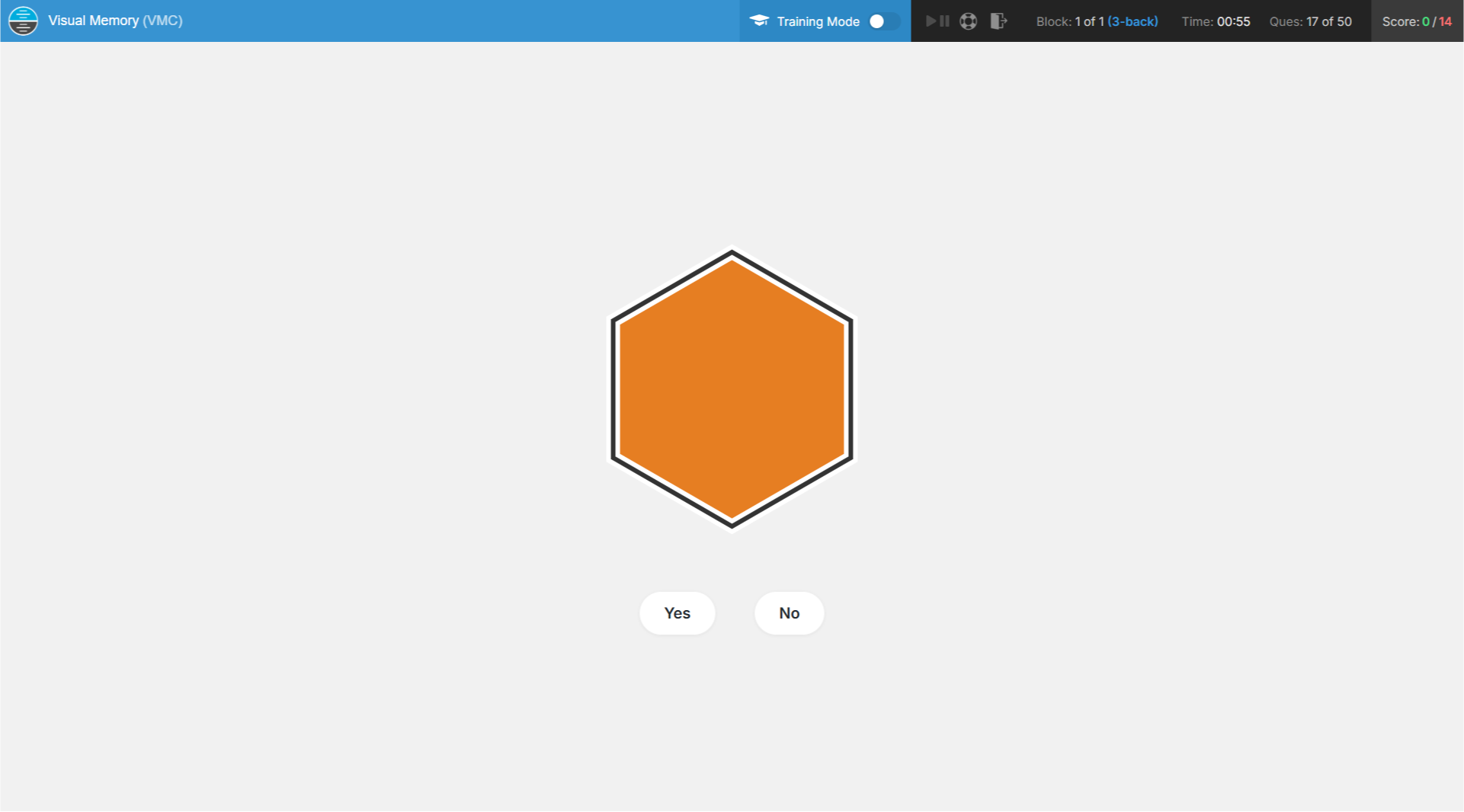
In n-back tasks, the candidate views a continuous stream of items (such as coloured shapes) and must indicate whether the current item matches the item shown n positions earlier. The DLR Visual Memory (VMC) module presents 40 coloured shapes and requires the candidate to continuously update their memory, discarding old items and comparing each new item against the item held in memory from n steps ago.
The n-back format is one of the most demanding memory assessments used in pilot aptitude testing. It requires constant updating of the contents of working memory, sustained attention, and the ability to inhibit responses to items that are similar but not identical to the target. This mirrors the continuous updating demands of maintaining situational awareness during flight.
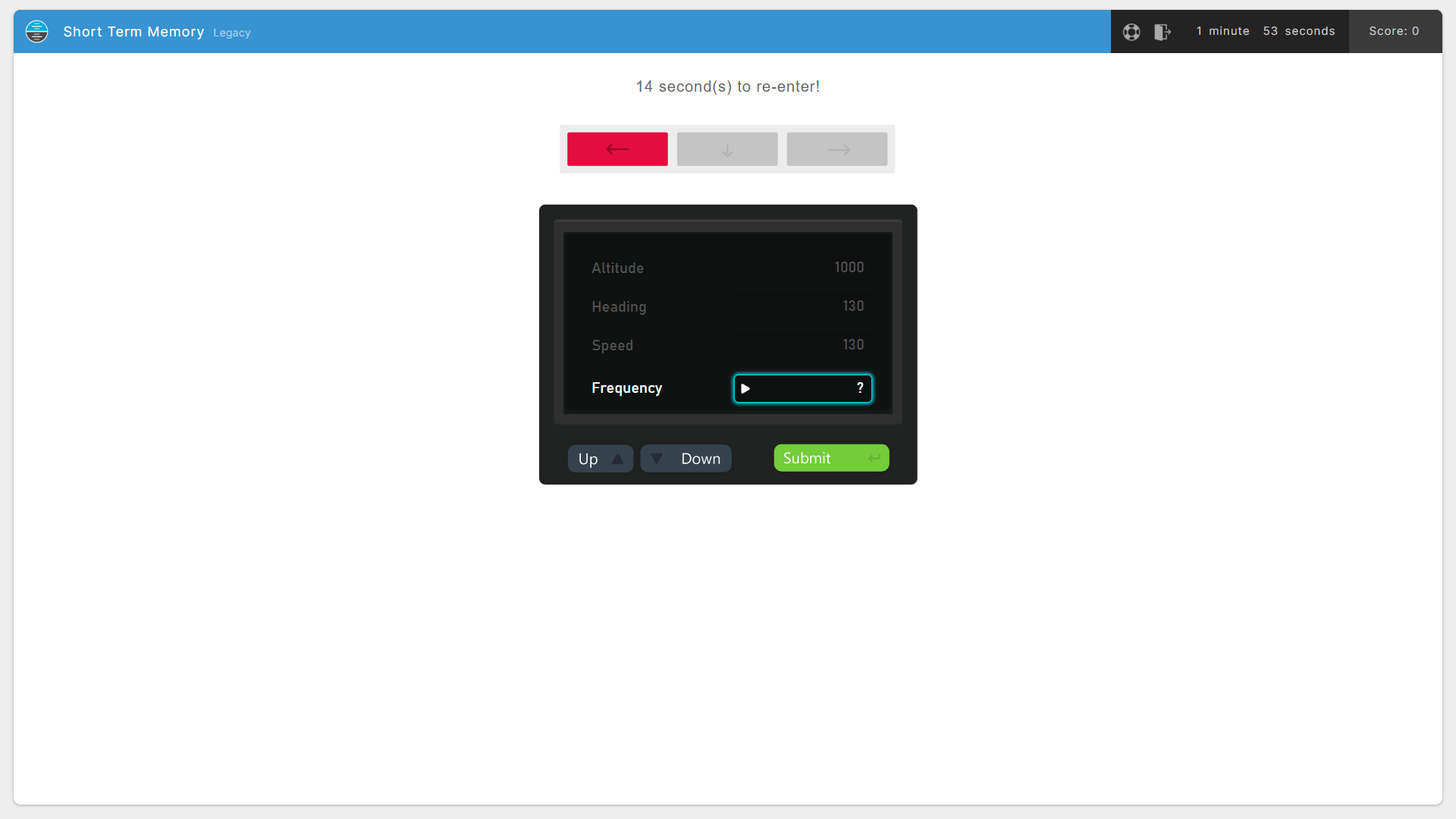
In aviation information recall tasks, the candidate is shown information in a format resembling real cockpit data (altitude, heading, speed, radio frequency) and must memorise and recall it after a brief interval. The COMPASS and Advanced COMPASS Memory modules present aviation-relevant data and require the candidate to recall it accurately.
This format has high face validity for pilot selection: it directly mirrors the operational task of receiving, retaining and recalling aviation-specific information. The data presented is structured in a way that is meaningful within an aviation context, which allows candidates with aviation knowledge to apply chunking strategies (grouping related values together) to improve their performance.
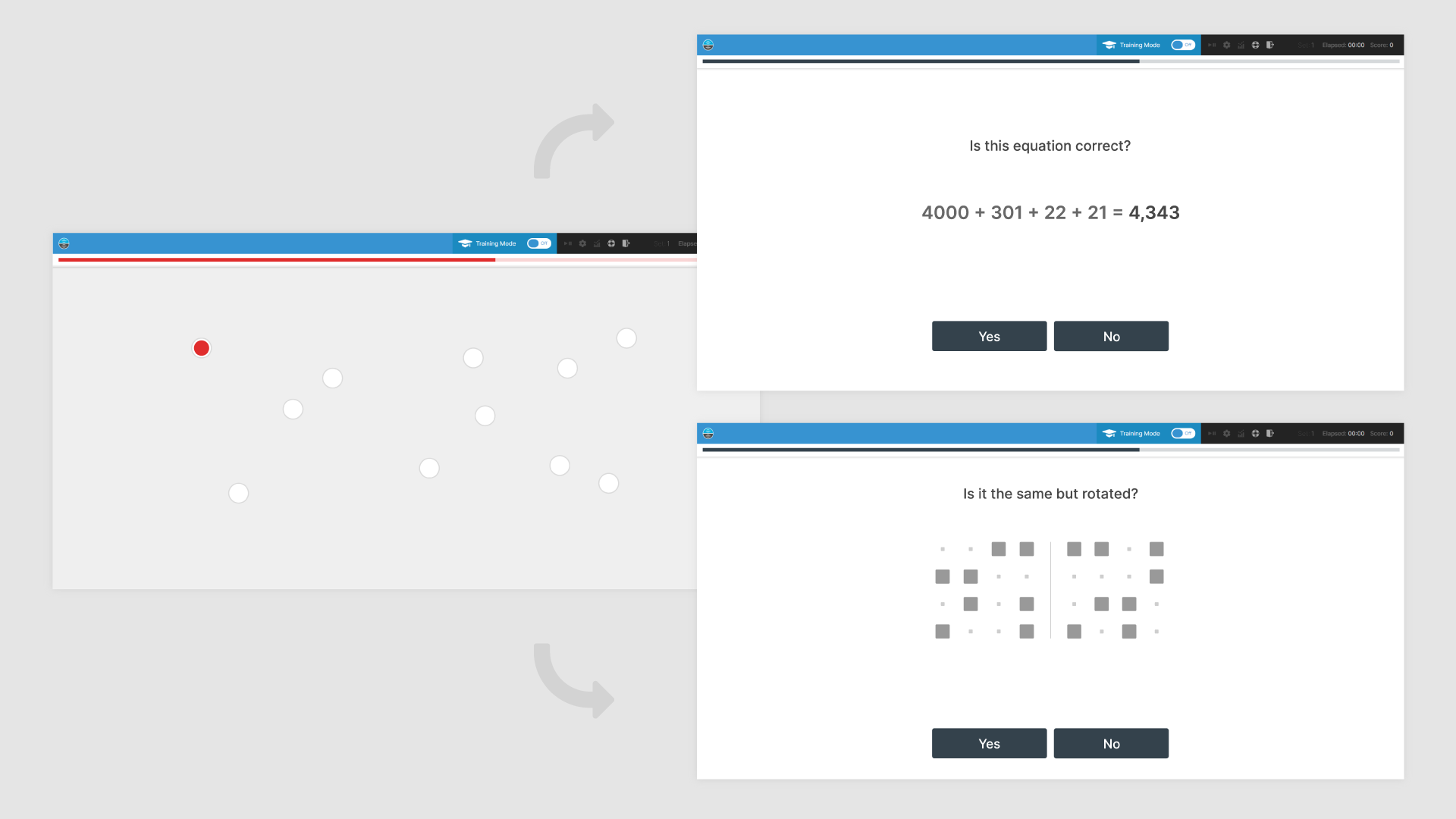
Some memory modules embed the recall task within a broader assessment that includes a concurrent cognitive demand. The Aon Working Memory (gridChallenge) module requires the candidate to memorise the positions and order of dots displayed on screen, but between memorisation and recall phases, the candidate must answer spatial reasoning questions (identifying mirrored or rotated images). This dual-task design adds a realistic element of distraction, requiring the candidate to protect the memorised information from interference whilst performing a different cognitive task.
This format is particularly relevant to aviation, where memory is rarely tested in isolation. In the cockpit, the pilot must retain information (such as a clearance or a procedure step) while simultaneously managing other tasks (flying the aircraft, communicating, monitoring systems). The dual-task memory module assesses the candidate's ability to maintain information in working memory under exactly this kind of competing cognitive demand.
Memory Recall is assessed in the following pilot aptitude test systems:
The table below outlines the Memory Recall modules in each assessment, linking each to the relevant preparation activity in our software.
| Assessment | Module | Memory Type | Format | Activity |
|---|---|---|---|---|
| Aon (Cut-e) | Working Memory (gridChallenge) | Dual-Task | Infinite, 9 min | Switch |
| COMPASS | Memory | Aviation Info | Infinite, 5 min | Short-Term Memory FMS |
| Adv. COMPASS | Memory | Aviation Info | Infinite, 5 min | Short-Term Memory FMS |
| DLR | Tracked Memory (RMS) | Auditory / Reverse | 25 questions | Numbers |
| DLR | Visual Memory (MEK) | Associative | 40 questions, ~10 min | Visual Memory |
| DLR | Visual Memory (VMC) | N-Back | 40 questions, ~10 min | Visual Memory (VMC) |
| Vienna Test System | Corsi Block-Tapping (CORSI) | Spatial Sequence | Infinite, ~10 min | Blocks |
| Arctic Shores | Tiles | Spatial Sequence | ~40 tasks | Tiles |
Having identified the modules relevant to your assessment, you can navigate directly to the corresponding activities within our software.
Our software organises activities by the type of assessment you are preparing for, the skill being evaluated, and the specific airline, flying school or cadet scheme you are applying to. This means you do not need to manually cross-reference the table above; the relevant Memory Recall activities will already be included in your tailored preparation.
To find the activities relevant to you, navigate to one of the following within the software:
- Activities by Aptitude Test
- If you know which test system your assessment uses. For example, to find Memory Recall activities for the DLR, navigate to Activities by Aptitude Test and select DLR.
- Activities by Skill
- If you want to focus specifically on Memory Recall across all test systems. Navigate to Activities by Skill and select Memory Recall to see every relevant activity.
- Activities by Airline, Flying School or Cadet Scheme
- If you know where you are applying but not which test system is used. Navigate to Activities by Airline or Activities by Flying School and select your chosen organisation. The software will include the appropriate Memory Recall activities alongside all other relevant preparation.
If you have created a Preparation Strategy, the relevant Memory Recall activities will already appear in your Focus Activities; no additional navigation is required.
Memory Recall is closely associated with several other competencies assessed in pilot aptitude testing. Candidates preparing for Memory Recall modules may also benefit from developing the following related skills:
Academic Sources referenced in this KB Article
The following academic sources were consulted in the preparation of this article:
[1] Baddeley, A. D. (2003). Working memory: Looking back and looking forward. Nature Reviews Neuroscience, 4(10), 829-839.
[2] Baddeley, A. D., & Hitch, G. (1974). Working memory. In G. H. Bower (Ed.), The Psychology of Learning and Motivation (Vol. 8, pp. 47-89). Academic Press.
[3] Dismukes, R. K. (2012). Prospective memory in workplace and everyday situations. Current Directions in Psychological Science, 21(4), 215-220.
[4] Engle, R. W. (2002). Working memory capacity as executive attention. Current Directions in Psychological Science, 11(1), 19-23.
[5] Ericsson, K. A., & Kintsch, W. (1995). Long-term working memory. Psychological Review, 102(2), 211-245.
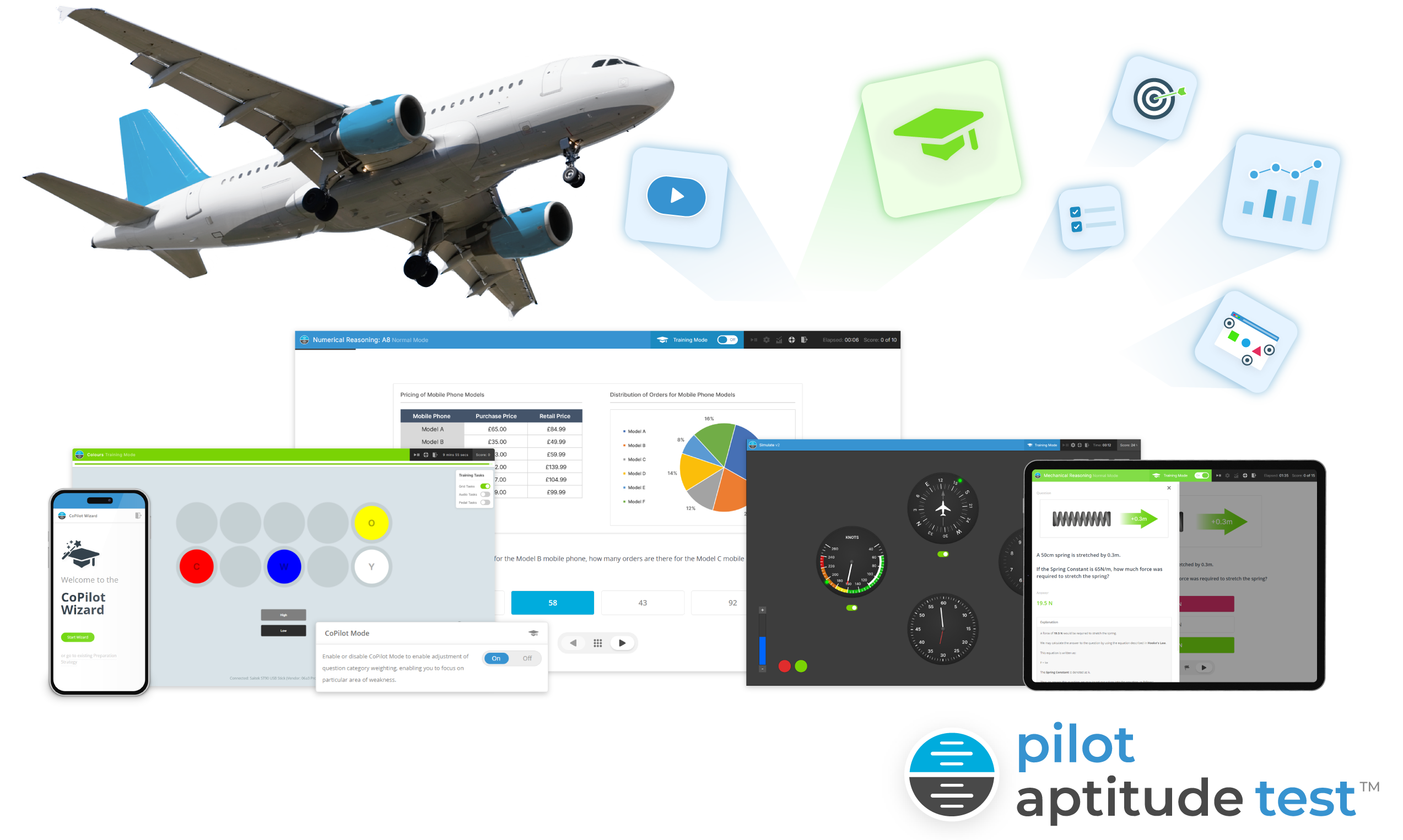
With a section dedicated to Memory Recall, our one-of-a-kind software represents the ultimate way for you to get prepared.
By leveraging our cutting-edge software, including those unique features and extensive guidance not offered elsewhere, you can immerse yourself in realistic simulations, master those competencies assessed, and familiarise yourself with the methods and mechanisms of assessment.
Our software is backed by our meticulous attention to detail and deep expertise as experienced commercial pilots, empowering pilot applicants to approach their assessments with confidence and helping to propel them to supersonic levels of success.
Start using our incredible preparation software immediately on PC, Mac, iOS and Android by purchasing a subscription:
Buy Preparation SoftwareWith increasing prevalence and awareness of computerised pilot aptitude testing in pilot assessments, it's never been more important to ensure that you can fly past the competition. This is made easy with features unique to our software:












Discover the key advantages of using our cutting-edge software:
How can I prepare for my Memory Recall pilot assessment?
The best way to prepare for your Memory Recall pilot assessment is with our latest industry-leading software, developed over 5 years by experienced airline pilots. With realistic exam simulations, personalised Preparation Strategies which guide you through your preparation, immersive Explainer Videos, customisable Training Modes that manipulate your simulation environments, comprehensive Instruction and Guidance, and extensive performance feedback which incorporates unique features such as Predictive Scoring, a Strength & Weakness Map and Colour Coding, our unique software will help you to accelerate improvement of your problem areas and fly through each part of the Memory Recall assessment. The software runs in a web browser, is compatible with laptop, desktop, tablet and smartphone, and is complimented with extensive support, provided from 9AM to 9PM GMT. To purchase a subscription to our software and start preparing for your Memory Recall pilot assessment, click here!
What is the pass mark for the Memory Recall pilot assessment?
Many pilot aptitude tests do not have a fixed threshold (or pass mark), but rather indicate the pilot candidate's overall performance and suitability using a variety of different methods - many of which are emulated within our software. Rather than worrying about a specific pass mark, the better approach is to focus on comprehensive preparation that maximizes your chances of success within each part of the Memory Recall pilot assessment. Our industry-leading pilot preparation software provides that comprehensive preparation, helping you to develop the essential sklls, familiarity with assessment and confidence needed to perform at your best. If you have any questions about the Memory Recall pilot assessment, please contact us.
How often is your Memory Recall assessment preparation software updated?
Our pilot assessment preparation software is continuously updated, with daily improvements based on feedback from hundreds of monthly users. Developed by experienced airline pilots, the simulations provided within our unique software faithfully reflect the Memory Recall pilot assessment, ensuring that you have the most current and comprehensive preparation. To see the recent updates to our preparation software, please visit our Updates page.
What support is available with your Memory Recall assessment preparation software?
With our own industry experiences, we understand the pressures and stresses that come with preparing for pilot assessments. When you use our software to prepare for your Memory Recall pilot assessment, you'll have access to exceptional support and guidance from our team of experienced airline pilots, provided between 9AM and 9PM GMT. This support sets us apart, helping you to develop the skills, knowledge, and confidence needed to approach your assessment feeling completely ready to demonstrate your true potential and fly past the competition at every stage of the Memory Recall pilot assessment.
How quickly can I prepare for my Memory Recall pilot assessment with this software?
If you'd like to start preparing for the Memory Recall assessment, you may start using our software within as little as a few minutes. We offer access to our preparation software for 7 days, 1 month or 3 months, and provide the opportunity to purchase additional time. This ensures you can work through the comprehensive simulations, and benefit from our guidance at your own pace, with support available whenever you need it. To get started, choose a subscription duration to our preparation software, create an account and complete your purchase - then, login and begin your preparation. The entire process typically takes between 2-3 minutes, with secure payment by credit or debit card securely processed with Stripe or PayPal.
Feature-packed and one-of-a kind preparation software for your assessment.
Regularly updated, realistic and infinite simulations of aptitude tests.
Instant activation, fast support and uniquely in-depth guidance.