

 Maths for Pilots
 Science for Pilots
 English Language for Pilots
 Verbal Reasoning for Pilots
 Numerical Reasoning for Pilots
 Mechanical Reasoning for Pilots
 ATPL Knowledge for Pilots
 WhatsApp
 Facebook Chat
 Email
Email










































If you don't have time to read this article but would like to know whether our software can help - it can. You can buy access to our software and get started immediately, 365 days-a-year.
Buy Preparation SoftwareScience describes the ability to understand, apply and reason with fundamental scientific principles across physics, chemistry and earth science. In pilot aptitude testing, Science is assessed as the candidate's capacity to answer questions that require knowledge of physical laws, scientific relationships and the behaviour of matter and energy, typically presented in a text-based multiple-choice format. Science modules assess a broad range of topics, from classical mechanics and thermodynamics through to electricity, wave behaviour and the properties of gases. The specific sub-topics assessed across pilot aptitude tests include:
Science is closely related to Mechanical Reasoning, and there is significant cross-over between the two skills. Dedicated Science modules cover the full breadth of scientific topics listed above, including electricity, magnetism, thermodynamics and wave behaviour. Mechanical Reasoning modules focus more narrowly on the behaviour of physical and mechanical systems such as pulleys, gears, levers, hydraulics and springs. However, topics such as Levers and Gears, Mechanics, Hooke's Law, and Force, Motion and Energy appear in both disciplines, and several test systems assess both science and mechanical reasoning content within a single module.
Further Reading on Scientific Literacy in Professional Contexts
Why Scientific Knowledge Matters for Pilots
Scientific literacy in the context of pilot aptitude testing is not about assessing whether a candidate could pass a physics degree examination. It is about assessing whether the candidate possesses the foundational understanding of physical principles that will underpin their technical training. Research into pilot selection has shown that technical aptitude, including scientific comprehension, is a meaningful predictor of ground school performance [1]. This is because pilot training requires candidates to learn how and why aircraft systems work, not simply to memorise procedures.
The scientific principles assessed in pilot aptitude tests (gas laws, thermodynamics, electrical circuits, wave behaviour) are the same principles that govern aircraft systems. A candidate who understands Boyle's Law will find it easier to learn about pressurisation systems. A candidate who understands electrical circuits will progress through avionics training more efficiently. The aptitude test therefore serves as an indicator of how readily a candidate will absorb the technical content of their training programme.
The scientific principles assessed in pilot aptitude tests are not abstract concepts confined to textbooks. They describe the physical world we interact with every day. When you feel your ears pop during a lift ride or on a mountain road, you are experiencing the effect of changing air pressure on a sealed cavity, the same principle (Boyle's Law) that governs aircraft pressurisation. When a car's engine heats up and the coolant system activates, that is thermodynamics in action. The static shock you receive after walking across a carpet is a demonstration of electrical charge and discharge.
Other everyday examples include: understanding why a metal spoon heats up faster than a wooden one in a hot pan (thermal conductivity), recognising why objects float or sink in water (buoyancy and density), noticing that sound travels more slowly than light during a thunderstorm (wave propagation), and understanding why a bicycle pump gets warm during use (gas compression and Gay-Lussac's Law). Each of these observations reflects a scientific principle that may appear in a pilot aptitude test.
Aviation is fundamentally an applied science. Every aspect of flight, from the generation of lift to the operation of onboard systems, is governed by the physical laws and scientific principles assessed in pilot aptitude tests. The breadth of scientific knowledge expected of a professional pilot becomes apparent during ATPL ground school, where subjects such as Principles of Flight, Aircraft General Knowledge, Meteorology and Instrumentation all require a solid understanding of physics.
- Boyle-Mariotte Law in cabin pressurisation:
- Aircraft pressurisation systems maintain a safe and comfortable cabin environment at altitude by controlling the relationship between air volume and pressure. Boyle's Law (pressure and volume are inversely proportional at constant temperature) describes why cabin altitude must be carefully managed: as the aircraft climbs and external pressure decreases, the air inside the cabin would expand if not controlled. The pressurisation system regulates outflow valves to maintain a pressure differential, typically equivalent to a cabin altitude of 6,000 to 8,000 feet even when the aircraft is cruising above 30,000 feet.
- Dalton's Law and oxygen requirements:
- Dalton's Law of partial pressures states that the total pressure of a gas mixture equals the sum of the partial pressures of each individual gas. At altitude, although the proportion of oxygen in the atmosphere remains constant at approximately 21%, the partial pressure of oxygen decreases as total atmospheric pressure falls. This is why supplemental oxygen is required above certain altitudes and why rapid decompression is dangerous: the partial pressure of oxygen drops below the level required to sustain consciousness.
- Gay-Lussac Law and temperature effects:
- Gay-Lussac's Law describes the relationship between temperature and pressure at constant volume. In aviation, this principle explains why tyre pressures increase during and after landing (friction generates heat, increasing the temperature of the air inside the tyre, which increases pressure), why hydraulic fluid pressures vary with temperature, and why fuel temperature is monitored in cold conditions to prevent fuel from reaching its freezing point.
- Ohm's Law and aircraft electrical systems:
- Aircraft electrical systems distribute power from generators and batteries to hundreds of individual components, from flight instruments and navigation equipment to lighting and galley systems. Ohm's Law (voltage equals current multiplied by resistance) is the foundation for understanding how these systems operate, why circuit breakers are rated for specific current loads, and how electrical faults manifest as symptoms that the pilot can interpret and manage.
- Magnetism and compass systems:
- Magnetic compasses remain a primary navigation reference in aviation, and understanding their behaviour requires knowledge of magnetic fields, deviation and dip. Electromagnetic principles also underpin the operation of flux-gate compasses, generators and electric motors found throughout the aircraft. Pilots must understand compass errors caused by acceleration and turning, both of which are rooted in the physics of magnetism.
- Newton's Laws and flight:
- Newton's three laws of motion are fundamental to understanding flight. The first law (an object remains at rest or in uniform motion unless acted upon by a force) explains why thrust must overcome drag to accelerate, and why an aircraft at a constant speed and altitude is in equilibrium. The second law (force equals mass multiplied by acceleration) governs the relationship between thrust, weight and aircraft performance. The third law (every action has an equal and opposite reaction) describes the operating principle of jet engines: accelerating exhaust gases rearward produces a forward thrust force.
- Mechanics and structural loading:
- Understanding how forces act on structures is essential for pilots operating within the aircraft's design limits. Concepts such as stress, strain, load factors and the distinction between elastic and plastic deformation help pilots understand why manoeuvring speed exists, why turbulence can be hazardous at certain speeds, and why flight envelope protections are built into modern aircraft. These concepts appear in both Science and Mechanical Reasoning assessments.
- Heat engines and propulsion:
- Both piston and turbine engines operate on thermodynamic cycles. Piston engines use the Otto cycle (or diesel cycle), whilst jet engines use the Brayton cycle. Understanding the basic principles of thermodynamics, including the conversion of heat energy into mechanical work, the concepts of efficiency and entropy, and the behaviour of gases during compression and expansion, provides the foundation for understanding engine operation, performance limitations, and the effects of ambient temperature and altitude on engine output.
- Temperature scales and operational limits:
- Pilots routinely work with temperature in multiple contexts: outside air temperature for performance calculations, engine temperature limits (EGT, CHT, TIT), cabin temperature management, and de-icing system activation points. The ability to work comfortably with Celsius, Kelvin and Fahrenheit scales, and to understand the physical significance of temperature (as a measure of molecular kinetic energy), is a practical scientific competency that supports day-to-day operations.
- Radio waves and navigation:
- VHF and HF radio communications, VOR, ILS, DME and radar all rely on the transmission and reception of electromagnetic waves. Understanding wave properties (frequency, wavelength, amplitude, propagation) helps pilots understand why VHF communication is limited to line-of-sight, why HF is used for oceanic crossings, why ILS signals can be affected by terrain reflections, and how weather radar detects precipitation by measuring returned energy.
- Atmospheric science and meteorology:
- The Earth, Atmosphere and Universe topic connects directly to the meteorological knowledge required of professional pilots. Understanding atmospheric layers, temperature lapse rates, the behaviour of air masses, and the relationship between pressure, temperature and humidity provides the scientific foundation for interpreting weather charts, understanding cloud formation, and predicting turbulence, icing and wind shear.
ATPL ground school is one of the most academically demanding phases of pilot training. Across the 14 ATPL subjects, several require a working understanding of physics: Principles of Flight relies on aerodynamics and Newton's Laws, Aircraft General Knowledge requires understanding of hydraulic, pneumatic and electrical systems, Meteorology depends on atmospheric physics, and Instrumentation involves the physics of gyroscopes, pitot-static systems and radio wave propagation.
A candidate who enters ground school with a solid foundation in scientific principles will progress more efficiently through this technical content. Science modules in pilot aptitude tests are designed to identify candidates who possess this foundation, or who have the capacity to develop it quickly. Research into pilot selection has consistently identified technical and scientific aptitude as significant predictors of training performance [2].
Beyond ground school, scientific knowledge supports a pilot's ability to understand aircraft systems at a deeper level than rote memorisation allows. When a system malfunctions, the pilot must interpret symptoms, identify the probable cause, and determine the appropriate response. This requires an understanding of the physical principles that govern the system's behaviour.
For example, if cabin altitude begins to rise unexpectedly, a pilot who understands the gas laws can reason through the possible causes: a leak in the pressure hull (reducing the contained air volume), a failure of the pressurisation controller, or an outflow valve stuck in a more open position. This kind of principled reasoning, built on scientific understanding, supports better decision-making when checklists alone may not provide a complete answer [3].
Science is assessed across multiple test systems both as dedicated modules and as content embedded within broader technical assessments. The DLR Science (TVT) module and the COMPASS Technical Test are dedicated science assessments. Additionally, the DLR Technical Comprehension, COMPASS Technical Insight, and TestAir360 Physics modules all include scientific content alongside mechanical reasoning material. This means that scientific knowledge is relevant to a wider range of candidates than the dedicated module count alone might suggest.
Further Reading on Scientific Aptitude in Pilot Selection Research
The Predictive Value of Technical Knowledge Tests
Meta-analyses of pilot selection research have found that tests of technical and scientific knowledge contribute meaningfully to the prediction of training outcomes, particularly in the ground school phase [4]. This predictive value holds even after controlling for general cognitive ability, suggesting that scientific knowledge represents a distinct competency that is not fully captured by reasoning or aptitude tests alone [5].
The inclusion of science modules in pilot aptitude batteries therefore reflects an evidence-based approach to selection: candidates who demonstrate scientific understanding are statistically more likely to succeed in training programmes that have a significant technical component. For candidates, this means that time invested in developing scientific knowledge for the aptitude test is not wasted effort; it is early preparation for the technical learning that will follow throughout their training.
Computerised pilot aptitude tests evaluate Science using text-based multiple-choice questions that require the candidate to apply scientific knowledge and reasoning to select the correct answer from the available options.
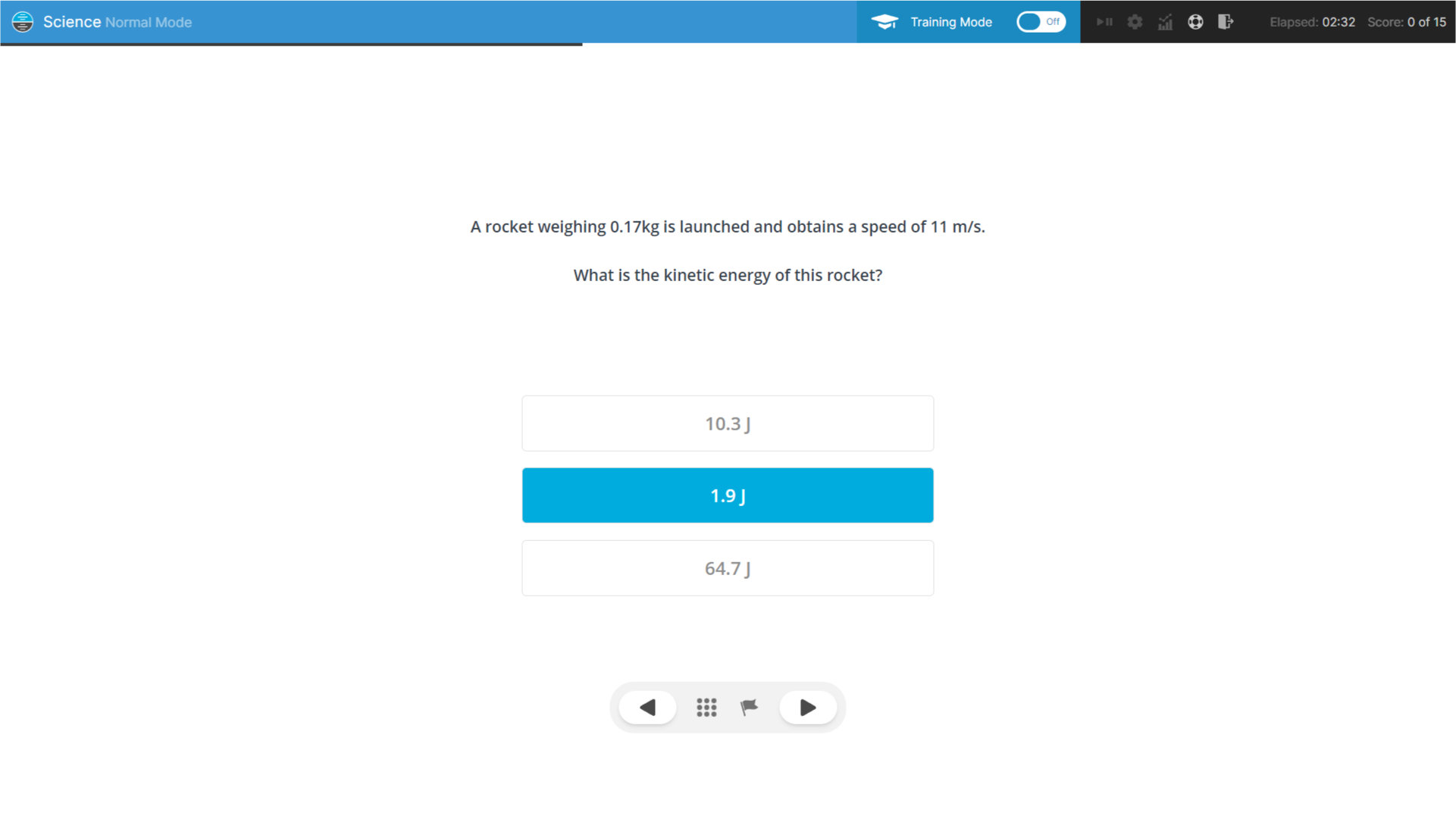
Unlike Mechanical Reasoning, which presents questions primarily through graphical illustrations, Science modules are predominantly text-based. Questions describe a scientific scenario or state a principle and ask the candidate to identify the correct answer from multiple options. Some questions may include a supporting diagram or formula, but the primary demand is on the candidate's knowledge and understanding of scientific concepts rather than their ability to interpret a visual system.
Questions range from direct factual recall (identifying the correct unit of measurement for a physical quantity, or stating the relationship described by a named law) through to applied reasoning (predicting what will happen to the pressure inside a sealed container if the temperature is increased, or determining which material would be the most effective conductor in a given scenario).
The DLR Science (TVT) module presents 40 questions in 35 minutes, covering force, motion and energy, electricity, radiation and magnetism, mass, weight and gravity, and broader scientific principles. The COMPASS Technical Test presents 20 questions in 10 minutes, covering the same core areas. Both modules use a multiple-choice format and assess the same underlying scientific competency, though the DLR module is significantly longer and allows more time per question.
Several other pilot aptitude test modules contain scientific content alongside mechanical reasoning material. The DLR Technical Comprehension module, the COMPASS Technical Insight module, and the TestAir360 Physics module all include questions that require the candidate to apply scientific principles. In these modules, the science content typically focuses on the mechanical and physical end of the spectrum (force, motion, energy, pressure, levers and gears) rather than the broader topics (electricity, wave behaviour, atmospheric science).
Candidates preparing for these cross-over modules should use both our Science and Mechanical Reasoning activities. For a detailed breakdown of the mechanical reasoning content in these modules, see our dedicated Mechanical Reasoning Knowledgebase Article.
A distinctive feature of Science assessment in pilot aptitude testing is the frequency with which named laws appear. Questions may reference a law by name (Boyle's Law, Ohm's Law, Newton's Laws) and require the candidate to state the relationship it describes, apply it to a given scenario, or identify the correct formula. The named laws assessed include:
Boyle-Mariotte Law describes the inverse relationship between pressure and volume for a gas at constant temperature. If the volume of a gas is halved, its pressure doubles.
Dalton's Law states that the total pressure exerted by a mixture of gases is equal to the sum of the partial pressures of each individual gas in the mixture.
Gay-Lussac Law describes the directly proportional relationship between the pressure and temperature of a gas at constant volume. As temperature increases, pressure increases proportionally.
Hooke's Law states that the extension of a spring is directly proportional to the force applied to it, provided the elastic limit is not exceeded.
Newton's Laws describe the relationship between forces and motion: an object remains at rest or in uniform motion unless acted upon by a force (first law), force equals mass multiplied by acceleration (second law), and every action has an equal and opposite reaction (third law).
Ohm's Law states that voltage equals current multiplied by resistance in an electrical circuit.
Science is assessed as a dedicated module in the following pilot aptitude test systems:
Additionally, the following test systems include significant scientific content within broader technical or physics modules:
Candidates preparing for a DLR, COMPASS or TestAir360 assessment that includes a Technical Comprehension, Technical Insight or Physics module should prepare using both our Science and Mechanical Reasoning activities.
The table below outlines the dedicated Science modules and the technical/physics modules that contain significant scientific content, linking each to the relevant preparation activities in our software.
| Assessment | Module | Scope | Format | Activities |
|---|---|---|---|---|
| DLR | Science (TVT) | Dedicated | 40 questions, 35 min | Science |
| COMPASS | Technical Test | Dedicated | 20 questions, 10 min | Science |
| DLR | Technical Comprehension * | Cross-over | Multiple choice | Science Mechanical Reasoning |
| COMPASS | Technical Insight * | Cross-over | Multiple choice | Science Mechanical Reasoning |
| TestAir360 | Physics * | Cross-over | Multiple choice | Science Mechanical Reasoning |
* These modules also assess mechanical reasoning content (pulleys, gears, levers, hydraulics). Candidates should prepare using both activities. See our Mechanical Reasoning Knowledgebase Article for a full breakdown.
Having identified the modules relevant to your assessment, you can navigate directly to the corresponding activities within our software.
Our software organises activities by the type of assessment you are preparing for, the skill being evaluated, and the specific airline, flying school or cadet scheme you are applying to. This means you do not need to manually cross-reference the table above; the relevant Science activities will already be included in your tailored preparation.
To find the activities relevant to you, navigate to one of the following within the software:
- Activities by Aptitude Test
- If you know which test system your assessment uses. For example, to find Science activities for the DLR, navigate to Activities by Aptitude Test and select DLR.
- Activities by Skill
- If you want to focus specifically on Science across all test systems. Navigate to Activities by Skill and select Science to see every relevant activity.
- Activities by Airline, Flying School or Cadet Scheme
- If you know where you are applying but not which test system is used. Navigate to Activities by Airline or Activities by Flying School and select your chosen organisation. The software will include the appropriate Science activities alongside all other relevant preparation.
If you have created a Preparation Strategy, the relevant Science activities will already appear in your Focus Activities; no additional navigation is required.
Science is closely associated with several other competencies assessed in pilot aptitude testing. Candidates preparing for Science modules may also benefit from developing the following related skills:
Academic Sources referenced in this KB Article
The following academic sources were consulted in the preparation of this article:
[1] Carretta, T. R., & Ree, M. J. (2003). Pilot selection methods. In P. S. Tsang & M. A. Vidulich (Eds.), Principles and Practice of Aviation Psychology. Lawrence Erlbaum Associates.
[2] Hunter, D. R., & Burke, E. F. (1994). Predicting aircraft pilot-training success: A meta-analysis of published research. The International Journal of Aviation Psychology, 4(4), 297-313.
[3] Gentner, D., & Stevens, A. L. (Eds.). (1983). Mental Models. Lawrence Erlbaum Associates.
[4] Martinussen, M. (1996). Psychological measures as predictors of pilot performance: A meta-analysis. The International Journal of Aviation Psychology, 6(1), 1-20.
[5] Carretta, T. R. (1992). Recent developments in US Air Force pilot candidate selection and classification. Aviation, Space, and Environmental Medicine, 63(12), 1112-1114.
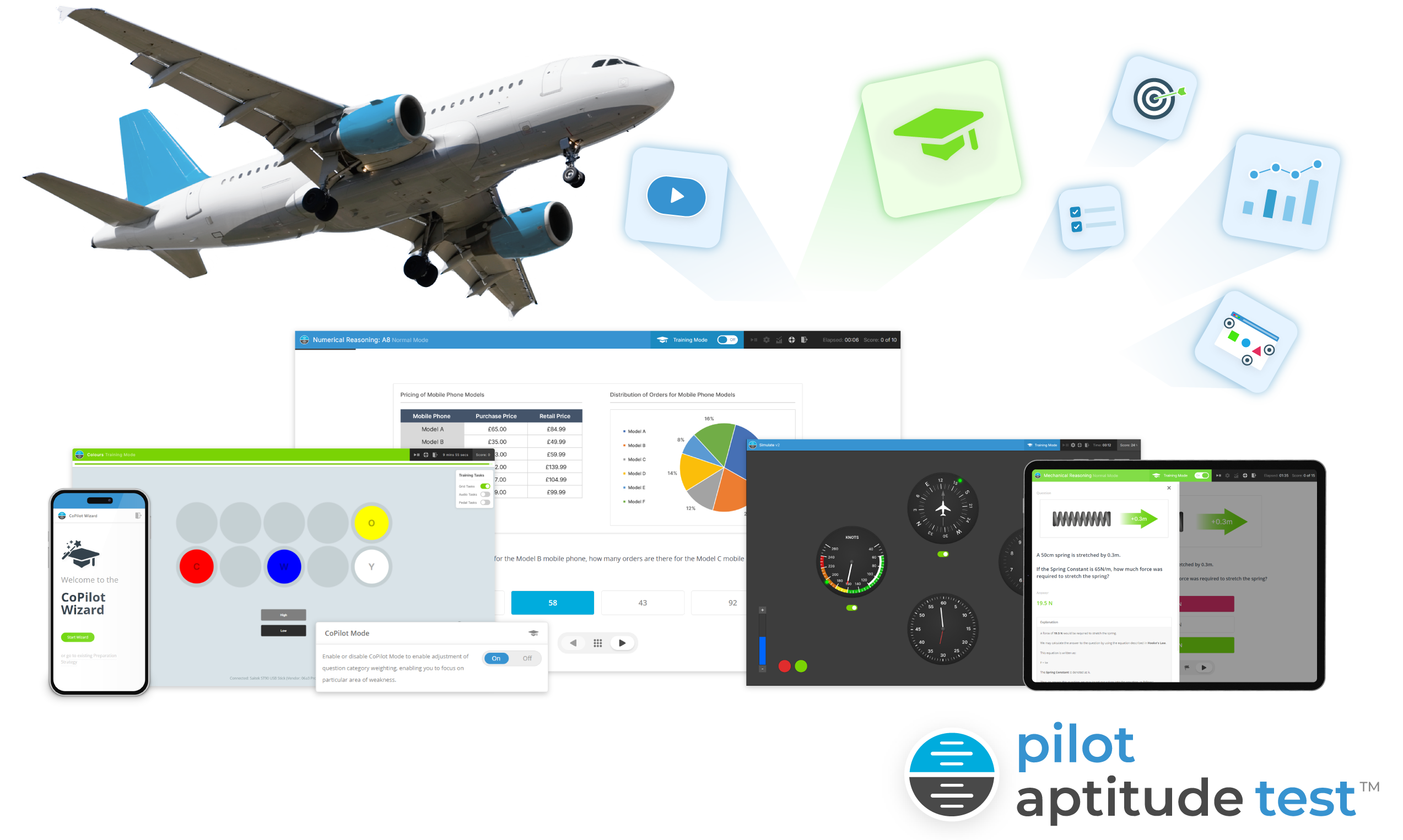
With a section dedicated to Science, our one-of-a-kind software represents the ultimate way for you to get prepared.
By leveraging our cutting-edge software, including those unique features and extensive guidance not offered elsewhere, you can immerse yourself in realistic simulations, master those competencies assessed, and familiarise yourself with the methods and mechanisms of assessment.
Our software is backed by our meticulous attention to detail and deep expertise as experienced commercial pilots, empowering pilot applicants to approach their assessments with confidence and helping to propel them to supersonic levels of success.
Start using our incredible preparation software immediately on PC, Mac, iOS and Android by purchasing a subscription:
Buy Preparation SoftwareWith increasing prevalence and awareness of computerised pilot aptitude testing in pilot assessments, it's never been more important to ensure that you can fly past the competition. This is made easy with features unique to our software:












Discover the key advantages of using our cutting-edge software:
How can I prepare for my Science pilot assessment?
The best way to prepare for your Science pilot assessment is with our latest industry-leading software, developed over 5 years by experienced airline pilots. With realistic exam simulations, personalised Preparation Strategies which guide you through your preparation, immersive Explainer Videos, customisable Training Modes that manipulate your simulation environments, comprehensive Instruction and Guidance, and extensive performance feedback which incorporates unique features such as Predictive Scoring, a Strength & Weakness Map and Colour Coding, our unique software will help you to accelerate improvement of your problem areas and fly through each part of the Science assessment. The software runs in a web browser, is compatible with laptop, desktop, tablet and smartphone, and is complimented with extensive support, provided from 9AM to 9PM GMT. To purchase a subscription to our software and start preparing for your Science pilot assessment, click here!
What is the pass mark for the Science pilot assessment?
Many pilot aptitude tests do not have a fixed threshold (or pass mark), but rather indicate the pilot candidate's overall performance and suitability using a variety of different methods - many of which are emulated within our software. Rather than worrying about a specific pass mark, the better approach is to focus on comprehensive preparation that maximizes your chances of success within each part of the Science pilot assessment. Our industry-leading pilot preparation software provides that comprehensive preparation, helping you to develop the essential sklls, familiarity with assessment and confidence needed to perform at your best. If you have any questions about the Science pilot assessment, please contact us.
How often is your Science assessment preparation software updated?
Our pilot assessment preparation software is continuously updated, with daily improvements based on feedback from hundreds of monthly users. Developed by experienced airline pilots, the simulations provided within our unique software faithfully reflect the Science pilot assessment, ensuring that you have the most current and comprehensive preparation. To see the recent updates to our preparation software, please visit our Updates page.
What support is available with your Science assessment preparation software?
With our own industry experiences, we understand the pressures and stresses that come with preparing for pilot assessments. When you use our software to prepare for your Science pilot assessment, you'll have access to exceptional support and guidance from our team of experienced airline pilots, provided between 9AM and 9PM GMT. This support sets us apart, helping you to develop the skills, knowledge, and confidence needed to approach your assessment feeling completely ready to demonstrate your true potential and fly past the competition at every stage of the Science pilot assessment.
How quickly can I prepare for my Science pilot assessment with this software?
If you'd like to start preparing for the Science assessment, you may start using our software within as little as a few minutes. We offer access to our preparation software for 7 days, 1 month or 3 months, and provide the opportunity to purchase additional time. This ensures you can work through the comprehensive simulations, and benefit from our guidance at your own pace, with support available whenever you need it. To get started, choose a subscription duration to our preparation software, create an account and complete your purchase - then, login and begin your preparation. The entire process typically takes between 2-3 minutes, with secure payment by credit or debit card securely processed with Stripe or PayPal.
Feature-packed and one-of-a kind preparation software for your assessment.
Regularly updated, realistic and infinite simulations of aptitude tests.
Instant activation, fast support and uniquely in-depth guidance.