

 Maths for Pilots
 Science for Pilots
 English Language for Pilots
 Verbal Reasoning for Pilots
 Numerical Reasoning for Pilots
 Mechanical Reasoning for Pilots
 ATPL Knowledge for Pilots
 WhatsApp
 Facebook Chat
 Email
Email








































If you don't have time to read this article but would like to know whether our software can help - it can. You can buy access to our software and get started immediately, 365 days-a-year.
Buy Preparation SoftwareMultitasking describes the ability to manage and perform multiple tasks concurrently, dividing attention between competing demands whilst maintaining acceptable performance on each. In pilot aptitude testing, Multitasking is assessed as the candidate's capacity to handle two or three distinct tasks simultaneously, rapidly switching attention between them without allowing any single task to deteriorate significantly. Unlike other skills assessed in pilot aptitude testing where the candidate focuses on one type of problem at a time, Multitasking modules require the candidate to engage with several different cognitive demands at once. These concurrent demands typically combine tasks from different domains, such as:
The central challenge of multitasking is not that any individual sub-task is particularly difficult in isolation. It is that performing them all at once creates interference: attending to one task means temporarily neglecting the others, and the candidate must develop a scanning strategy that allocates attention efficiently across all tasks to maintain performance across the board.
Further Reading on Theories of Divided Attention
How Divided Attention Works
Cognitive psychology research suggests that attention is a limited resource, and that performing multiple tasks simultaneously requires sharing that resource between them [1]. When two tasks draw on the same cognitive system (for example, two tasks that both require visual processing), they interfere with each other more than tasks that draw on different systems (such as one visual and one auditory task). This principle, known as multiple resource theory, explains why multitasking modules in pilot aptitude tests typically combine tasks from different modalities: a motor tracking task (visual-motor), a mathematical verification task (cognitive), and an auditory monitoring task (auditory) [2].
Research also shows that multitasking performance improves with practice, as component tasks become more automatic and require fewer attentional resources [3]. This is directly relevant to preparation: candidates who practise the sub-tasks individually until they become fluent will have more attentional capacity available for the task-switching and monitoring demands that make multitasking challenging. The goal is not to perform each task perfectly, but to maintain an acceptable level of performance across all tasks simultaneously.
Multitasking is a familiar experience in daily life. Driving is one of the most common examples: the driver must control the vehicle (motor task), monitor the road and mirrors (visual scanning), listen for emergency sirens or navigation prompts (auditory monitoring), and make decisions about route and speed (cognitive task), all concurrently. A learner driver finds this overwhelming because each sub-task still demands conscious attention; an experienced driver handles it comfortably because many of the sub-tasks have become automatic.
Cooking a meal with multiple dishes provides another example. The cook monitors timing on the oven, stirs something on the hob, chops ingredients for the next course, and keeps an ear out for the doorbell. The skill lies not in any single action but in the ability to cycle attention between tasks at the right moment, preventing anything from burning or being forgotten. This pattern of attention management, knowing when to check, when to switch, and when to let a task run unattended, is exactly what multitasking modules assess.
Flying an aircraft is inherently a multitasking activity. At no point during a flight is the pilot performing only one task. Even in the quietest cruise phase, the pilot is monitoring instruments, maintaining the correct altitude and heading, listening to the radio frequency, and maintaining awareness of weather, fuel state and traffic. During high-workload phases such as departure, approach, and any abnormal situation, the number of concurrent demands increases significantly.
- The approach phase:
- An instrument approach to landing is one of the most multitasking-intensive phases of flight. The pilot must fly the aircraft along a precise lateral and vertical path (motor/tracking), monitor altitude, speed, descent rate and configuration (visual scanning), listen for and respond to ATC instructions (auditory monitoring), brief the approach and configure the aircraft (procedural/cognitive), and maintain awareness of weather conditions, terrain and traffic (situational awareness). All of these tasks are performed simultaneously, with priorities shifting dynamically as the approach progresses.
- Abnormal and emergency procedures:
- When a system malfunction occurs, the crew must diagnose the problem and execute the appropriate checklist whilst continuing to fly the aircraft and communicate with ATC. This represents a sudden increase in task load: the new diagnostic and procedural tasks must be managed on top of the existing flying and monitoring tasks. The ability to absorb this additional workload without losing control of any task is a critical multitasking competency.
- Single-pilot operations:
- In multi-crew operations, tasks can be distributed between pilots. In single-pilot operations, commonly found in general aviation, corporate flying and some regional turboprop operations, the pilot must handle all tasks alone. This includes flying, navigating, communicating, managing systems, and making decisions, with no one to share the workload. Single-pilot IFR operations in particular demand a high level of multitasking ability, as the pilot must fly on instruments, communicate with ATC, and manage the approach simultaneously.
- Hover and low-speed manoeuvring:
- Hovering a helicopter requires continuous concurrent inputs on three controls (cyclic, collective and pedals) whilst simultaneously monitoring visual references outside the aircraft, checking instruments (torque, rotor RPM, engine parameters), listening to radio communications, and maintaining awareness of obstacles, wind changes and other traffic. The workload during a confined area landing or a hover alongside a ship is extremely high because the motor demands of controlling the aircraft are themselves a significant task that cannot be automated or delegated.
- HEMS and SAR operations:
- Helicopter Emergency Medical Service and Search and Rescue missions require the pilot to fly the aircraft (often at low level and in challenging conditions), navigate to an unfamiliar site, communicate with multiple agencies (dispatch, hospital, ground teams), manage fuel and performance calculations, and coordinate with the crew in the rear cabin. The variety and simultaneity of these demands make HEMS and SAR some of the most multitasking-intensive roles in aviation.
- Underslung load operations:
- During external load operations, the pilot must fly the aircraft, monitor the load behaviour (which affects aircraft handling), communicate with the ground crew, manage aircraft performance (load weight affects power margins), and be ready to release the load instantly if safety is compromised. The load introduces an additional dynamic task (damping oscillations) that must be managed alongside all other flying tasks.
The ability to manage multiple concurrent tasks is not an occasional requirement in aviation; it is a continuous one. Research into pilot workload has consistently identified task management as a core competency that distinguishes effective pilots from those who struggle under pressure [4]. When workload exceeds a pilot's capacity, tasks are shed, often without the pilot being consciously aware that they have stopped performing them. The consequences of unconscious task shedding can range from minor (missing a radio call) to catastrophic (losing control of the aircraft).
Multitasking modules in pilot aptitude tests provide a controlled environment in which to assess a candidate's capacity for sustained divided attention. By requiring the candidate to manage multiple tasks simultaneously and measuring performance across all tasks, these modules provide an indication of the candidate's raw capacity for the kind of workload management that professional flying demands.
Pilot training itself is a multitasking environment. From the earliest simulator sessions, trainees must fly the aircraft whilst simultaneously learning new procedures, responding to instructor prompts, and managing simulated malfunctions. Candidates who enter training with a strong capacity for divided attention are better able to absorb instruction whilst maintaining aircraft control, which accelerates their progression through the training syllabus.
Research into pilot selection has found that measures of divided attention and multitasking ability are significant predictors of training success, particularly in the flight training phase where the demands most closely resemble the operational environment [5].
Multitasking is assessed across Aon (Cut-e), CBAT / CFAST / MACTS, COMPASS, Advanced COMPASS, DLR and Vienna Test System assessments. The Aon assessment includes four variant modules, any one of which may be presented to the candidate. The CBAT family includes three dedicated multitasking modules (Cognitive Updating Test, Dynamic Projection Test and Target Recognition Test), each combining task management, monitoring and attention-spreading demands. The DLR Instruments (MIC) module and the VTS Determination Test (DT) also incorporate significant multitasking demands alongside their primary assessment of motor skills and reaction time respectively.
Further Reading on Multitasking as a Predictor of Pilot Performance
Why Divided Attention Predicts Operational Success
Meta-analyses of pilot selection research have shown that tests of divided attention and multitasking contribute meaningfully to the prediction of training outcomes, particularly when the criterion is flight training performance rather than ground school results [5]. This makes intuitive sense: ground school is primarily a single-task academic environment, whereas flight training and operational flying require the continuous management of multiple concurrent demands.
The predictive value of multitasking assessments is enhanced when the sub-tasks used in the test are relevant to the operational domain. This is why many pilot multitasking modules incorporate aviation-flavoured sub-tasks (such as tracking an aircraft on a runway, verifying mathematical equations similar to those encountered in calculations, or monitoring auditory information). The closer the test tasks are to operational demands, the stronger the predictive relationship [6].
Computerised pilot aptitude tests evaluate Multitasking by requiring the candidate to perform multiple distinct tasks simultaneously. Performance is measured across all tasks, so the candidate cannot succeed by focusing on one task at the expense of the others. The specific sub-tasks vary between modules, but the underlying demand is always the same: divide attention, manage competing priorities, and maintain acceptable performance on everything at once.
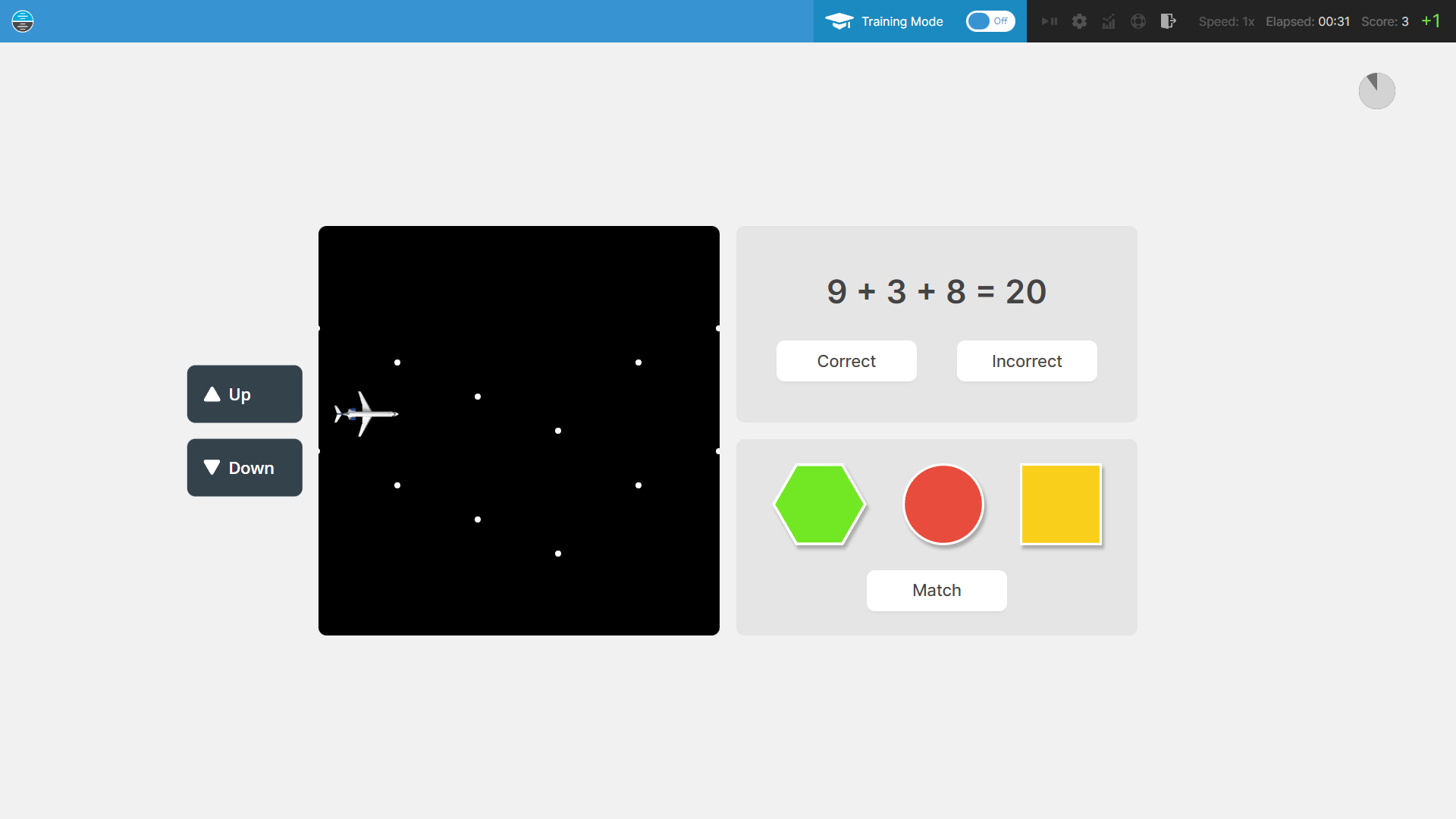
The Aon (Cut-e) assessment includes four variant Multi-Tasking Capability modules, any one of which may appear in a candidate's test battery. All four variants require the candidate to manage three concurrent sub-tasks simultaneously for 5 minutes.
The sub-tasks combine different types of cognitive demand. One sub-task is always motor or visual in nature: the candidate may need to manoeuvre an object along a path, guide an aircraft to land on a runway, steer an aircraft to avoid falling obstacles, or confirm the orientation of a shape. A second sub-task is always mathematical: confirming whether equations displayed on screen are correct or incorrect. The third sub-task varies: it may be auditory (verifying whether a spoken statement matches information shown on screen) or visual (identifying duplicate letters in a series).
The combination of motor, mathematical and monitoring sub-tasks mirrors the real-world cockpit demand of flying the aircraft (motor), performing calculations or verifications (cognitive), and monitoring communications or displays (auditory/visual). The candidate does not know in advance which of the four variants they will be given, making it important to prepare broadly across all sub-task types.
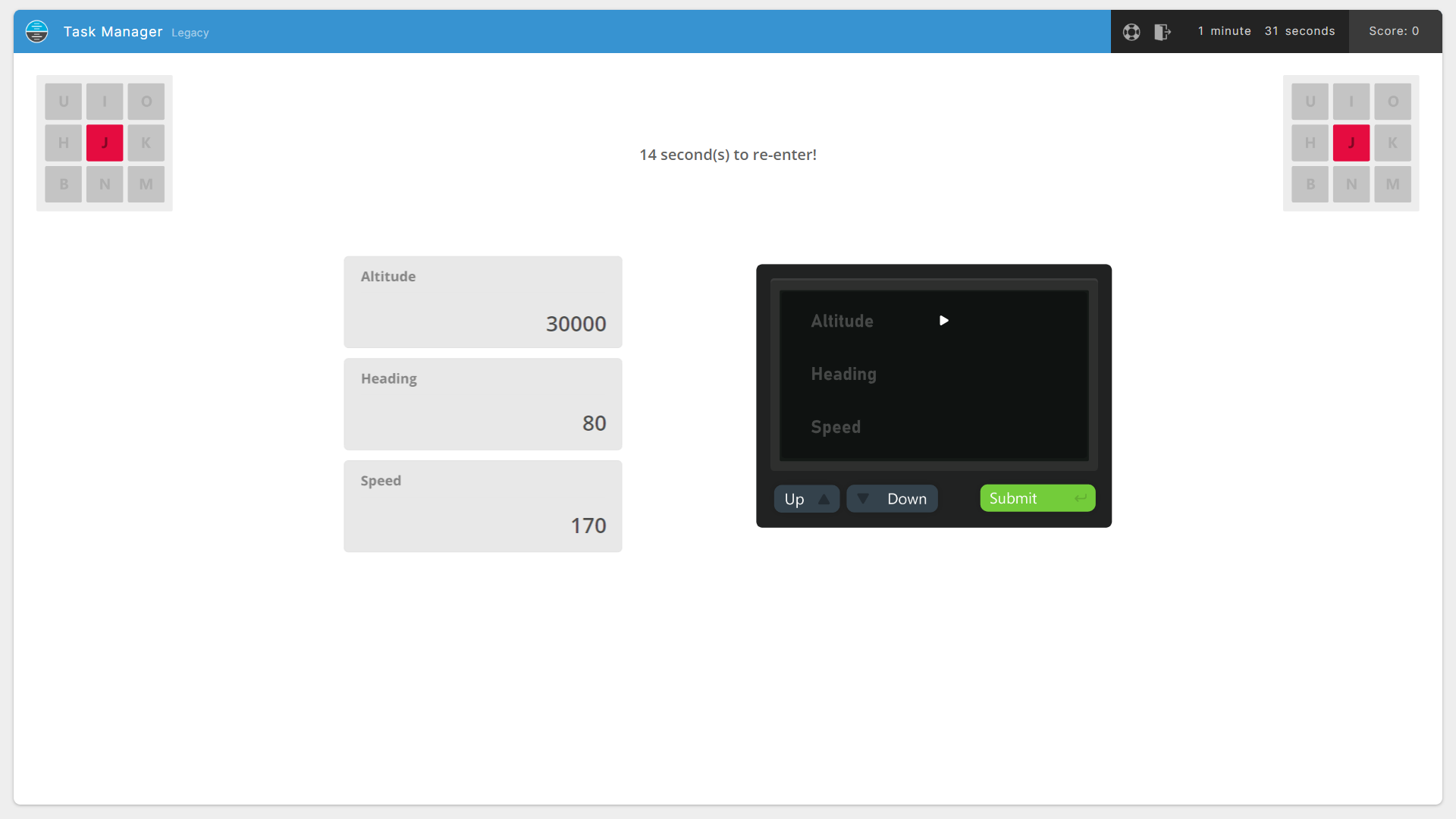
The COMPASS and Advanced COMPASS Task Manager module requires the candidate to perform two concurrent tasks for 5 minutes. The primary task is information transfer: the candidate observes information presented on screen and inputs it into a simulated computer display. The secondary task is monitoring: lights illuminate periodically and randomly, and the candidate must extinguish them promptly whilst continuing the primary task.
This format assesses the candidate's ability to maintain a steady, systematic approach to a primary task whilst remaining vigilant for unpredictable events that require an immediate response. The monitoring component mirrors the operational requirement to remain alert to warnings and annunciations even whilst engaged in a focused task such as programming an FMS or completing paperwork.
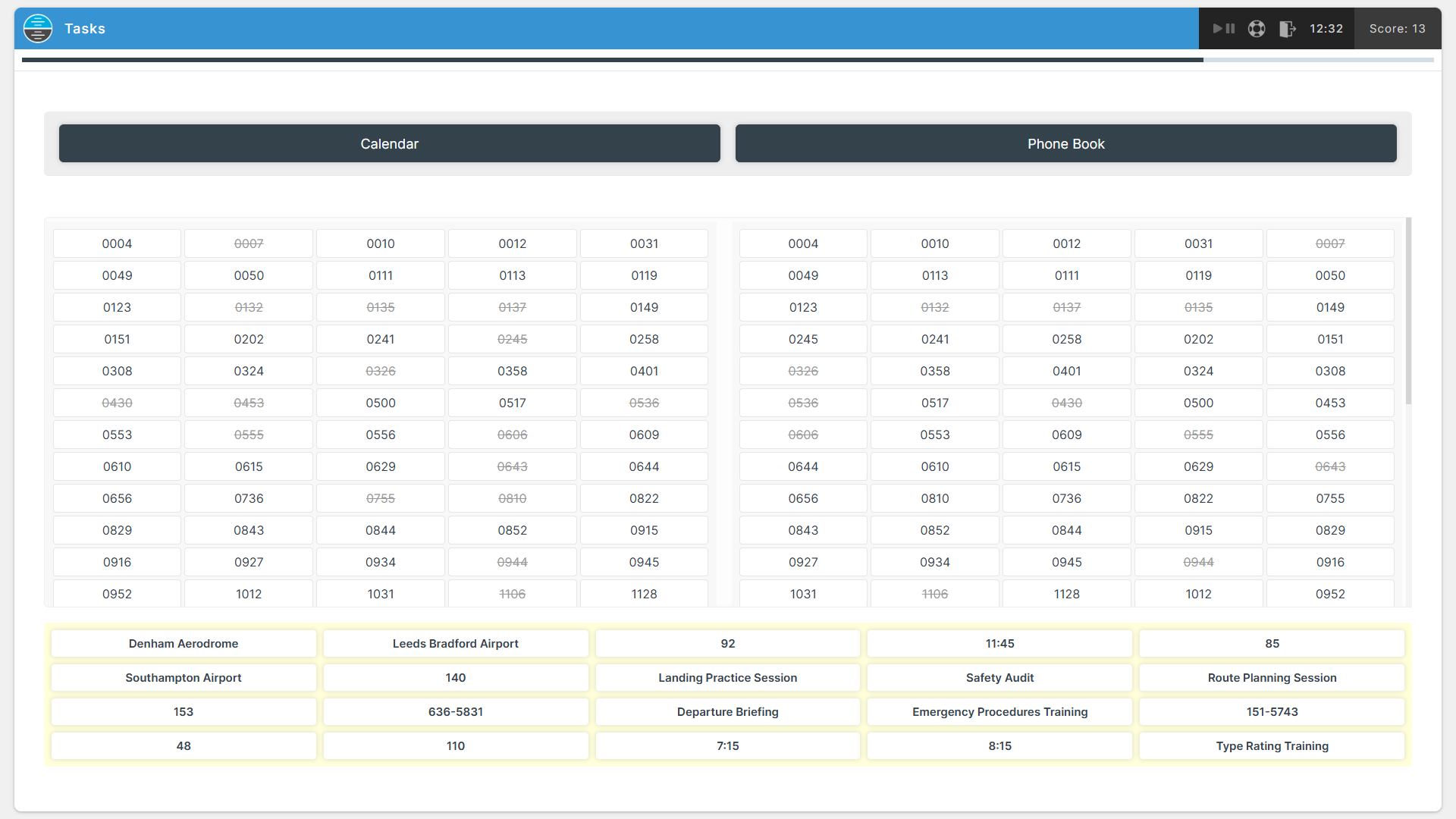
The Vienna Test System Simultaneous Capacity (SIMKAP) module requires the candidate to manage two concurrent tasks across different sensory channels for 15 minutes. The visual task involves comparing two separate code sheets to identify discrepancies. The auditory task involves listening to questions delivered through headphones and looking up answers using two reference sources: a telephone book and a calendar.
The SIMKAP module is the longest multitasking module at 15 minutes (compared to 5 minutes for Aon and COMPASS modules). This extended duration means that sustained attention and mental stamina play a larger role, as the candidate must maintain divided attention over a longer period without performance declining due to fatigue. The cross-modal design (visual task plus auditory task) means the two tasks draw on different attentional resources, which makes them easier to perform simultaneously than two tasks in the same modality, but the complexity of each individual task compensates for this.
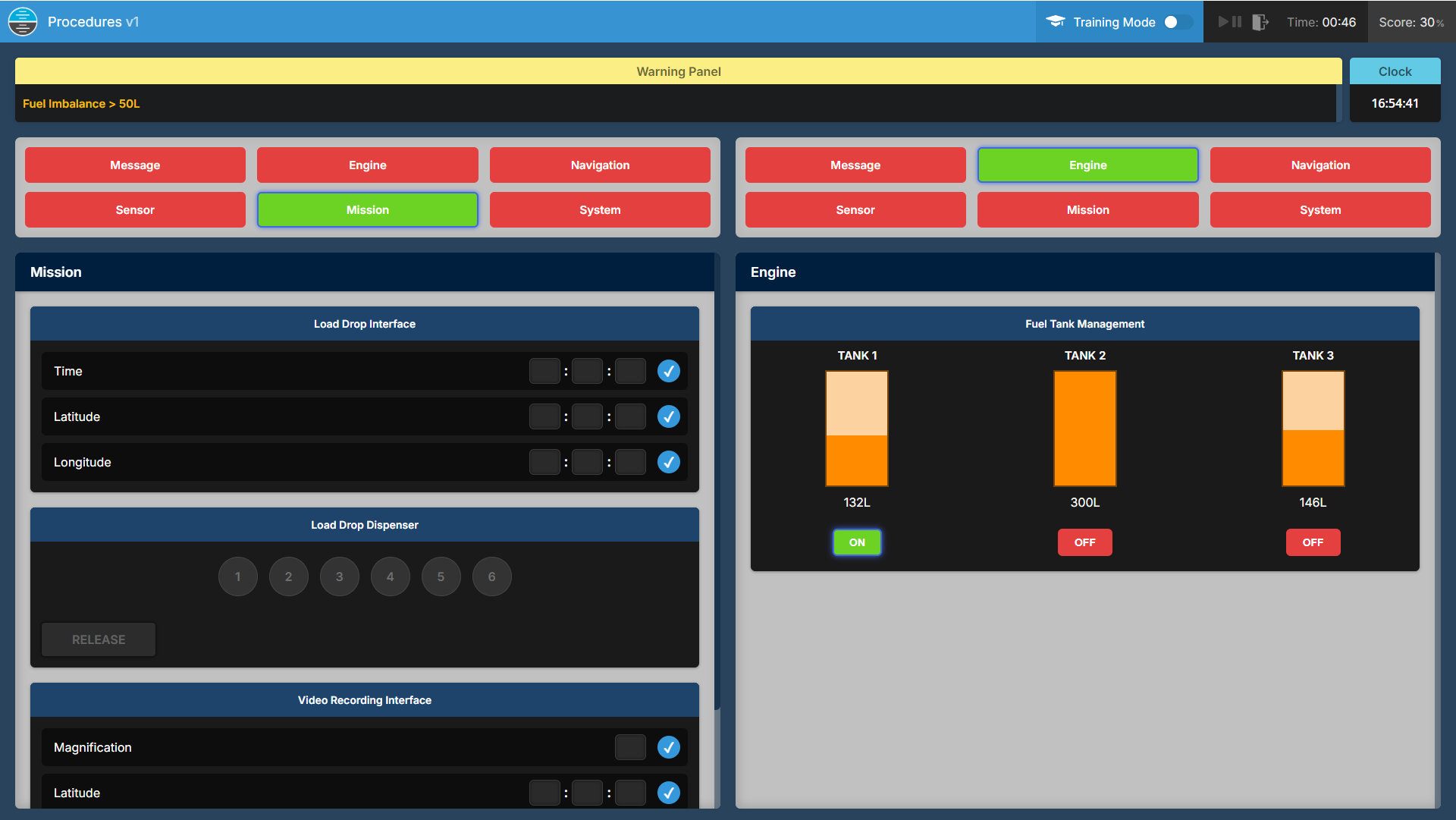
The CBAT family of assessments includes three dedicated multitasking modules, each with a distinct operational flavour. The Cognitive Updating Test (CUT) requires the candidate to manage a variety of tasks to ensure sustained operation within specified parameters, demanding effective task management and prioritisation as conditions change. The Dynamic Projection Test (DPT) requires the candidate to manage the flight of multiple aircraft from a top-down perspective, simultaneously tracking and directing several aircraft whilst anticipating trajectories and making timely decisions. The Target Recognition Test (TRT) requires the candidate to spread their attention across multiple concurrent tasks in what is described as a labour-intensive module, demonstrating effective prioritisation and sustained attention.
These modules are distinctive in their use of operationally-themed scenarios (systems management, air traffic projection, target identification) rather than abstract sub-tasks. The multitasking demand arises from the need to manage realistic, dynamic situations in which multiple elements require simultaneous attention and where conditions change unpredictably.
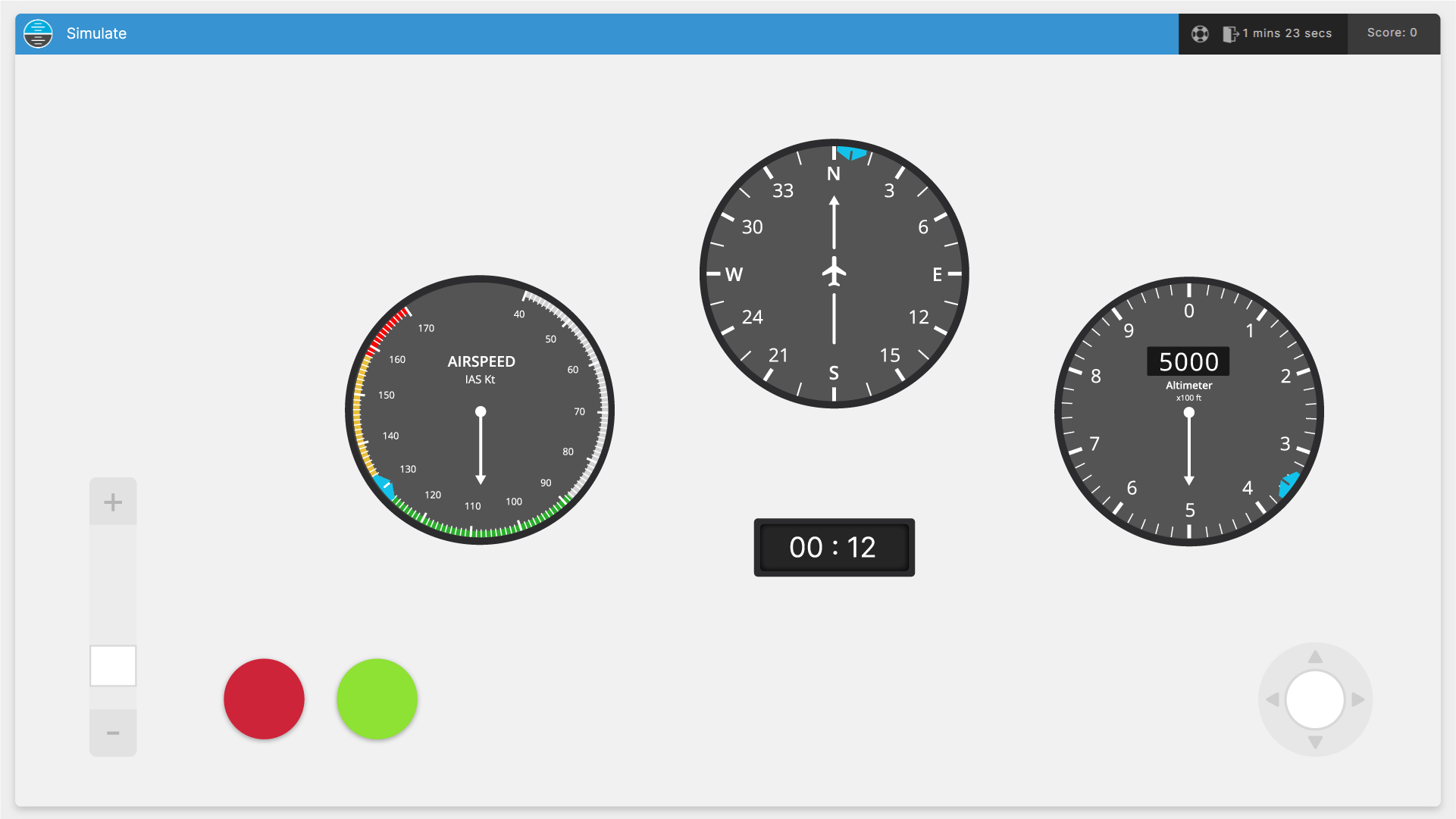
The DLR Instruments (MIC) module is primarily a motor skills assessment, but it incorporates a significant multitasking component. The candidate is presented with simulated aircraft instruments (an Airspeed Indicator, a Direction Indicator and an Altimeter) and must manoeuvre the aircraft to maintain speed, heading and altitude values specified by the computer. Concurrently, the candidate must engage with a secondary auditory monitoring task, requiring them to listen to and respond to audio statements whilst maintaining aircraft control.
At approximately 40 minutes (including 20 minutes of preparation), the MIC module is the longest assessment that includes multitasking demands. The combination of continuous motor tracking across three axes with auditory monitoring closely mirrors the real-world cockpit demand of flying the aircraft whilst monitoring radio communications.
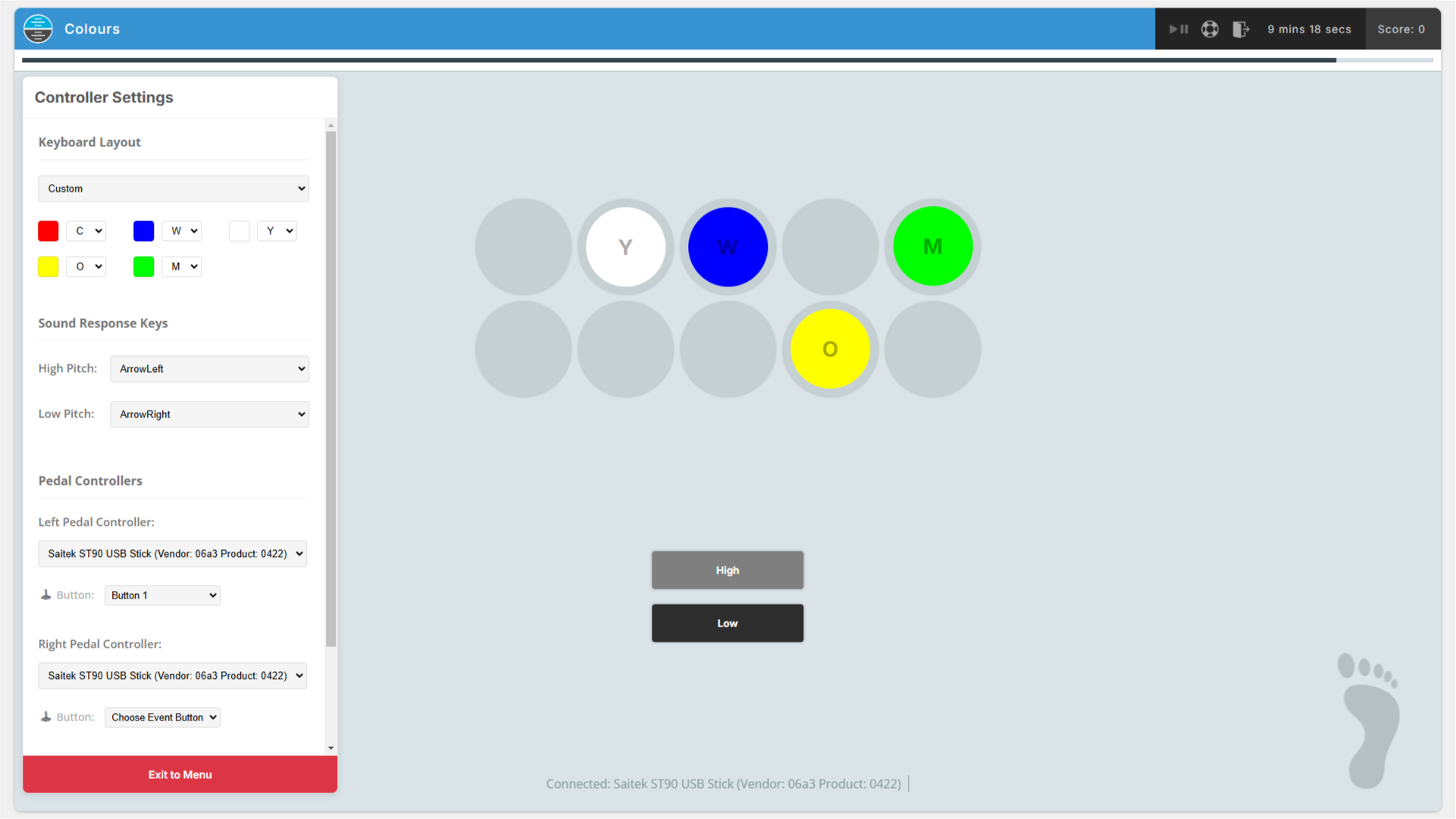
The Vienna Test System Determination Test (DT) is primarily a reaction time assessment, but it incorporates multitasking through the simultaneous presentation of stimuli across multiple sensory channels. The candidate must respond to coloured circles appearing at random intervals across a grid (requiring specific key responses), high and low-pitched tones demanding immediate acknowledgement, and periodically illuminating pedals requiring prompt physical reactions.
The multitasking demand arises from the need to monitor and respond across three different input channels (visual, auditory and physical) simultaneously. Unlike the other multitasking modules where the candidate chooses when to switch attention between tasks, the DT module forces rapid task-switching by presenting stimuli unpredictably across all channels at a pace set by the test.
Multitasking is assessed in the following pilot aptitude test systems:
The table below outlines the Multitasking modules in each assessment, linking each to the relevant preparation activity in our software. Note that the Aon assessment includes four variant modules; your assessment will include one of these, but you will not know in advance which variant you will receive.
| Assessment | Module | Sub-Tasks | Format | Activity |
|---|---|---|---|---|
| Aon (Cut-e) | Multi-Tasking Capability (scales mt avi) | Motor + Maths + Audio | Infinite, 5 min | Align |
| Aon (Cut-e) | Multi-Tasking Capability (sonic) | Visual + Maths + Audio | Infinite, 5 min | Sonic |
| Aon (Cut-e) | Multi-Tasking Capability (runway) | Motor + Maths + Visual | Infinite, 5 min | Runway |
| Aon (Cut-e) | Multi-Tasking Capability (falling obstacles) | Motor + Maths + Visual | Infinite, 5 min | Multitasking Capability |
| CBAT / CFAST / MACTS | Cognitive Updating Test (CUT) | Task Management + Monitoring | TBC | Procedures |
| CBAT / CFAST / MACTS | Dynamic Projection Test (DPT) | Spatial + Monitoring | TBC | Traffic |
| CBAT / CFAST / MACTS | Target Recognition Test (TRT) | Attention Spreading + Monitoring | TBC | Targets |
| COMPASS | Task Manager | Info Transfer + Monitoring | Infinite, 5 min | Task Manager |
| Adv. COMPASS | Task Manager | Info Transfer + Monitoring | Infinite, 5 min | Task Manager |
| Vienna Test System | Simultaneous Capacity (SIMKAP) | Visual Comparison + Audio | Infinite, 15 min | Tasks |
| DLR | Instruments (MIC) | Motor + Tracking + Audio | Infinite, ~40 min | Simulate |
| Vienna Test System | Determination Test (DT) | Visual + Audio + Pedals | Infinite, 10 min | Colours |
Having identified the modules relevant to your assessment, you can navigate directly to the corresponding activities within our software.
Our software organises activities by the type of assessment you are preparing for, the skill being evaluated, and the specific airline, flying school or cadet scheme you are applying to. This means you do not need to manually cross-reference the table above; the relevant Multitasking activities will already be included in your tailored preparation.
To find the activities relevant to you, navigate to one of the following within the software:
- Activities by Aptitude Test
- If you know which test system your assessment uses. For example, to find Multitasking activities for Aon (Cut-e), navigate to Activities by Aptitude Test and select Aon (Cut-e).
- Activities by Skill
- If you want to focus specifically on Multitasking across all test systems. Navigate to Activities by Skill and select Multitasking to see every relevant activity.
- Activities by Airline, Flying School or Cadet Scheme
- If you know where you are applying but not which test system is used. Navigate to Activities by Airline or Activities by Flying School and select your chosen organisation. The software will include the appropriate Multitasking activities alongside all other relevant preparation.
If you have created a Preparation Strategy, the relevant Multitasking activities will already appear in your Focus Activities; no additional navigation is required.
Multitasking is closely associated with several other competencies assessed in pilot aptitude testing. Candidates preparing for Multitasking modules may also benefit from developing the following related skills:
Academic Sources referenced in this KB Article
The following academic sources were consulted in the preparation of this article:
[1] Kahneman, D. (1973). Attention and Effort. Prentice-Hall.
[2] Wickens, C. D. (2002). Multiple resources and performance prediction. Theoretical Issues in Ergonomics Science, 3(2), 159-177.
[3] Schneider, W., & Shiffrin, R. M. (1977). Controlled and automatic human information processing: I. Detection, search, and attention. Psychological Review, 84(1), 1-66.
[4] Wickens, C. D. (2008). Multiple resources and mental workload. Human Factors, 50(3), 449-455.
[5] Hunter, D. R., & Burke, E. F. (1994). Predicting aircraft pilot-training success: A meta-analysis of published research. The International Journal of Aviation Psychology, 4(4), 297-313.
[6] Carretta, T. R., & Ree, M. J. (2003). Pilot selection methods. In P. S. Tsang & M. A. Vidulich (Eds.), Principles and Practice of Aviation Psychology. Lawrence Erlbaum Associates.
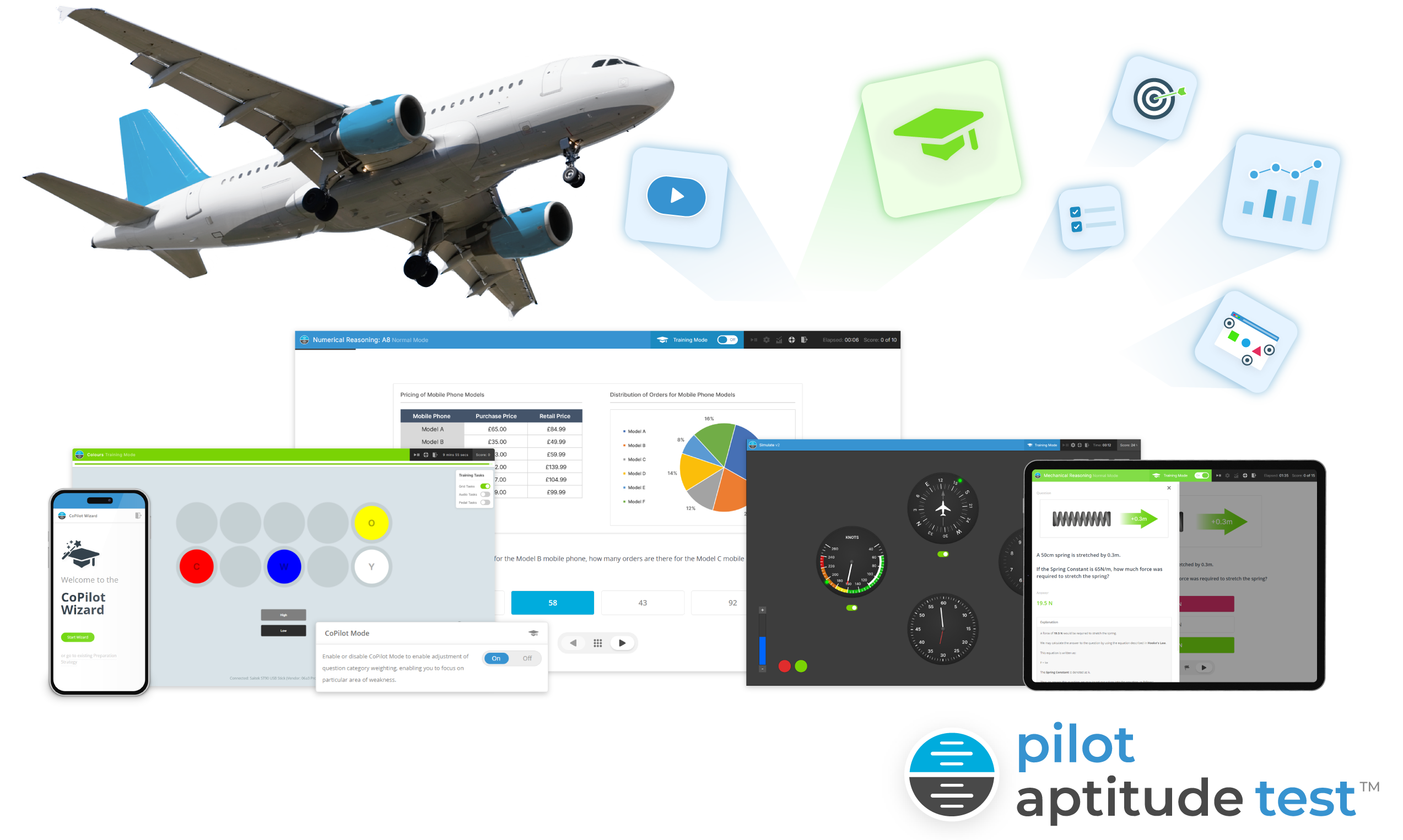
With a section dedicated to Multitasking, our one-of-a-kind software represents the ultimate way for you to get prepared.
By leveraging our cutting-edge software, including those unique features and extensive guidance not offered elsewhere, you can immerse yourself in realistic simulations, master those competencies assessed, and familiarise yourself with the methods and mechanisms of assessment.
Our software is backed by our meticulous attention to detail and deep expertise as experienced commercial pilots, empowering pilot applicants to approach their assessments with confidence and helping to propel them to supersonic levels of success.
Start using our incredible preparation software immediately on PC, Mac, iOS and Android by purchasing a subscription:
Buy Preparation SoftwareWith increasing prevalence and awareness of computerised pilot aptitude testing in pilot assessments, it's never been more important to ensure that you can fly past the competition. This is made easy with features unique to our software:












Discover the key advantages of using our cutting-edge software:
How can I prepare for my Multitasking pilot assessment?
The best way to prepare for your Multitasking pilot assessment is with our latest industry-leading software, developed over 5 years by experienced airline pilots. With realistic exam simulations, personalised Preparation Strategies which guide you through your preparation, immersive Explainer Videos, customisable Training Modes that manipulate your simulation environments, comprehensive Instruction and Guidance, and extensive performance feedback which incorporates unique features such as Predictive Scoring, a Strength & Weakness Map and Colour Coding, our unique software will help you to accelerate improvement of your problem areas and fly through each part of the Multitasking assessment. The software runs in a web browser, is compatible with laptop, desktop, tablet and smartphone, and is complimented with extensive support, provided from 9AM to 9PM GMT. To purchase a subscription to our software and start preparing for your Multitasking pilot assessment, click here!
What is the pass mark for the Multitasking pilot assessment?
Many pilot aptitude tests do not have a fixed threshold (or pass mark), but rather indicate the pilot candidate's overall performance and suitability using a variety of different methods - many of which are emulated within our software. Rather than worrying about a specific pass mark, the better approach is to focus on comprehensive preparation that maximizes your chances of success within each part of the Multitasking pilot assessment. Our industry-leading pilot preparation software provides that comprehensive preparation, helping you to develop the essential sklls, familiarity with assessment and confidence needed to perform at your best. If you have any questions about the Multitasking pilot assessment, please contact us.
How often is your Multitasking assessment preparation software updated?
Our pilot assessment preparation software is continuously updated, with daily improvements based on feedback from hundreds of monthly users. Developed by experienced airline pilots, the simulations provided within our unique software faithfully reflect the Multitasking pilot assessment, ensuring that you have the most current and comprehensive preparation. To see the recent updates to our preparation software, please visit our Updates page.
What support is available with your Multitasking assessment preparation software?
With our own industry experiences, we understand the pressures and stresses that come with preparing for pilot assessments. When you use our software to prepare for your Multitasking pilot assessment, you'll have access to exceptional support and guidance from our team of experienced airline pilots, provided between 9AM and 9PM GMT. This support sets us apart, helping you to develop the skills, knowledge, and confidence needed to approach your assessment feeling completely ready to demonstrate your true potential and fly past the competition at every stage of the Multitasking pilot assessment.
How quickly can I prepare for my Multitasking pilot assessment with this software?
If you'd like to start preparing for the Multitasking assessment, you may start using our software within as little as a few minutes. We offer access to our preparation software for 7 days, 1 month or 3 months, and provide the opportunity to purchase additional time. This ensures you can work through the comprehensive simulations, and benefit from our guidance at your own pace, with support available whenever you need it. To get started, choose a subscription duration to our preparation software, create an account and complete your purchase - then, login and begin your preparation. The entire process typically takes between 2-3 minutes, with secure payment by credit or debit card securely processed with Stripe or PayPal.
Feature-packed and one-of-a kind preparation software for your assessment.
Regularly updated, realistic and infinite simulations of aptitude tests.
Instant activation, fast support and uniquely in-depth guidance.