

 Maths for Pilots
 Science for Pilots
 English Language for Pilots
 Verbal Reasoning for Pilots
 Numerical Reasoning for Pilots
 Mechanical Reasoning for Pilots
 ATPL Knowledge for Pilots
 WhatsApp
 Facebook Chat
 Email
Email










































If you don't have time to read this article but would like to know whether our software can help - it can. You can buy access to our software and get started immediately, 365 days-a-year.
Buy Preparation SoftwareSpatial Transformation describes the ability to mentally manipulate, rotate, fold or reorient objects and perspectives in space. In pilot aptitude testing, Spatial Transformation is assessed as the candidate's capacity to visualise how objects appear from different angles, track the results of rotations applied to three-dimensional objects, fold two-dimensional nets into three-dimensional shapes, and determine the manoeuvres required to change an aircraft's orientation from one attitude to another. Where Spatial Awareness focuses on understanding where things are in space, Spatial Transformation focuses on mentally changing them: rotating, folding, reorienting, or projecting from one perspective to another. The specific transformation demands vary between modules, but collectively the types assessed include:
The central challenge of Spatial Transformation is that the candidate must perform these manipulations mentally, without physically moving or rotating anything. The ability to build, hold and manipulate a three-dimensional mental model is what distinguishes strong performance in these modules, and it is this same ability that enables pilots to understand how their aircraft is oriented in space, to predict the results of control inputs, and to maintain spatial orientation when visual references are limited or absent.
Further Reading on Mental Rotation and Spatial Visualisation
The Cognitive Basis of Spatial Transformation
The study of mental rotation was pioneered by Shepard and Metzler (1971), who demonstrated that the time required to determine whether two three-dimensional objects are identical increases linearly with the angular difference between them, suggesting that people mentally rotate one object to match the other at a constant rate [1]. This finding established that spatial transformation is an analogue process: the mind manipulates spatial representations in a way that mirrors physical rotation.
Subsequent research has distinguished between spatial visualisation (the ability to perform complex, multi-step spatial transformations, such as folding a net into a cube or tracking a series of rotations) and speeded rotation (the ability to quickly determine whether two objects are identical despite differences in orientation) [2]. Pilot aptitude tests assess both: cube net folding and auditory-guided rotation tasks demand spatial visualisation, whilst rapid perspective comparison tasks demand speeded rotation. Both are relevant to flying, where the pilot must sometimes reason carefully about spatial relationships (planning an approach) and sometimes respond quickly to spatial changes (recovering from an unusual attitude).
Spatial Transformation is engaged whenever you need to mentally change the orientation or perspective of something. Packing a suitcase efficiently requires you to mentally rotate items to see how they fit together. Assembling flat-pack furniture from a diagram requires you to mentally fold two-dimensional images into three-dimensional structures and rotate components to match the instructions. Reading a map whilst facing south requires you to mentally rotate the map's orientation to match your own perspective.
More demanding examples include reversing a car into a tight space (where the steering relationship is reversed and you must mentally transform the direction of turn into the resulting movement of the rear of the vehicle), or giving someone directions to a destination you have only ever approached from the opposite direction (requiring you to mentally reverse the entire route, swapping all left and right turns). These tasks require the same kind of perspective transformation and mental manipulation assessed in pilot aptitude tests, where the candidate must rotate cubes, fold nets, determine attitude changes, or select the manoeuvre required to achieve a particular orientation.
Spatial Transformation underpins the pilot's ability to understand and predict how the aircraft's orientation changes in response to control inputs, to translate between different representations of the same spatial situation (instrument displays, charts, the view from the cockpit), and to maintain accurate spatial orientation when the sensory environment is misleading or degraded.
- Unusual attitude recovery:
- When an aircraft enters an unusual attitude (an unexpected nose-high, nose-low, or banked condition), the pilot must rapidly interpret the attitude indicator, determine the aircraft's current orientation, and identify the correct recovery actions. This requires spatial transformation: the pilot must mentally map the abstract display on the attitude indicator to the aircraft's actual three-dimensional orientation and then determine which control inputs will return the aircraft to straight and level flight. Incorrect spatial interpretation during unusual attitude recovery is a leading cause of loss-of-control accidents.
- Instrument-to-reality translation:
- Throughout instrument flight, the pilot translates two-dimensional instrument displays into a three-dimensional mental model of the aircraft's state. The attitude indicator shows pitch and bank, the heading indicator shows direction, and the navigation display shows lateral position. Integrating these separate two-dimensional representations into a single coherent three-dimensional picture requires continuous spatial transformation. This is the same cognitive process assessed in modules that require the candidate to fold a two-dimensional net into a three-dimensional cube, or to determine an aircraft's attitude from instrument readings.
- Holding patterns and procedure turns:
- Entering a holding pattern requires the pilot to determine the correct entry procedure based on the aircraft's heading relative to the holding fix and the inbound course. This involves mentally rotating the aircraft's position and heading relative to the published pattern, determining which of three entry types (direct, parallel, or teardrop) is appropriate, and then flying the entry accurately. The spatial transformation demand is in mentally projecting the aircraft's future track through turns and legs that are not directly visible but must be visualised from the published procedure.
- Chart interpretation:
- Approach charts, departure procedures and en-route charts present spatial information in two dimensions that the pilot must mentally transform into three-dimensional understanding. A profile view shows the vertical path, a plan view shows the lateral path, and the pilot must integrate both into a complete spatial picture of the procedure. When the chart orientation does not match the aircraft's heading (which is common), the pilot must mentally rotate the chart information to reconcile it with their actual direction of travel.
- Tail rotor awareness during manoeuvring:
- During low-speed manoeuvring, the helicopter pilot must maintain constant awareness of the tail rotor position, which is behind and to one side of the cockpit and therefore not directly visible. When turning, hovering sideways, or backing into a confined space, the pilot must mentally project the tail rotor's position and path through space, transforming their forward-facing cockpit perspective into an awareness of what is happening behind and to the side of the aircraft. A failure of this spatial transformation can result in a tail rotor strike on an obstacle.
- Deck landings and confined area approaches:
- Approaching a ship's deck or a confined landing site from different directions requires the pilot to mentally transform their approach path relative to the landing surface, accounting for wind direction, obstacle positions, and escape routes. When the approach direction changes (for example, due to a change in wind or ship heading), the entire spatial picture must be mentally re-oriented, demanding rapid spatial transformation under time pressure.
- Formation flying and relative positioning:
- In formation flying, each pilot must maintain their position relative to the lead aircraft. When the formation turns, the spatial relationships between aircraft change dynamically, and each pilot must mentally transform their required position, heading and speed to maintain the correct geometry. The pilot must visualise the three-dimensional formation from their own perspective whilst simultaneously understanding it from a plan view (as briefed), requiring continuous perspective transformation.
The ability to translate between two-dimensional instrument displays and three-dimensional spatial reality is a core demand of instrument flying. Every time a pilot reads an attitude indicator, interprets a navigation display, or follows an approach procedure, they are performing a spatial transformation: converting abstract, symbolic information into a mental model of the aircraft's position and orientation in three-dimensional space.
Candidates with stronger spatial transformation ability learn instrument flying more quickly because they can build accurate three-dimensional mental models from instrument information more readily. Research has consistently shown that spatial visualisation ability is a significant predictor of flight training success, particularly during the instrument flying phase [3].
Aviation is fundamentally a three-dimensional activity. The aircraft moves through three axes (pitch, roll and yaw), and the pilot must understand how control inputs affect movement in each axis, how these movements combine, and how the resulting changes in attitude and flight path relate to the pilot's perspective from the cockpit. This three-dimensional reasoning is precisely what spatial transformation modules assess.
Modules that require the candidate to determine the attitude change between two aircraft orientations (such as the VTS Pilot's Spatial Test) or to track the result of sequential rotations applied to a cube (such as the DLR Rotating Cubes module) are directly assessing the kind of three-dimensional reasoning that pilots use when visualising manoeuvres, understanding aircraft behaviour, and maintaining spatial orientation.
Spatial Transformation is assessed across Aon (Cut-e), CBAT / CFAST / MACTS, DLR and Vienna Test System assessments. The DLR assessment includes three modules that assess spatial transformation (3D Cubes, Rotating Cubes and Path Figure Test), each targeting a different aspect of the skill. The VTS includes both a pilot-specific attitude change task and an adaptive cube comparison task. This breadth reflects the central role of spatial manipulation in aviation, where the ability to mentally rotate, fold and reorient spatial information supports instrument interpretation, procedure comprehension, manoeuvre planning and spatial orientation throughout all phases of flight.
Further Reading on Spatial Transformation and Training Outcomes
Why Spatial Visualisation Predicts Flight Performance
The relationship between spatial transformation ability and pilot performance is well established in the selection research literature. Meta-analyses have shown that spatial tests are among the strongest cognitive predictors of flight training outcomes, with the relationship being particularly robust for the flight training phase where instrument flying demands are highest [3].
One explanation for this relationship is that spatial transformation ability determines how efficiently a candidate can build and maintain the "mental model" of the aircraft's state that is essential for safe instrument flying [4]. Candidates with stronger spatial transformation ability require less cognitive effort to maintain this model, leaving more attentional resources available for other tasks (communication, system management, decision-making). This efficiency advantage compounds over training, as each new skill builds on the spatial foundation established earlier.
Computerised pilot aptitude tests evaluate Spatial Transformation by requiring the candidate to mentally manipulate spatial information: rotating objects, folding nets, tracking sequential rotations, determining attitude changes, or selecting manoeuvres. The tasks vary in format but share a common demand: the candidate must perform the transformation mentally, without physical aids, and produce the correct answer under time pressure.
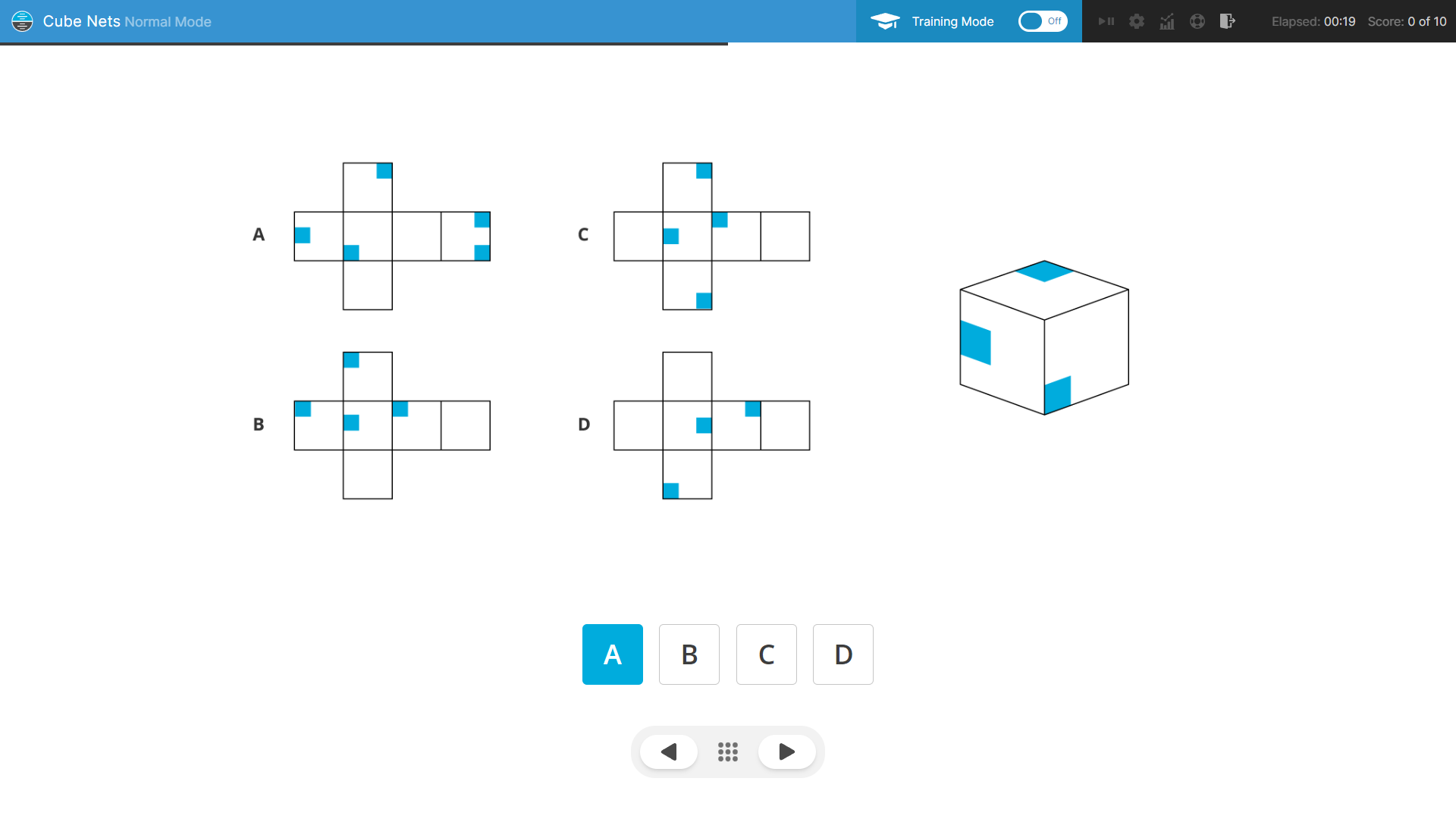
In cube net folding tasks, the candidate is shown a two-dimensional net (an unfolded cube) and must determine which of several three-dimensional cubes it would form when folded. The DLR 3D Cubes (PPT) module presents 40 cube nets over 20 minutes, each with differently designed faces, and the candidate must select the correctly constructed cube from multiple-choice options.
This task requires the candidate to mentally fold the net along its edges, tracking how each face rotates into position and how the patterns on adjacent faces relate to each other in three dimensions. The difficulty increases with the complexity of the face designs and the similarity between the answer options. Cube net folding is a classic measure of spatial visualisation: the multi-step, constructive transformation from two dimensions to three dimensions.
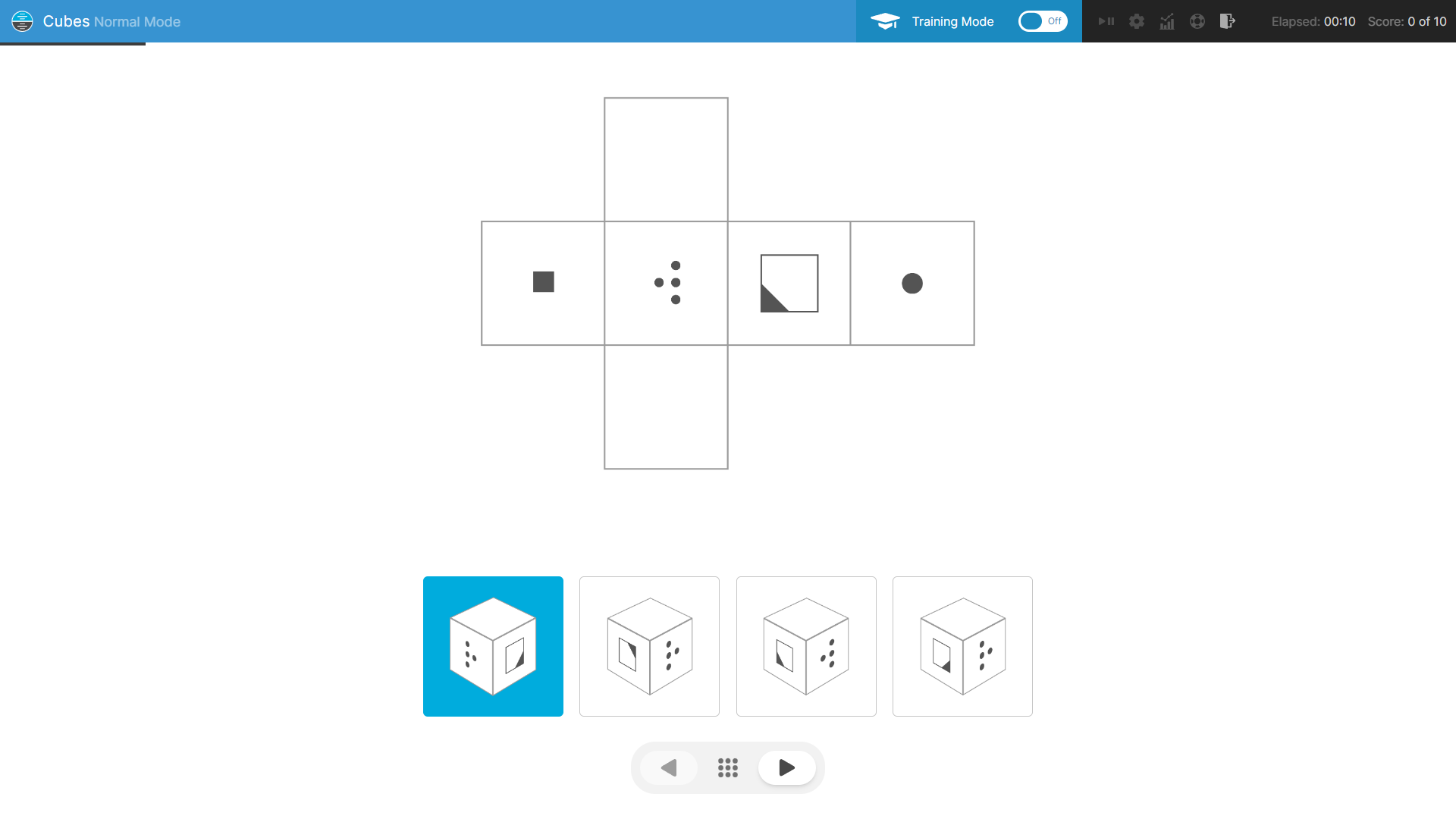
In mental rotation tasks, the candidate compares two three-dimensional objects presented from different viewpoints and determines whether they are the same object or different. The VTS Adaptive Spatial Ability Test (A3DW) presents cubes with differently designed faces and requires the candidate to identify which cube corresponds to another presented from an alternative perspective. With 10 questions in 5 minutes, the A3DW is adaptive, meaning difficulty adjusts based on the candidate's performance.
This format requires the candidate to mentally rotate one cube to match the orientation of another, comparing the visible faces to confirm or reject a match. The adaptive nature of the A3DW means that strong performers are presented with increasingly difficult comparisons (greater angular differences, more similar face designs), whilst the test calibrates to each candidate's ability level.
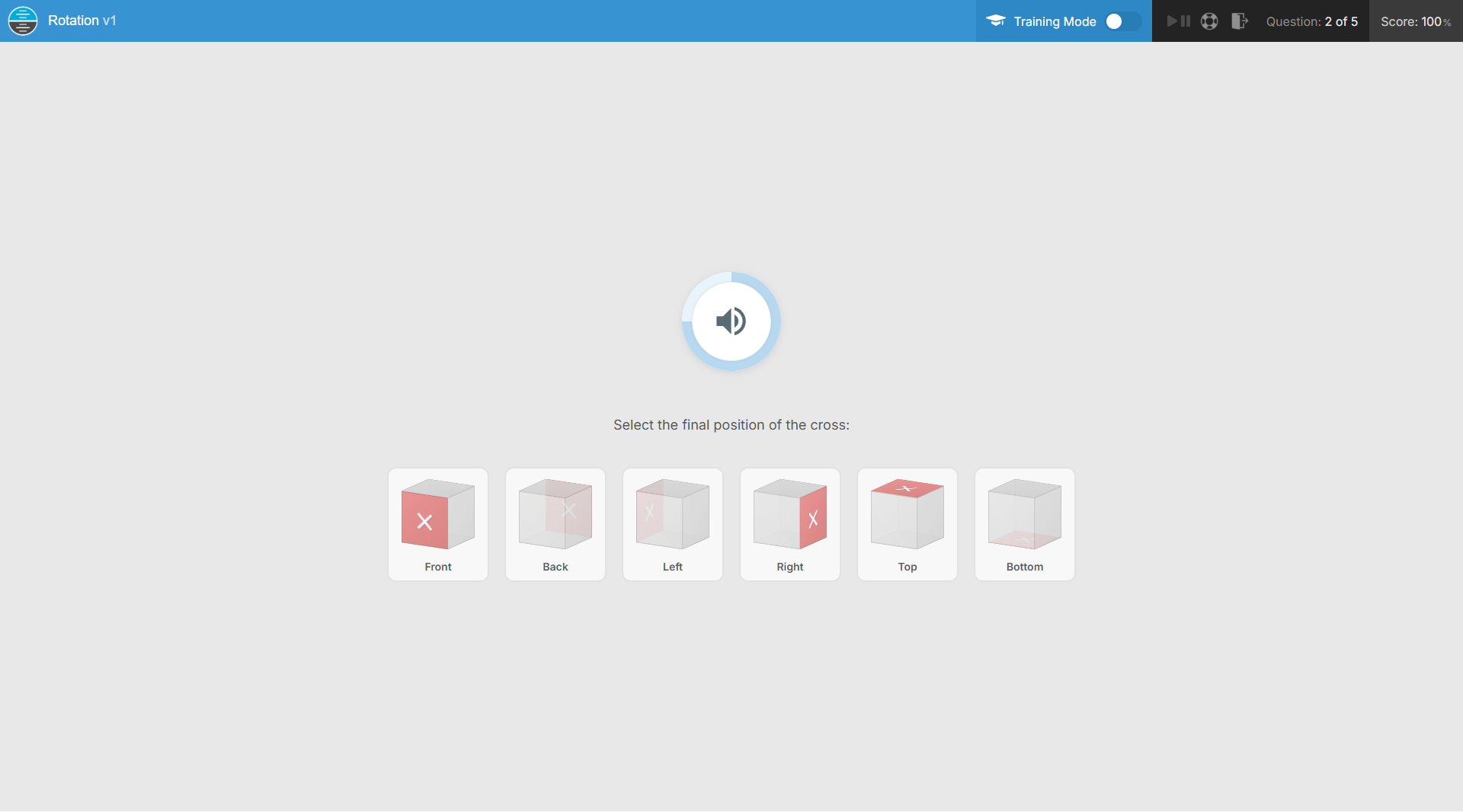
The DLR Rotating Cubes (ROT) module presents a unique challenge: the candidate sees a cube with one coloured or marked face, then listens to an audio narration describing a series of rotations applied to the cube (for example, "rotate right, then rotate forward, then rotate left"). The candidate must mentally track the cube's orientation through each sequential rotation and identify the final position of the marked face from multiple-choice options.
This module is distinctive because it combines spatial transformation with auditory processing: the rotation instructions are spoken, not written, requiring the candidate to hold the verbal instructions in working memory whilst simultaneously performing the mental rotations. The number and complexity of the rotations increases with difficulty. This cross-modal demand (auditory input, spatial processing) is particularly relevant to aviation, where the pilot frequently receives verbal instructions (from ATC or crew) that require spatial interpretation and action.
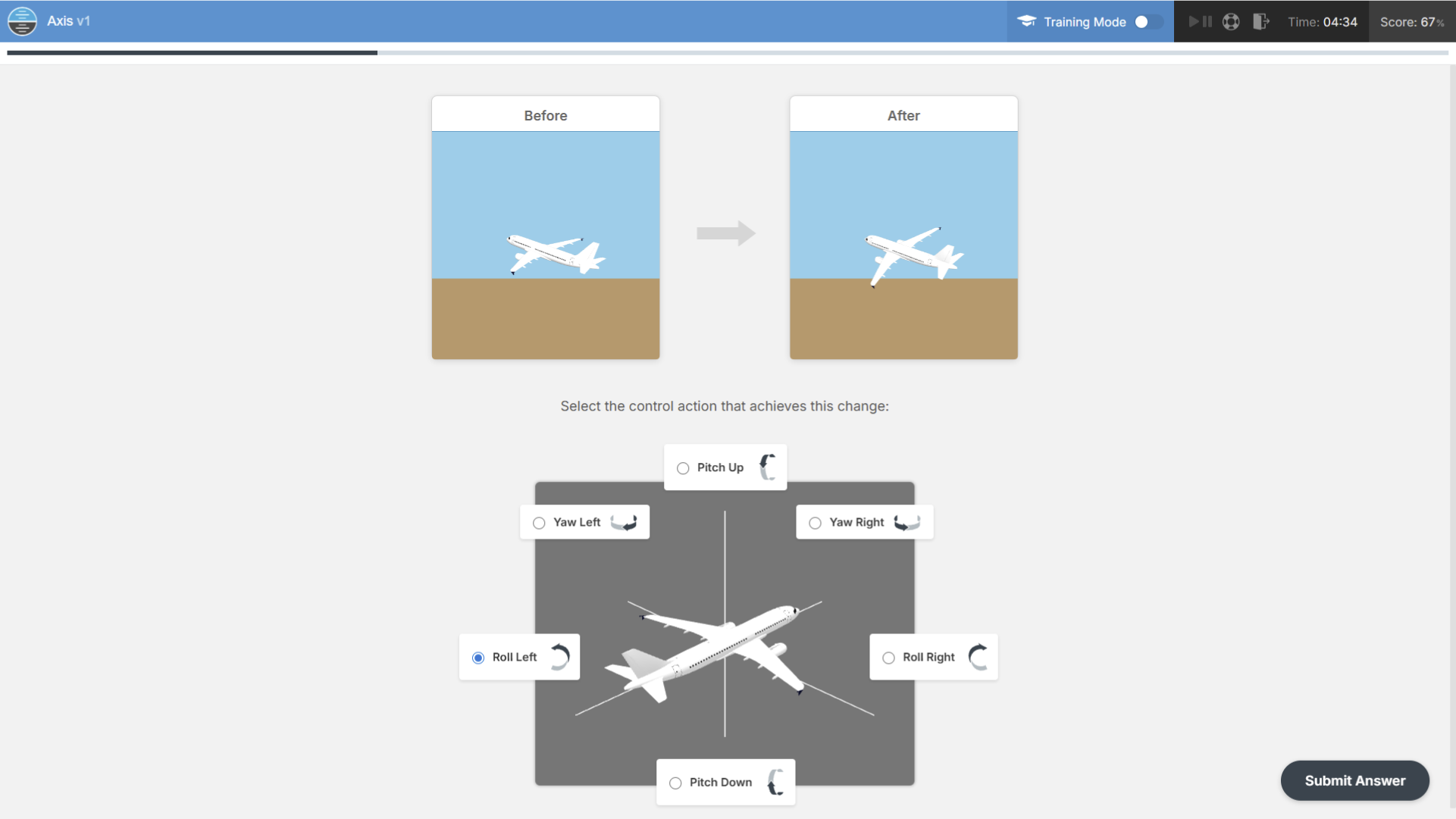
The VTS Pilot's Spatial Test (PST) presents two images of an aircraft rendered in three-dimensional space, each showing a different attitude (pitch, bank, and heading). The candidate must determine the control actions required to change the aircraft from the first attitude to the second.
This is the most aviation-specific spatial transformation module. The candidate must compare two three-dimensional orientations, determine the differences in pitch, bank and heading, and identify the sequence of control inputs that would produce the required change. This directly mirrors the cognitive process a pilot uses when comparing the current aircraft attitude to the desired attitude and determining the correct control inputs, a process that occurs continuously during instrument flying.
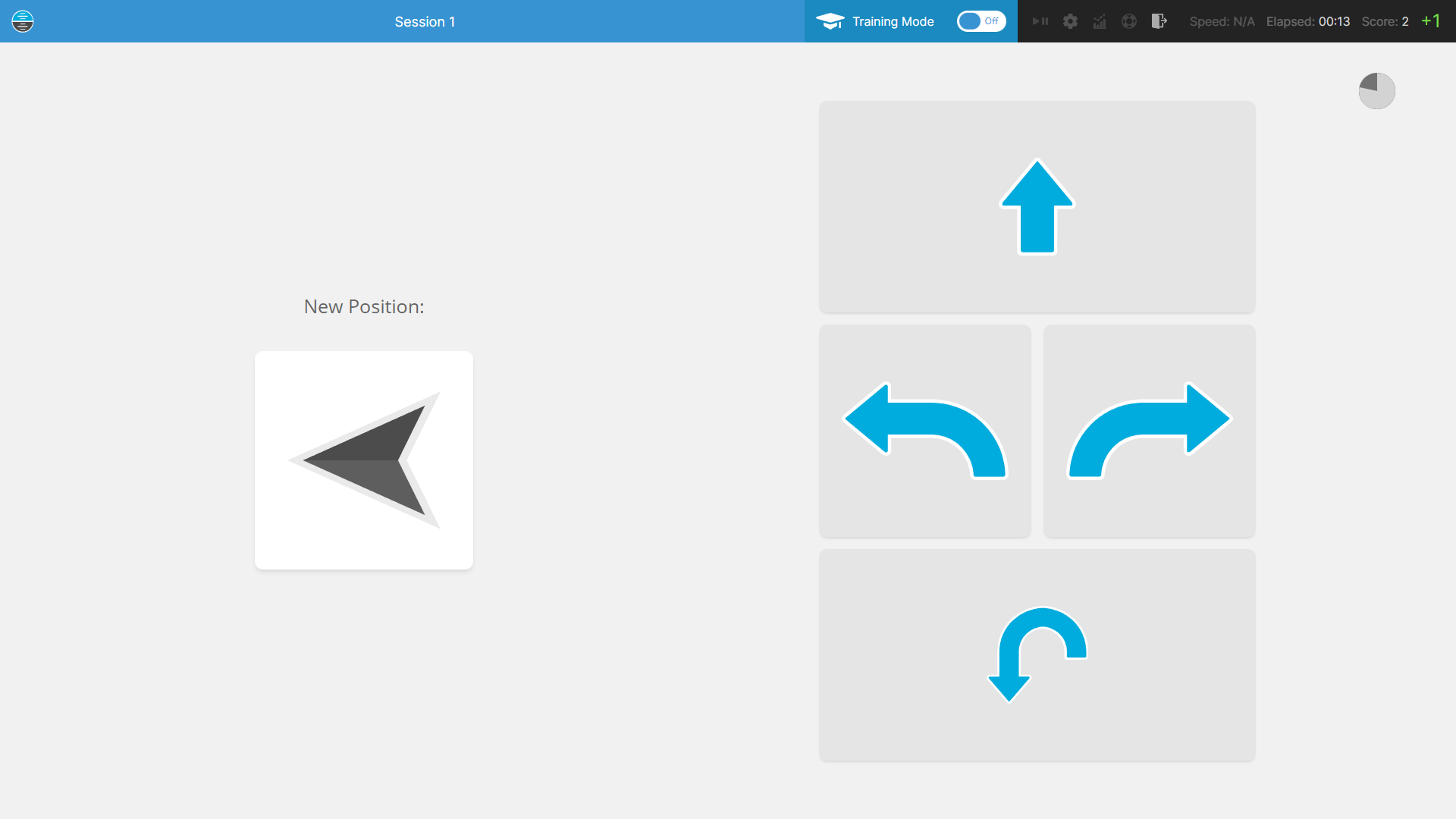
The Aon Sense of Direction (scales nav) module presents an arrow oriented in a particular direction and requires the candidate to select the manoeuvre that would achieve that orientation. The candidate must determine which sequence of turns or movements would result in the displayed heading, performing the spatial transformation in reverse: working backwards from the desired outcome to the required action.
At only 1 minute, this is the shortest spatial transformation module, demanding rapid spatial reasoning under significant time pressure. The emphasis is on speed of spatial processing rather than the complexity of the transformation, making it a measure of speeded rotation rather than the more deliberate spatial visualisation assessed by cube-based modules.

The CBAT Directions & Distances (DAD) module requires the candidate to combine spatial and mathematical reasoning to identify relative distances and directions from various positions. The candidate must interpret positional information and apply logical reasoning to determine correct answers, transforming between different spatial reference frames.
The CBAT Instrument Comprehension Test (INSC) requires the candidate to interpret standard aviation instruments and match them with three-dimensional images, transforming two-dimensional instrument readings into three-dimensional spatial understanding. This module also appears in the Spatial Awareness article, as it assesses both positional understanding and perspective transformation.
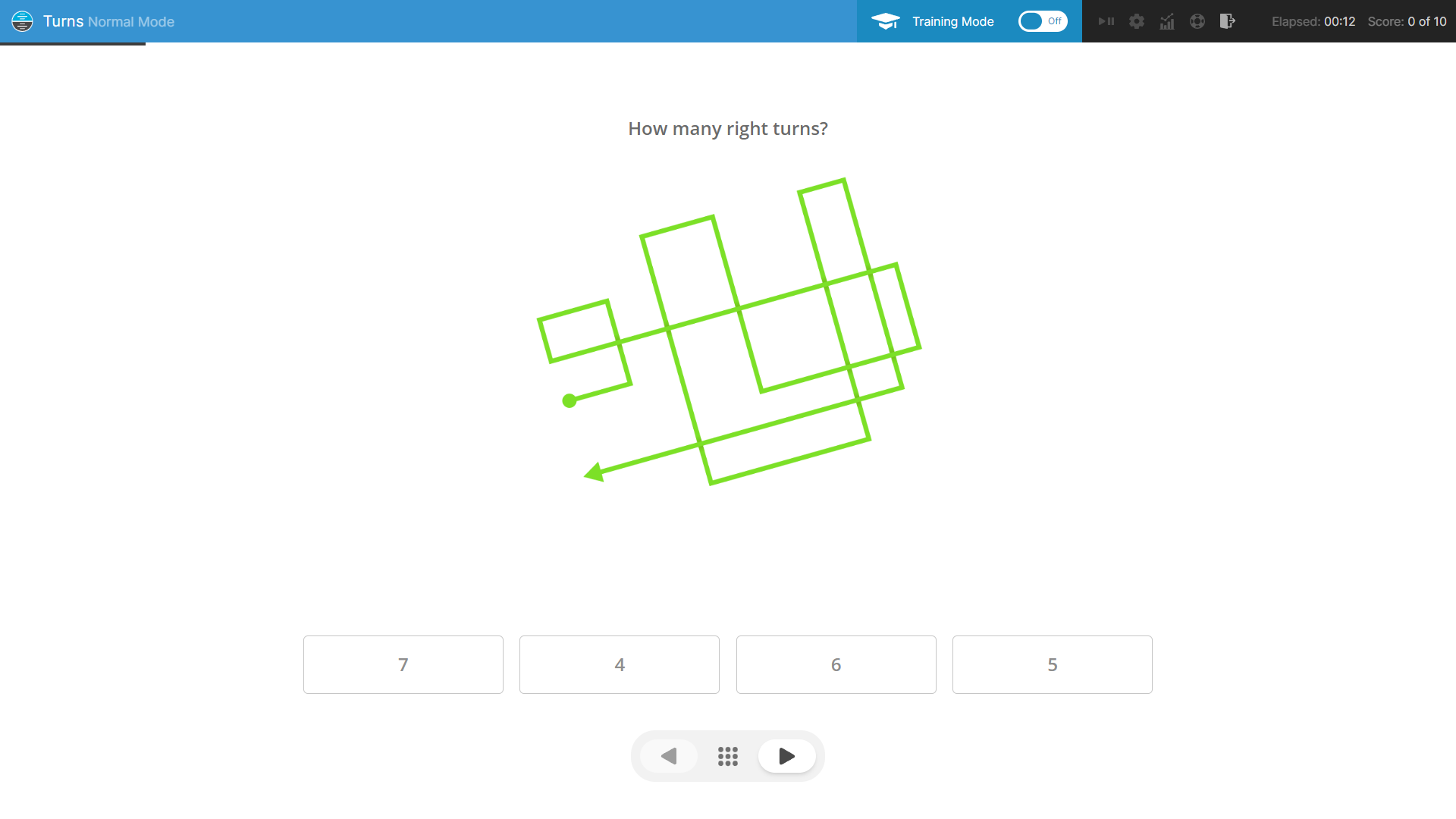
The DLR Path Figure Test (WFG) presents randomly generated line drawings depicting routes with multiple turns. The candidate must examine each route and correctly identify the number of left or right turns it contains. This requires mentally tracing the path, maintaining and updating the current heading at each turn, and classifying each direction change correctly.
The transformation demand lies in tracking cumulative directional changes: as the route progresses, the candidate must continuously update their mental heading, which means that a turn that is physically to the right on the page may be a left turn relative to the direction of travel. This module also appears in the Spatial Awareness article, as it assesses both directional tracking and spatial transformation.
Spatial Transformation is assessed in the following pilot aptitude test systems:
The table below outlines the modules that assess Spatial Transformation in each test system, linking each to the relevant preparation activity in our software.
| Assessment | Module | Transformation Type | Format | Activity |
|---|---|---|---|---|
| Aon (Cut-e) | Sense of Direction (scales nav) | Manoeuvre Selection | Infinite, 1 min | Sense of Direction |
| CBAT / CFAST / MACTS | Directions & Distances (DAD) | Positional Transformation | TBC | Positions |
| CBAT / CFAST / MACTS | Instrument Comprehension Test (INSC) | Perspective Transformation | TBC | Instrument Comprehension |
| DLR | 3D Cubes (PPT) | Cube Net Folding | 40 questions, 20 min | Cubes |
| DLR | Rotating Cubes (ROT) | Auditory-Guided Rotation | 30 questions | Rotation |
| DLR | Path Figure Test (WFG) | Route Tracing | 16 questions, 10 min | Turns |
| Vienna Test System | Pilot's Spatial Test (PST) | Attitude Change | Infinite, ~10 min | Axis |
| Vienna Test System | Adaptive Spatial Ability Test (A3DW) | Mental Rotation | 10 questions, 5 min | Cubes Cube Nets |
Having identified the modules relevant to your assessment, you can navigate directly to the corresponding activities within our software.
Our software organises activities by the type of assessment you are preparing for, the skill being evaluated, and the specific airline, flying school or cadet scheme you are applying to. This means you do not need to manually cross-reference the table above; the relevant Spatial Transformation activities will already be included in your tailored preparation.
To find the activities relevant to you, navigate to one of the following within the software:
- Activities by Aptitude Test
- If you know which test system your assessment uses. For example, to find Spatial Transformation activities for the DLR, navigate to Activities by Aptitude Test and select DLR.
- Activities by Skill
- If you want to focus specifically on Spatial Transformation across all test systems. Navigate to Activities by Skill and select Spatial Transformation to see every relevant activity.
- Activities by Airline, Flying School or Cadet Scheme
- If you know where you are applying but not which test system is used. Navigate to Activities by Airline or Activities by Flying School and select your chosen organisation. The software will include the appropriate Spatial Transformation activities alongside all other relevant preparation.
If you have created a Preparation Strategy, the relevant Spatial Transformation activities will already appear in your Focus Activities; no additional navigation is required.
Spatial Transformation is closely associated with several other competencies assessed in pilot aptitude testing. Candidates preparing for Spatial Transformation modules may also benefit from developing the following related skills:
Academic Sources referenced in this KB Article
The following academic sources were consulted in the preparation of this article:
[1] Shepard, R. N., & Metzler, J. (1971). Mental rotation of three-dimensional objects. Science, 171(3972), 701-703.
[2] Carroll, J. B. (1993). Human Cognitive Abilities: A Survey of Factor-Analytic Studies. Cambridge University Press.
[3] Hunter, D. R., & Burke, E. F. (1994). Predicting aircraft pilot-training success: A meta-analysis of published research. The International Journal of Aviation Psychology, 4(4), 297-313.
[4] Endsley, M. R. (1995). Toward a theory of situation awareness in dynamic systems. Human Factors, 37(1), 32-64.
With a section dedicated to Spatial Transformation, our one-of-a-kind software represents the ultimate way for you to get prepared.
By leveraging our cutting-edge software, including those unique features and extensive guidance not offered elsewhere, you can immerse yourself in realistic simulations, master those competencies assessed, and familiarise yourself with the methods and mechanisms of assessment.
Our software is backed by our meticulous attention to detail and deep expertise as experienced commercial pilots, empowering pilot applicants to approach their assessments with confidence and helping to propel them to supersonic levels of success.
Start using our incredible preparation software immediately on PC, Mac, iOS and Android by purchasing a subscription:
Buy Preparation SoftwareWith increasing prevalence and awareness of computerised pilot aptitude testing in pilot assessments, it's never been more important to ensure that you can fly past the competition. This is made easy with features unique to our software:












Discover the key advantages of using our cutting-edge software:
How can I prepare for my Spatial Transformation pilot assessment?
The best way to prepare for your Spatial Transformation pilot assessment is with our latest industry-leading software, developed over 5 years by experienced airline pilots. With realistic exam simulations, personalised Preparation Strategies which guide you through your preparation, immersive Explainer Videos, customisable Training Modes that manipulate your simulation environments, comprehensive Instruction and Guidance, and extensive performance feedback which incorporates unique features such as Predictive Scoring, a Strength & Weakness Map and Colour Coding, our unique software will help you to accelerate improvement of your problem areas and fly through each part of the Spatial Transformation assessment. The software runs in a web browser, is compatible with laptop, desktop, tablet and smartphone, and is complimented with extensive support, provided from 9AM to 9PM GMT. To purchase a subscription to our software and start preparing for your Spatial Transformation pilot assessment, click here!
What is the pass mark for the Spatial Transformation pilot assessment?
Many pilot aptitude tests do not have a fixed threshold (or pass mark), but rather indicate the pilot candidate's overall performance and suitability using a variety of different methods - many of which are emulated within our software. Rather than worrying about a specific pass mark, the better approach is to focus on comprehensive preparation that maximizes your chances of success within each part of the Spatial Transformation pilot assessment. Our industry-leading pilot preparation software provides that comprehensive preparation, helping you to develop the essential sklls, familiarity with assessment and confidence needed to perform at your best. If you have any questions about the Spatial Transformation pilot assessment, please contact us.
How often is your Spatial Transformation assessment preparation software updated?
Our pilot assessment preparation software is continuously updated, with daily improvements based on feedback from hundreds of monthly users. Developed by experienced airline pilots, the simulations provided within our unique software faithfully reflect the Spatial Transformation pilot assessment, ensuring that you have the most current and comprehensive preparation. To see the recent updates to our preparation software, please visit our Updates page.
What support is available with your Spatial Transformation assessment preparation software?
With our own industry experiences, we understand the pressures and stresses that come with preparing for pilot assessments. When you use our software to prepare for your Spatial Transformation pilot assessment, you'll have access to exceptional support and guidance from our team of experienced airline pilots, provided between 9AM and 9PM GMT. This support sets us apart, helping you to develop the skills, knowledge, and confidence needed to approach your assessment feeling completely ready to demonstrate your true potential and fly past the competition at every stage of the Spatial Transformation pilot assessment.
How quickly can I prepare for my Spatial Transformation pilot assessment with this software?
If you'd like to start preparing for the Spatial Transformation assessment, you may start using our software within as little as a few minutes. We offer access to our preparation software for 7 days, 1 month or 3 months, and provide the opportunity to purchase additional time. This ensures you can work through the comprehensive simulations, and benefit from our guidance at your own pace, with support available whenever you need it. To get started, choose a subscription duration to our preparation software, create an account and complete your purchase - then, login and begin your preparation. The entire process typically takes between 2-3 minutes, with secure payment by credit or debit card securely processed with Stripe or PayPal.
Feature-packed and one-of-a kind preparation software for your assessment.
Regularly updated, realistic and infinite simulations of aptitude tests.
Instant activation, fast support and uniquely in-depth guidance.