

 Maths for Pilots
 Science for Pilots
 English Language for Pilots
 Verbal Reasoning for Pilots
 Numerical Reasoning for Pilots
 Mechanical Reasoning for Pilots
 ATPL Knowledge for Pilots
 WhatsApp
 Facebook Chat
 Email
Email









































If you don't have time to read this article but would like to know whether our software can help - it can. You can buy access to our software and get started immediately, 365 days-a-year.
Buy Preparation SoftwareLogic describes the cognitive ability to analyse information systematically, identify rules and relationships, and apply structured reasoning to solve problems. In the context of pilot aptitude testing, Logic is assessed as a distinct competency that encompasses elements of both Deductive Reasoning (applying known rules to reach specific conclusions) and Inductive Reasoning (discovering rules from observed patterns), often within tasks that demand sustained concentration and rapid information processing. Whilst deductive and inductive reasoning are assessed as separate skills in some test systems, Logic modules tend to combine these reasoning processes within a single task. A candidate may need to observe a set of rules (inductive), retain them, and then apply those rules accurately across hundreds of stimuli over an extended period (deductive). This combination of rule discovery, rule retention and sustained rule application under time pressure makes Logic a particularly demanding competency to assess and to develop.
Logic is most prominently assessed in the DLR pilot assessment, which includes three dedicated modules that each test a different facet of logical thinking. It also features in the Aon (Cut-e), Arctic Shores and Sova assessments. Candidates preparing for any of these test systems will benefit from understanding how logical reasoning is assessed and how to approach each task type effectively.
Further Reading on the Psychology of Logical Thinking
Executive Function and Logical Reasoning
Modern cognitive psychology understands logical reasoning not as a single ability but as an orchestration of several executive functions: the higher-order cognitive processes that control and regulate other cognitive activities. The key executive functions involved in logical reasoning include working memory (holding and manipulating information), inhibitory control (suppressing irrelevant or incorrect responses), and cognitive flexibility (switching between rules or strategies) [1].
Pilot aptitude tests that assess Logic are, in effect, measuring the efficiency and coordination of these executive functions under demanding conditions. A candidate who can hold multiple rules in working memory, suppress the tendency to apply an incorrect rule, and switch flexibly between rule sets as conditions change will perform well on Logic modules. These same executive functions are critical for cockpit performance, where pilots must continuously manage competing information streams, apply the correct procedure for the current situation, and adapt when circumstances change.
The Distinction Between Logic and Reasoning Skills
Candidates sometimes ask how Logic differs from Deductive Reasoning and Inductive Reasoning. The distinction lies primarily in how the skills are assessed rather than in fundamental cognitive differences. Deductive Reasoning modules typically present a self-contained problem that can be solved in a single step or short sequence. Inductive Reasoning modules typically require the candidate to discover a pattern from a set of examples. Logic modules, by contrast, tend to combine both processes within tasks that are longer, more sustained, and more demanding of working memory and concentration [2].
In the DLR assessment, for example, the Triangles module requires the candidate to identify progression rules (inductive) and then apply those rules to respond correctly to 400 stimuli over an extended period (deductive, with sustained concentration). This blended demand is what distinguishes Logic as a separate competency in pilot aptitude testing.
Logical thinking is used in everyday life whenever a person analyses a situation systematically, identifies the rules governing it, and applies those rules to reach a conclusion or make a decision. The following are common examples that closely relate to the logical abilities assessed in pilot aptitude testing.
- Solving a sliding puzzle or strategy game:
- Games such as Rush Hour, Sokoban or sliding tile puzzles require the player to analyse the current state of the board, identify the constraints, and plan a sequence of moves that will achieve the goal. The player must think several steps ahead, evaluating the consequences of each potential move before committing. This forward planning under constraints is directly analogous to the planning tasks used in Logic modules, where candidates must manoeuvre objects through grids or construct solutions within defined rules.
- Debugging a process or workflow:
- When a process produces an unexpected result, logical thinking is required to trace back through the steps, identify where the deviation occurred, and determine why. A software developer debugging code, an engineer diagnosing a system fault, or a manager identifying a bottleneck in a workflow all use the same structured analytical approach: observe the symptoms, identify the rules that should apply, determine which rule has been violated, and correct the error. This systematic troubleshooting mirrors the stimulus-response mapping tasks used in pilot aptitude tests.
- Learning and applying the rules of a complex board game:
- A game with multiple interacting rules (such as chess, or a complex card game with conditional effects) requires the player to hold several rules in mind simultaneously and apply the correct one to each specific situation. When the game state changes, the player must update their understanding and switch to the appropriate rule. This combination of rule retention, rule application, and rule switching is a core component of what Logic modules assess.
- Interpreting a timetable with conditional information:
- Reading a bus or train timetable that includes exceptions ("does not run on bank holidays," "calls at this station on Mondays only") requires the reader to apply conditional logic to the specific day and time to determine the correct departure. The reader must identify which conditions apply, evaluate them against the current situation, and reach the correct conclusion. This is a practical application of the same conditional reasoning assessed in Logic modules.
Further Reading on Working Memory and Logical Performance
Research has consistently demonstrated that working memory capacity is one of the strongest predictors of performance on logical reasoning tasks [3]. Working memory is the cognitive system responsible for temporarily holding and manipulating information during complex cognitive activities. When a person solves a logic problem, they must simultaneously hold the rules in mind, track the current state of the problem, evaluate potential next steps, and compare outcomes.
The challenge is that working memory has a limited capacity (typically estimated at 4 ± 1 items for most adults). When a logic task requires the individual to hold more information than their working memory can accommodate, performance degrades: they begin to forget rules, lose track of the problem state, or apply the wrong rule to the current stimulus.
This is precisely why pilot aptitude test Logic modules are designed to be demanding. Tasks like the DLR Signal Processing module present changing rule sets across 300 questions, deliberately taxing the candidate's working memory. Candidates who can manage their working memory efficiently (for example, by chunking related information or developing systematic strategies for tracking rule changes) will outperform those who rely on raw cognitive capacity alone.
The everyday examples above share a common structure: rules must be identified, retained, and applied systematically to specific situations, often under time pressure and with the added demand of adapting when conditions change. In aviation, these demands are present throughout every phase of flight.
- Conditional checklist execution:
- Many aircraft checklists contain conditional items: "If anti-ice is required, select engine anti-ice ON." The pilot must evaluate the current conditions, determine whether the condition is met, and apply the appropriate action. In abnormal and emergency checklists, the conditional logic becomes more complex, with branching paths that depend on observed system states. Following these branching procedures quickly and accurately under stress is a direct application of logical thinking.
- Airspace rule application:
- Controlled airspace is governed by rules that vary according to airspace class, altitude, weather conditions, time of day and aircraft type. A pilot transiting through multiple airspace types must continuously update which set of rules applies, apply those rules to their specific situation, and comply accordingly. Failure to apply the correct rule to the correct airspace can result in infringements with serious safety and regulatory consequences.
- Systems logic and automation management:
- Modern aircraft systems operate according to defined logic: if a certain condition is detected, the system will respond in a specific way. Pilots must understand this logic to anticipate system behaviour, verify that the automation is doing what it should, and intervene when it is not. When multiple systems interact (for example, autothrust, autopilot and flight management systems responding simultaneously to a change in conditions), the pilot must trace through the logical chain to understand and predict the combined output.
- Priority and sequencing decisions:
- When multiple tasks compete for attention (a radio call, a system caution, a weather deviation, an approach briefing), the pilot must apply a logical framework to determine the correct priority and sequence. The well-known "aviate, navigate, communicate" hierarchy is a logical rule that governs task priority, but within each category, further logical decisions must be made about which specific action takes precedence.
Rotary-wing operations present additional contexts in which logical thinking is exercised:
- Decision gate frameworks:
- Many helicopter operations use decision gate frameworks: predefined points at which the pilot must evaluate conditions against criteria and decide whether to continue, modify, or abort the mission. Each gate involves applying conditional logic to the observed situation. For example, a helicopter emergency medical service (HEMS) pilot approaching a scene may apply the rule: "If the landing site is not confirmed clear by ground crew, do not descend below 200 feet." The logic is simple but must be applied precisely and without compromise under time pressure.
- Power management calculations:
- Helicopter power management involves applying a chain of conditional rules: if the temperature is above a certain value, the available power is reduced; if the weight exceeds a certain threshold at the current temperature and altitude, a specific manoeuvre may not be achievable. The pilot must trace through this logical chain to determine the operational limits for each specific situation. An error in this chain of reasoning can lead to exceeding the aircraft's capabilities, with potentially catastrophic results.
- Multi-agency coordination logic:
- Military and emergency helicopter operations frequently involve coordination with multiple agencies, each with their own rules of engagement, operating procedures and communication protocols. The pilot must track which rules apply to which agency, apply the correct protocol for each interaction, and switch between rule sets as they communicate with different parties. This is directly analogous to the rule-switching demands assessed in Logic modules.
- Night vision goggle (NVG) operations:
- NVG operations require the pilot to apply specific rules regarding scan patterns, altitude limitations, lighting conditions and crew communication that differ from day visual flight rules. The pilot must hold these NVG-specific rules in mind alongside the standard operating rules and apply the correct set at all times. The cognitive load of maintaining two parallel rule sets whilst flying in a degraded visual environment is substantial, and relies heavily on the same logical reasoning abilities assessed in pilot aptitude tests.
Logic is assessed in pilot aptitude testing because the professional pilot role demands the continuous application of rules to specific situations under time pressure, often with the added complexity of rules changing as conditions evolve. The combination of rule discovery, rule retention and sustained rule application that Logic modules assess maps directly onto the cognitive demands of cockpit operations.
Professional pilot training involves absorbing and applying large volumes of procedural, regulatory and technical information. Candidates with strong logical thinking abilities are better equipped to understand the structure of this information, see how different rules relate to one another, and apply the correct rule to novel situations encountered during training.
The DLR assessment, which includes three dedicated Logic modules, is specifically designed to assess the candidate's capacity for sustained, rule-based cognitive work. Performance on these modules is predictive of how efficiently the candidate will process and apply the rule-heavy content of professional pilot training, from ground school examinations through to simulator assessments.
In operational flying, logical errors (applying the wrong rule, forgetting a rule, or failing to update when rules change) can have immediate safety consequences. The ability to maintain accurate rule application over extended periods, particularly under fatigue and stress, is a critical safety competency.
Research into human error in aviation has identified rule-based errors as a distinct category of mistake, separate from skill-based slips and knowledge-based errors [4]. Rule-based errors occur when the individual applies the wrong rule to the current situation (often because the situation superficially resembles one in which a different rule applies) or when the individual fails to switch to a new rule when conditions change. Logic modules in pilot aptitude testing are designed to assess precisely these vulnerabilities.
A distinguishing feature of Logic modules (particularly those in the DLR assessment) is their length and volume. The DLR Triangles module presents 400 questions across 10 sets. The Signal Processing module presents 300 stimuli with changing rule sets. These are not short, sharp tests of reasoning ability; they are sustained assessments that measure the candidate's capacity to maintain logical accuracy over an extended period.
This design is deliberate. Professional pilots must apply rules accurately not just in moments of peak concentration, but throughout long duty periods, during monotonous cruise phases, and under the cumulative effects of fatigue. Logic modules assess whether the candidate can maintain consistent performance when the task is prolonged and the cognitive demands are relentless.
Further Reading on Rule-Based Performance in High-Reliability Organisations
Three Levels of Cognitive Control
Jens Rasmussen's influential framework for human performance in complex systems distinguishes three levels of cognitive control: skill-based (automatic, habitual responses), rule-based (applying learned rules to recognised situations), and knowledge-based (reasoning from first principles when no applicable rule exists) [5].
Most routine flying operates at the rule-based level: the pilot recognises a familiar situation and applies the appropriate procedure. Logic modules in pilot aptitude testing assess the candidate's capacity for this rule-based performance, including the ability to recognise which rule applies, apply it correctly, and switch to a different rule when the situation changes.
Why Rule-Based Errors are Dangerous
Rasmussen's framework also explains why rule-based errors are particularly dangerous in aviation. Unlike skill-based slips (which are usually caught quickly because they feel wrong) or knowledge-based errors (which the individual recognises as uncertain), rule-based errors are committed with confidence. The pilot believes they are applying the correct rule and may not recognise the error until the consequences become apparent. This is why pilot aptitude tests place such emphasis on assessing the candidate's capacity for accurate, flexible, and sustained rule application.
Computerised pilot aptitude tests evaluate Logic using tasks that require candidates to identify rules, retain them, and apply them accurately and consistently across large numbers of stimuli. The tasks vary in format, but all share the common demand of sustained, rule-based reasoning under time pressure. Logic is most extensively assessed in the DLR, which includes three dedicated modules.
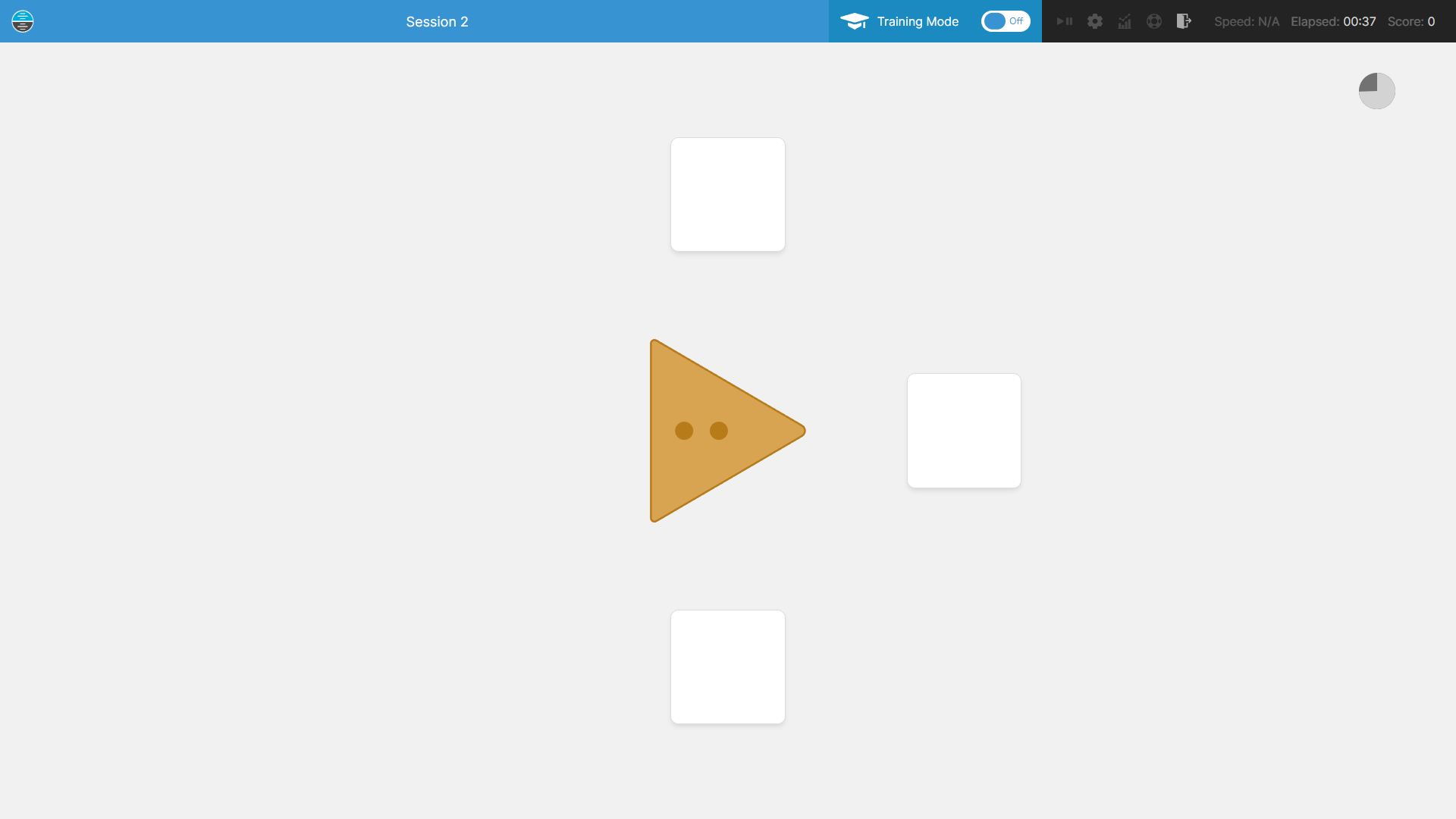
Pattern progression tasks present the candidate with a sequence of visual elements (such as coloured shapes containing varying quantities of markers) that follow defined progression rules. The candidate must identify the rules governing how the elements change from one to the next, and apply those rules to predict or confirm the next element in the sequence.
These tasks are made particularly demanding by their volume: the DLR Triangles module presents 400 questions across 10 sets, requiring the candidate to maintain accurate rule application over an extended period. The rules may change between sets, requiring the candidate to identify the new pattern and adapt accordingly. This sustained demand tests not only logical reasoning but also concentration, working memory and cognitive endurance.
Pattern progression is assessed in the DLR Triangles (SKT) module.
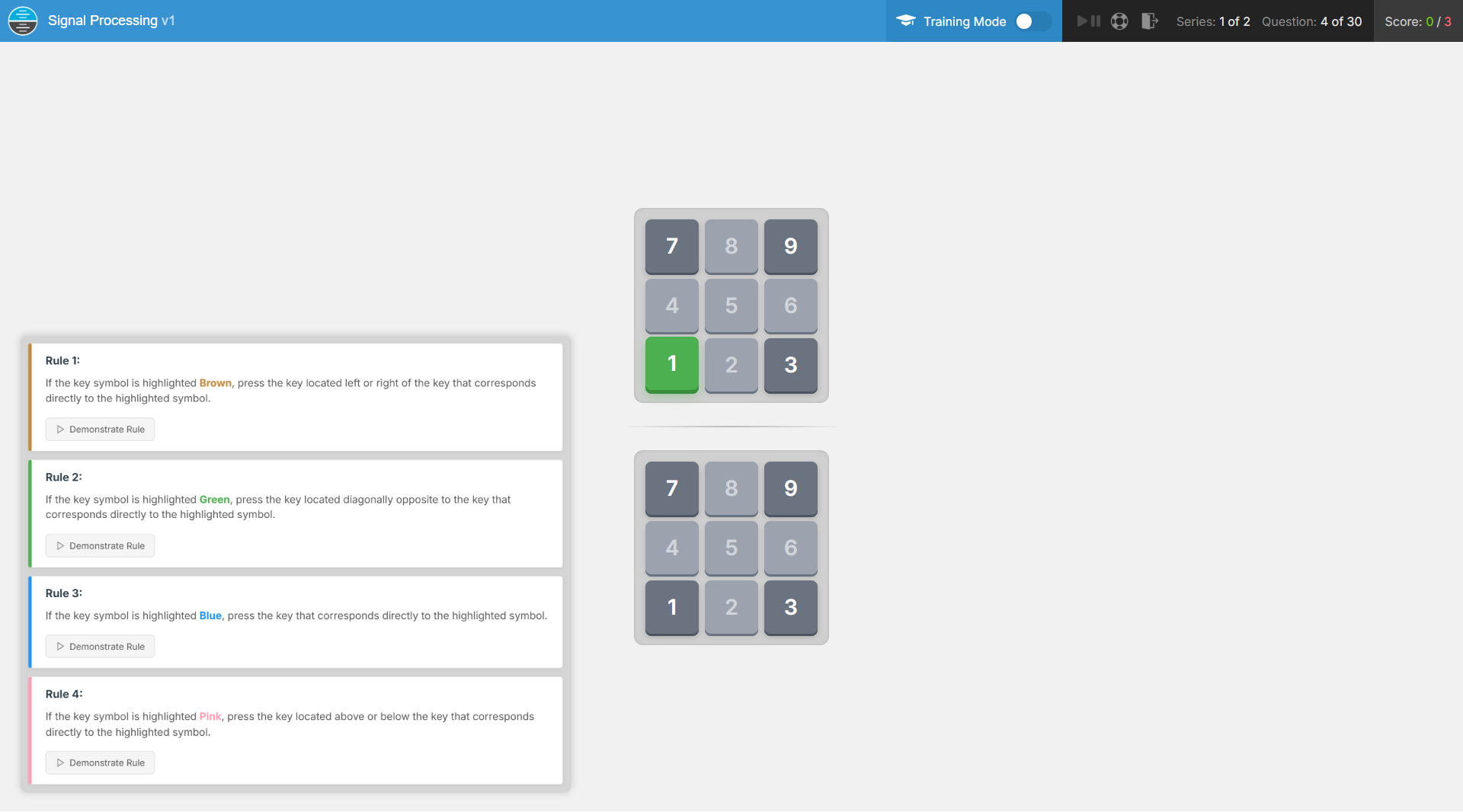
Stimulus-response mapping tasks present the candidate with a set of declared rules that define which response should be given to each type of stimulus. The candidate must memorise the rules and then apply them rapidly and accurately as stimuli are presented. The critical challenge is that the rules change periodically throughout the test, requiring the candidate to discard the previous rule set, learn the new one, and begin applying it without error.
This task type is one of the most cognitively demanding formats in pilot aptitude testing. The combination of rule memorisation, rapid application, and periodic rule switching places extreme demands on working memory and cognitive flexibility. The DLR Signal Processing module presents 300 stimuli with varying rule sets, making it a sustained test of the candidate's ability to maintain logical accuracy under relentless cognitive pressure.
Stimulus-response mapping is assessed in the DLR Signal Processing (DRT) module.
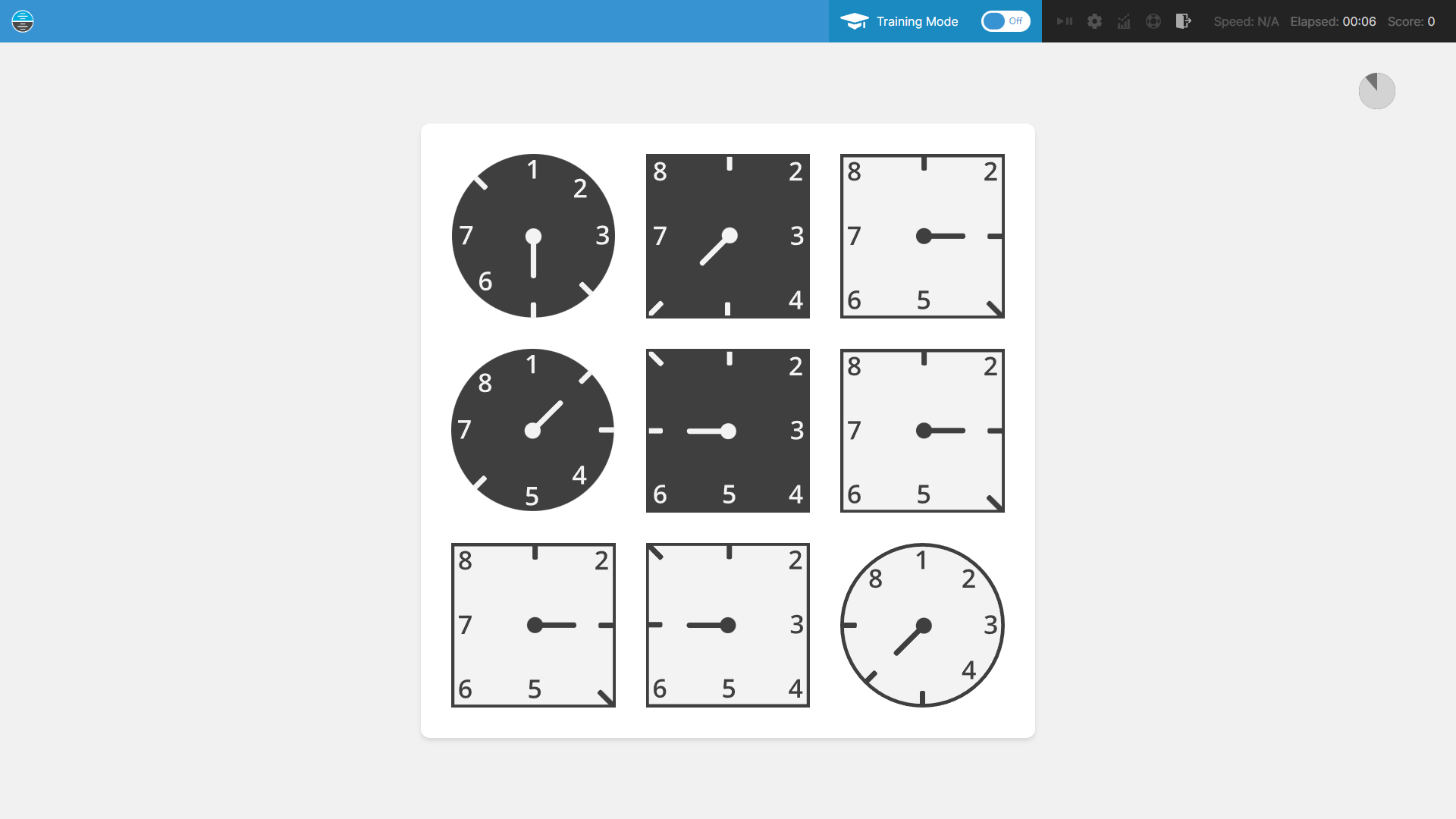
Observation and recall tasks present the candidate with a set of visual elements (such as clock faces with varying features) for a brief period, then require them to answer questions about what was shown. The logical component arises from the need to process and encode the information systematically during the observation period, rather than attempting to memorise every detail.
Candidates who approach this task logically (identifying the distinguishing features, categorising the elements, and using systematic strategies to encode the information) outperform those who rely on raw visual memory. The time constraint (as little as 2.5 seconds per question in the DLR Dials module) means that the candidate must process the information efficiently, using logical frameworks to compress and organise what they observe.
Observation and recall with logical deduction is assessed in the DLR Dials (OWT) module.
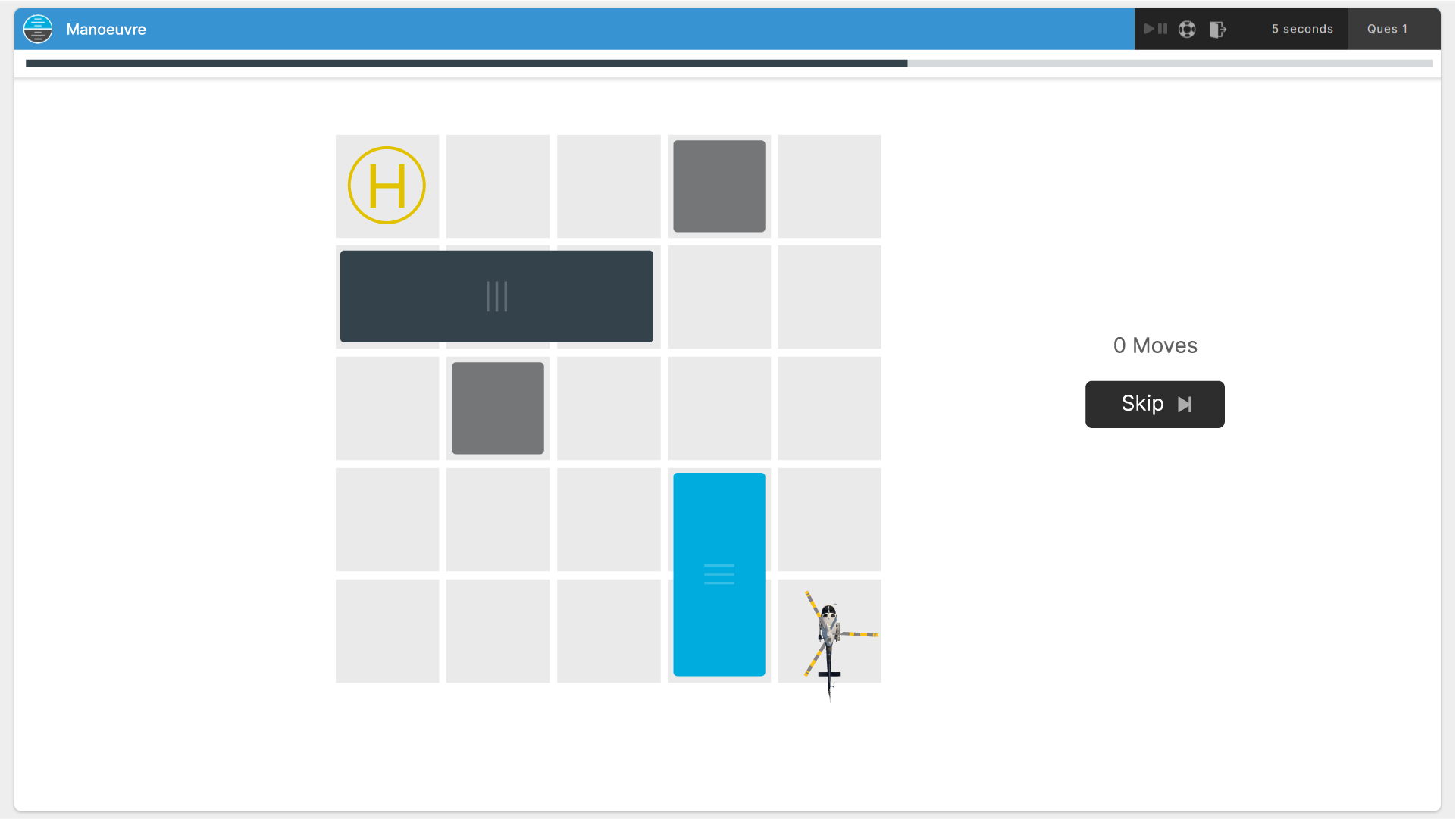
Spatial planning tasks present the candidate with a grid containing a target object and a set of obstacles, and require them to plan a sequence of moves that clears a path for the target to reach an exit. Similar in concept to Rush Hour sliding puzzles, these tasks demand forward planning: the candidate must evaluate the consequences of each potential move before committing, identify the optimal sequence, and execute the solution within a time limit.
The cognitive demand lies in mental simulation: the candidate must "play forward" multiple sequences of moves in their mind, evaluating each against the constraints of the grid, to identify the solution path. This type of planning under constraints is directly relevant to aviation, where pilots must plan actions (routing, sequencing, resource allocation) within defined operational limitations.
Spatial planning is assessed in the Aon Complex Planning Capability (motionChallenge) module.
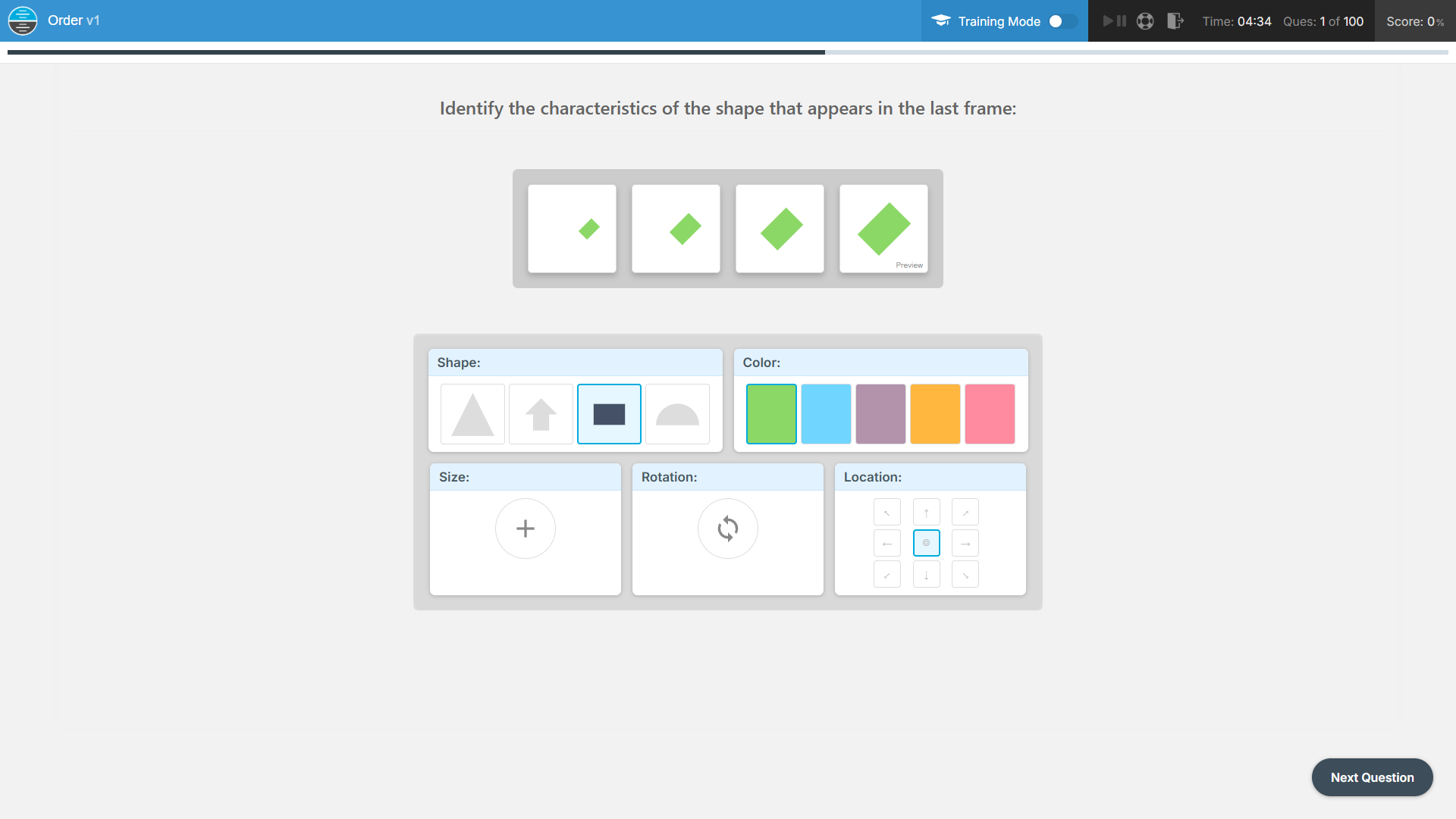
Pattern construction tasks present the candidate with a sequence of frames, each containing a shape that changes according to defined rules (colour, size, orientation, position). The candidate must identify the progression rules and then construct the next element in the sequence by selecting the correct attributes.
Unlike multiple-choice formats where the candidate selects from provided options, pattern construction requires the candidate to generate the answer from scratch. This places a higher demand on the candidate's understanding of the underlying rules, because there are no options to eliminate or use as cues. The candidate must have fully identified the pattern before they can construct the correct response.
Pattern construction is assessed in the Arctic Shores Order module.
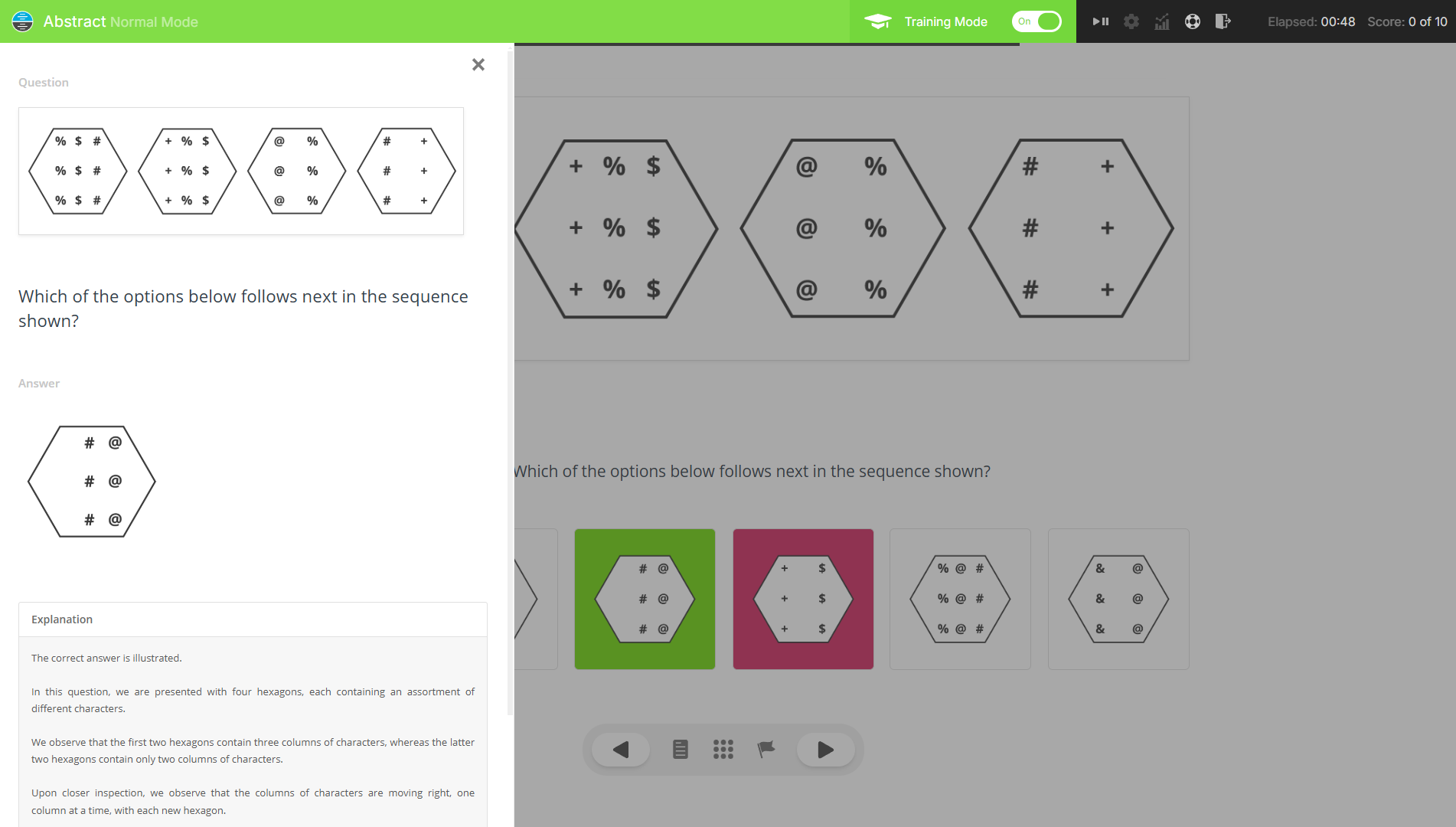
Abstract logical reasoning tasks present the candidate with sequences of geometric elements, symbols and numbers, and require them to identify the relationships governing their arrangement. The candidate must decode complex visual patterns and spatial relationships to determine how elements progress and what should appear next.
This format assesses the breadth of the candidate's logical reasoning: the ability to handle diverse types of relationships (rotation, reflection, numerical progression, colour alternation) within a single task. It also assesses cognitive flexibility, as different questions within the same module may require entirely different types of logical analysis.
Abstract logical reasoning is assessed in the Sova Logical Reasoning module.
Logic shares significant common ground with both Deductive Reasoning and Inductive Reasoning, which are assessed as separate competencies in some test systems. The Aon Inductive-logical Thinking (scales cls) module, for example, is categorised under both Logic and Inductive Reasoning because it requires the candidate to discover rules from visual examples (inductive) and then apply those rules to classify new stimuli (deductive).
Candidates preparing for assessments that include dedicated deductive or inductive reasoning modules will find that Logic preparation strengthens their performance on those modules as well, since all three skills draw on the same underlying executive functions. For detailed breakdowns, see our Deductive Reasoning and Inductive Reasoning Knowledgebase Articles.
Further Reading on Why the DLR Tests are So Long
Measuring Sustained Logical Performance
Candidates preparing for the DLR assessment often ask why the Logic modules contain so many questions (400 in Triangles, 300 in Signal Processing). The answer lies in the distinction between peak performance and sustained performance.
A short test measures the candidate's best performance: what they can achieve when fully focused and fresh. A long test measures their sustained performance: what they can achieve when fatigued, when the task has become monotonous, and when the temptation to disengage or take shortcuts is strongest. Research into vigilance and sustained attention has demonstrated that performance on cognitive tasks declines over time, and that the rate and extent of this decline varies between individuals [6].
Professional pilots must maintain accurate rule application not just during the demanding phases of flight (departure, approach, emergency) but throughout long duty periods that include extended cruise phases. The DLR's long Logic modules are specifically designed to measure whether the candidate can maintain logical accuracy over the kind of sustained, demanding cognitive workload that professional flying requires. Candidates who maintain consistent accuracy throughout these modules demonstrate the cognitive endurance that is valued in pilot selection.
Whilst each pilot aptitude assessment relies on the same underlying principles to evaluate logical thinking, the names and formats of the individual modules differ between test systems.
Effective preparation begins with identifying your assessment, understanding which modules evaluate Logic, and then engaging with targeted practice activities.
Logic is assessed across several major pilot aptitude test systems, with the DLR placing the greatest emphasis on this competency through three dedicated modules. The Aon (Cut-e), Arctic Shores and Sova assessments each include one Logic module.
Select an assessment above to view its dedicated Knowledgebase Article for a full breakdown of all modules, not just those evaluating Logic.
Candidates preparing for the Vienna Test System should also see our Deductive Reasoning Knowledgebase Article, as the VTS Tower of London module assesses closely related planning and logical reasoning abilities.
Once you know which assessment you will be undertaking, use the table below to identify the specific modules within that assessment that evaluate Logic.
Each module targets a particular aspect of logical ability, presented in a different format. The final column indicates which activity within our software corresponds to each module.
| Assessment | Module | Task Type | Format | Activity |
|---|---|---|---|---|
| Aon (Cut-e) | Complex Planning Capability (motionChallenge) | Spatial Planning | Grid Puzzle / Obstacle Manoeuvre | Manoeuvre |
| DLR | Triangles (SKT) | Pattern Progression | Coloured Triangle Sequences | Triangles |
| DLR | Dials (OWT) | Observation & Logical Recall | Clock Face Examination | Dials |
| DLR | Signal Processing (DRT) | Stimulus-Response Mapping | Changing Rule Sets | Signal Processing |
| Arctic Shores | Order | Pattern Construction | Shape Attribute Sequencing | Order |
| Sova | Logical Reasoning | Abstract Logical Reasoning | Geometric Patterns / Symbols | Abstract |
The Aon Inductive-logical Thinking (scales cls) module is also categorised under Logic. See our Inductive Reasoning article for its detailed breakdown and the corresponding Rules activity.
Having identified the modules relevant to your assessment, you can navigate directly to the corresponding activities within our software.
Our software organises activities by the type of assessment you are preparing for, the skill being evaluated, and the specific airline, flying school or cadet scheme you are applying to. This means you do not need to manually cross-reference the table above; the relevant Logic activities will already be included in your tailored preparation.
To find the activities relevant to you, navigate to one of the following within the software:
- Activities by Aptitude Test
- If you know which test system your assessment uses. For example, to find Logic activities for the DLR, navigate to Activities by Aptitude Test and select DLR.
- Activities by Skill
- If you want to focus specifically on Logic across all test systems. Navigate to Activities by Skill and select Logic to see every relevant activity.
- Activities by Airline, Flying School or Cadet Scheme
- If you know where you are applying but not which test system is used. Navigate to Activities by Airline or Activities by Flying School and select your chosen organisation. The software will include the appropriate Logic activities alongside all other relevant preparation.
If you have created a Preparation Strategy, the relevant Logic activities will already appear in your Focus Activities; no additional navigation is required.
Logic is closely associated with several other competencies assessed in pilot aptitude testing. Candidates preparing for Logic modules may also benefit from developing the following related skills:
Academic Sources referenced in this KB Article
The following academic sources were consulted in the preparation of this article:
[1] Miyake, A., Friedman, N.P., Emerson, M.J., Witzki, A.H., Howerter, A. & Wager, T.D. (2000). The Unity and Diversity of Executive Functions and Their Contributions to Complex "Frontal Lobe" Tasks: A Latent Variable Analysis. Cognitive Psychology, 41(1), 49-100.
[2] Evans, J.St.B.T. (2002). Logic and Human Reasoning: An Assessment of the Deduction Paradigm. Psychological Bulletin, 128(6), 978-996.
[3] Kyllonen, P.C. & Christal, R.E. (1990). Reasoning Ability Is (Little More Than) Working-Memory Capacity?! Intelligence, 14(4), 389-433.
[4] Reason, J. (1990). Human Error. Cambridge University Press.
[5] Rasmussen, J. (1983). Skills, Rules, and Knowledge; Signals, Signs, and Symbols, and Other Distinctions in Human Performance Models. IEEE Transactions on Systems, Man, and Cybernetics, SMC-13(3), 257-266.
[6] Warm, J.S., Parasuraman, R. & Matthews, G. (2008). Vigilance Requires Hard Mental Work and Is Stressful. Human Factors, 50(3), 433-441.
[7] Hunter, D.R. & Burke, E.F. (1994). Predicting Aircraft Pilot Training Success: A Meta-Analysis of Published Research. International Journal of Aviation Psychology, 4(4), 297-313.
[8] Martinussen, M. (1996). Psychological Measures as Predictors of Pilot Performance: A Meta-Analysis. International Journal of Aviation Psychology, 6(1), 1-20.
With a section dedicated to Logical Reasoning, our one-of-a-kind software represents the ultimate way for you to get prepared.
By leveraging our cutting-edge software, including those unique features and extensive guidance not offered elsewhere, you can immerse yourself in realistic simulations, master those competencies assessed, and familiarise yourself with the methods and mechanisms of assessment.
Our software is backed by our meticulous attention to detail and deep expertise as experienced commercial pilots, empowering pilot applicants to approach their assessments with confidence and helping to propel them to supersonic levels of success.
Start using our incredible preparation software immediately on PC, Mac, iOS and Android by purchasing a subscription:
Buy Preparation SoftwareWith increasing prevalence and awareness of computerised pilot aptitude testing in pilot assessments, it's never been more important to ensure that you can fly past the competition. This is made easy with features unique to our software:












Discover the key advantages of using our cutting-edge software:
How can I prepare for my Logical Reasoning pilot assessment?
The best way to prepare for your Logical Reasoning pilot assessment is with our latest industry-leading software, developed over 5 years by experienced airline pilots. With realistic exam simulations, personalised Preparation Strategies which guide you through your preparation, immersive Explainer Videos, customisable Training Modes that manipulate your simulation environments, comprehensive Instruction and Guidance, and extensive performance feedback which incorporates unique features such as Predictive Scoring, a Strength & Weakness Map and Colour Coding, our unique software will help you to accelerate improvement of your problem areas and fly through each part of the Logical Reasoning assessment. The software runs in a web browser, is compatible with laptop, desktop, tablet and smartphone, and is complimented with extensive support, provided from 9AM to 9PM GMT. To purchase a subscription to our software and start preparing for your Logical Reasoning pilot assessment, click here!
What is the pass mark for the Logical Reasoning pilot assessment?
Many pilot aptitude tests do not have a fixed threshold (or pass mark), but rather indicate the pilot candidate's overall performance and suitability using a variety of different methods - many of which are emulated within our software. Rather than worrying about a specific pass mark, the better approach is to focus on comprehensive preparation that maximizes your chances of success within each part of the Logical Reasoning pilot assessment. Our industry-leading pilot preparation software provides that comprehensive preparation, helping you to develop the essential sklls, familiarity with assessment and confidence needed to perform at your best. If you have any questions about the Logical Reasoning pilot assessment, please contact us.
How often is your Logical Reasoning assessment preparation software updated?
Our pilot assessment preparation software is continuously updated, with daily improvements based on feedback from hundreds of monthly users. Developed by experienced airline pilots, the simulations provided within our unique software faithfully reflect the Logical Reasoning pilot assessment, ensuring that you have the most current and comprehensive preparation. To see the recent updates to our preparation software, please visit our Updates page.
What support is available with your Logical Reasoning assessment preparation software?
With our own industry experiences, we understand the pressures and stresses that come with preparing for pilot assessments. When you use our software to prepare for your Logical Reasoning pilot assessment, you'll have access to exceptional support and guidance from our team of experienced airline pilots, provided between 9AM and 9PM GMT. This support sets us apart, helping you to develop the skills, knowledge, and confidence needed to approach your assessment feeling completely ready to demonstrate your true potential and fly past the competition at every stage of the Logical Reasoning pilot assessment.
How quickly can I prepare for my Logical Reasoning pilot assessment with this software?
If you'd like to start preparing for the Logical Reasoning assessment, you may start using our software within as little as a few minutes. We offer access to our preparation software for 7 days, 1 month or 3 months, and provide the opportunity to purchase additional time. This ensures you can work through the comprehensive simulations, and benefit from our guidance at your own pace, with support available whenever you need it. To get started, choose a subscription duration to our preparation software, create an account and complete your purchase - then, login and begin your preparation. The entire process typically takes between 2-3 minutes, with secure payment by credit or debit card securely processed with Stripe or PayPal.
Feature-packed and one-of-a kind preparation software for your assessment.
Regularly updated, realistic and infinite simulations of aptitude tests.
Instant activation, fast support and uniquely in-depth guidance.