

 Maths for Pilots
 Science for Pilots
 English Language for Pilots
 Verbal Reasoning for Pilots
 Numerical Reasoning for Pilots
 Mechanical Reasoning for Pilots
 ATPL Knowledge for Pilots
 WhatsApp
 Facebook Chat
 Email
Email









































If you don't have time to read this article but would like to know whether our software can help - it can. You can buy access to our software and get started immediately, 365 days-a-year.
Buy Preparation SoftwareReaction Time describes the speed and accuracy with which a person can detect a stimulus and produce the correct response. In pilot aptitude testing, Reaction Time is assessed as the candidate's capacity to perceive visual, auditory or physical stimuli and respond appropriately as quickly as possible, often under conditions that require sustained concentration over extended periods or the discrimination of one stimulus from another. Reaction Time assessments in pilot aptitude testing go beyond simple reflexes. They evaluate a combination of perceptual speed, decision-making under time pressure, and the ability to maintain response accuracy as fatigue or monotony sets in. The specific demands vary between modules, but collectively the types of reaction assessed include:
What distinguishes Reaction Time from other speed-dependent skills is that the emphasis is on the latency between stimulus and response rather than the complexity of the cognitive processing required. The stimuli are typically straightforward to interpret; the challenge lies in detecting them quickly, selecting the correct response, and maintaining that speed and accuracy consistently across many trials.
Further Reading on the Components of Reaction Time
Simple, Choice and Complex Reaction Time
Cognitive psychology distinguishes between several types of reaction time. Simple reaction time involves responding to a single stimulus with a single response (for example, pressing a button whenever a light appears). Choice reaction time involves selecting one of several possible responses depending on which stimulus is presented (for example, pressing a left key for one colour and a right key for another) [1]. Complex reaction time involves responding to stimuli across multiple sensory channels simultaneously, combining visual, auditory and sometimes physical responses.
Pilot aptitude tests primarily assess choice and complex reaction time, as these better reflect the operational demands of flying. In the cockpit, the pilot rarely responds to a single stimulus in isolation; instead, they must discriminate between different warnings, select the appropriate response, and often manage stimuli arriving through multiple channels concurrently. Hick's Law describes the relationship between the number of stimulus-response alternatives and reaction time: as the number of choices increases, reaction time increases logarithmically [2]. This principle explains why multi-stimulus reaction modules (such as the VTS Determination Test) are more demanding than simpler choice reaction tasks.
Reaction time is exercised constantly in daily life, most obviously in situations that require a rapid response to an unexpected event. Braking when a pedestrian steps into the road, catching an object that is about to fall, or stepping aside when someone unexpectedly opens a door are all examples of reaction time in action. In each case, the person must detect the stimulus, identify the appropriate response, and execute it as quickly as possible.
More sustained forms of reaction time are also common. A goalkeeper in football must maintain readiness to react to a shot that could come at any moment, sustaining vigilance over an extended period with only brief, unpredictable moments of high demand. A driver on a long motorway journey must remain alert for brake lights or hazards despite the monotony of the task, a challenge that closely mirrors the sustained vigilance demands of some reaction time modules in pilot aptitude testing. In both cases, the difficulty is not in the reaction itself, but in maintaining the readiness to react quickly and accurately over time.
Reaction time in aviation is rarely about raw reflex speed. It is about the ability to detect, identify and respond to events promptly and correctly, often after extended periods of low-intensity monitoring. The most critical reaction time demands occur during abnormal and emergency situations, where a delayed or incorrect response can have serious consequences.
- Rejected takeoff decision:
- If a malfunction occurs during the takeoff roll, the crew must recognise the problem and decide whether to reject the takeoff or continue. Below V1 (the decision speed), a rejected takeoff is the correct response to certain failures. The time between the onset of the failure and the initiation of the rejection directly affects the stopping distance available. A delayed reaction reduces the margin between the aircraft and the end of the runway. This is one of the most time-critical reaction demands in commercial aviation.
- TCAS Resolution Advisories:
- When the Traffic Collision Avoidance System (TCAS) issues a Resolution Advisory (RA), the crew is expected to respond within 5 seconds. The RA may command a climb, a descent, or a change in vertical rate, and the correct response depends on interpreting the specific advisory displayed. This is a choice reaction task: the pilot must identify the type of RA, select the correct response (which may be counterintuitive if the advisory conflicts with an ATC instruction), and execute it promptly. Delayed or incorrect responses to TCAS RAs have been identified as contributing factors in mid-air conflict incidents.
- Wind shear response:
- If wind shear is encountered during approach or departure, the pilot must react immediately to the changing flight path and airspeed indications. The correct response (typically applying maximum thrust and following the flight director wind shear guidance) must be initiated without delay, as wind shear conditions can cause a rapid loss of altitude if not countered promptly. The pilot must detect the wind shear (through instruments, feel, or a predictive wind shear alert), identify it correctly, and execute the escape manoeuvre within seconds.
- Master warning and caution responses:
- The cockpit alert system presents warnings and cautions that require the crew to identify the alert, determine its significance, and respond appropriately. Master warnings (red) require immediate attention and action; master cautions (amber) require timely awareness and may require subsequent action. The ability to react promptly to these alerts, particularly when they occur during high-workload phases such as approach, is a sustained vigilance demand that continues throughout every flight.
- Engine failure in the hover:
- An engine failure during a helicopter hover requires an immediate response: the pilot must lower the collective to maintain rotor RPM and enter autorotation or, in a multi-engine helicopter, manage the remaining engine to maintain controlled flight. The time available to react is extremely short, often less than two seconds before rotor RPM decays below a recoverable level. This represents one of the most demanding reaction time scenarios in aviation, combining the need for rapid detection with an immediate and precise physical response.
- Tail rotor failure:
- A tail rotor failure in forward flight requires the pilot to recognise the yaw departure and immediately apply the correct control inputs (which vary depending on the type of failure and the phase of flight). A delayed or incorrect response can result in loss of directional control. The pilot must discriminate between different types of tail rotor malfunction (loss of thrust, fixed pitch, runaway) based on the initial symptoms and respond differently to each, making this a choice reaction task under extreme time pressure.
- Wire and obstacle avoidance:
- During low-level helicopter operations, the detection of wires, masts, or other obstacles requires an immediate avoidance response. The time between detection and impact can be very short at low altitude and forward speed, making the speed of the initial avoidance input critical. This is a simple reaction task (detect and avoid), but it occurs within a complex operational environment where the pilot is already managing multiple demands.
Aviation contains specific scenarios where the time between stimulus and response directly determines the outcome. Rejected takeoffs, TCAS responses, engine failure drills, and wind shear encounters all have defined time windows within which the correct action must be initiated. A candidate's baseline reaction time, measured under controlled test conditions, provides an indication of their capacity to meet these operational time constraints.
Importantly, what is assessed is not just raw speed but the combination of speed and accuracy. Responding quickly but incorrectly (for example, selecting the wrong response to a TCAS RA, or applying the wrong control input during an engine failure) can be more dangerous than a slightly slower but correct response. Reaction time modules are designed to capture both dimensions, measuring how quickly the candidate responds and whether they select the correct response [3].
Many reaction time modules are intentionally monotonous. The Aon Reaction Time module presents a repetitive comparison task for 3 minutes, the VTS Vigilance (VIGIL) module requires the candidate to monitor a slowly moving dot for rare, unpredictable jumps over periods of up to 25 minutes, and the CBAT Vigilance Test requires sustained vigilance to detect and clear objects over an extended period. This monotony is not a design flaw; it is a deliberate feature that assesses the candidate's ability to maintain response readiness over time, even when the task is unstimulating.
This directly mirrors the operational demand of monitoring during cruise, where the pilot must remain alert to detect warnings, communication calls, or changes in aircraft state despite long periods of low activity. Research has shown that vigilance decrements (a decline in detection performance over time) are a well-established phenomenon, and that individuals vary in their susceptibility to these decrements [4]. Reaction time modules assess this individual variation.
Reaction Time is assessed across Aon (Cut-e), CBAT / CFAST / MACTS, Vienna Test System and Arctic Shores assessments. Each module approaches the skill differently: the Aon module uses choice reaction with visual comparison, the VTS Determination Test uses multi-stimulus reaction across three sensory channels, the VTS Vigilance module uses a sustained attention paradigm based on the Mackworth Clock, the CBAT Vigilance Test combines sustained monitoring with reactive clearing, and the Arctic Shores Security module introduces a risk-reward dimension alongside reaction speed. This variety means that the specific demands a candidate faces will depend on their assessment, but the underlying competency of rapid, accurate response to stimuli is common to all.
Further Reading on Reaction Time and Pilot Performance
The Speed-Accuracy Trade-off in Aviation
A well-established principle in cognitive psychology is the speed-accuracy trade-off: faster responses tend to be less accurate, and more accurate responses tend to be slower [5]. In pilot aptitude testing, both dimensions are measured, and the optimal strategy is not to maximise speed at the expense of accuracy or vice versa, but to find the fastest response rate that can be sustained without a significant increase in errors.
This trade-off is directly relevant to operational flying. During an emergency, the pilot must act quickly, but an incorrect action taken in haste can compound the problem. The goal is to respond as promptly as the situation requires whilst maintaining the accuracy needed for a correct outcome. Candidates who can sustain a fast, accurate response rate across many trials are demonstrating exactly this capacity.
Computerised pilot aptitude tests evaluate Reaction Time by presenting stimuli and measuring how quickly and accurately the candidate responds. The specific format varies between modules, ranging from simple visual comparison tasks through to complex multi-channel stimulus-response paradigms. All modules measure both speed and accuracy of response.
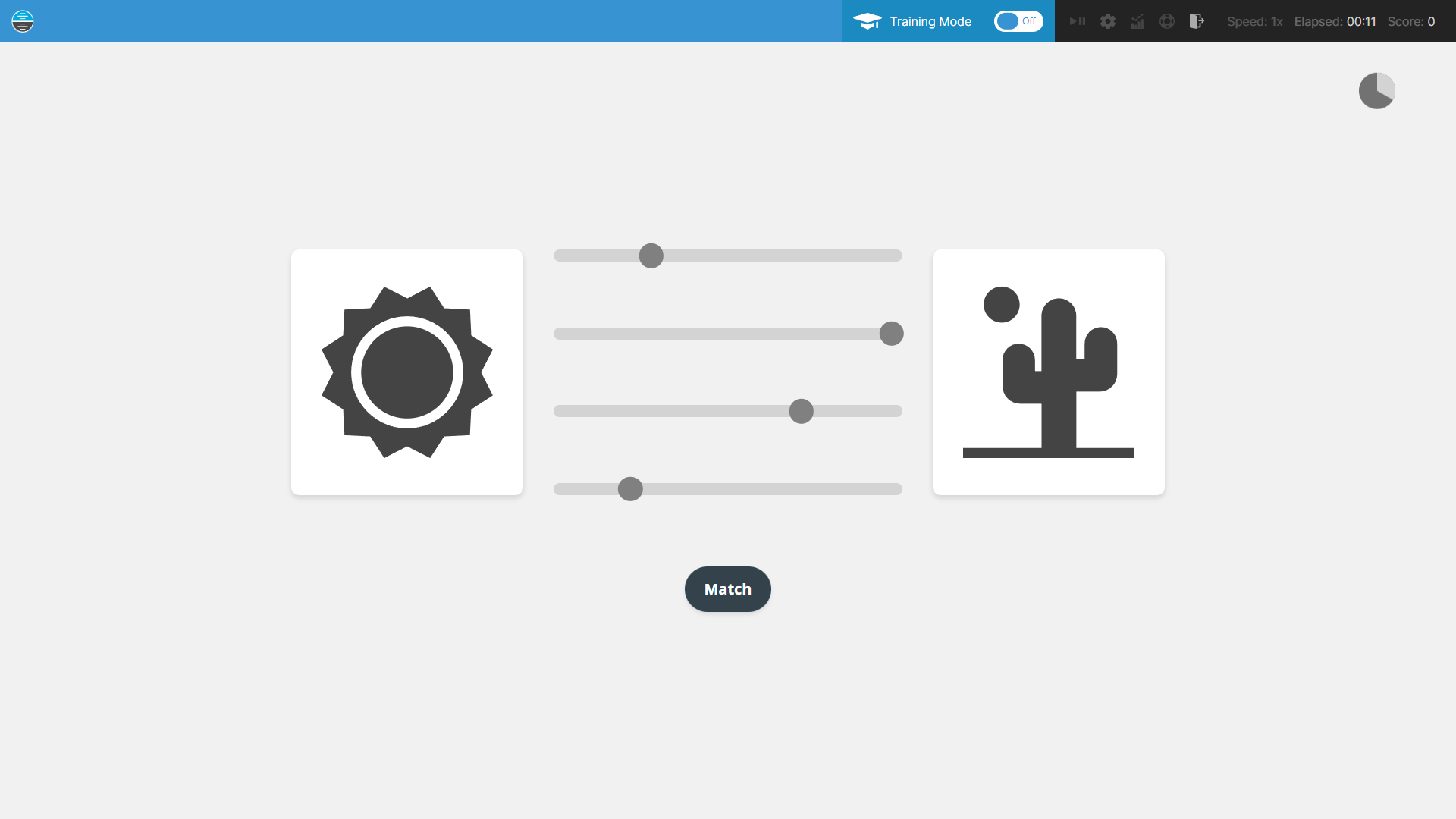
The Aon (Cut-e) Reaction Time (scales rt) module presents two images side by side. The candidate must determine, as quickly as possible, whether the two images are identical or different. This is repeated continuously for 3 minutes.
The task is intentionally monotonous and repetitive. The difficulty lies not in the comparison itself (which is straightforward) but in maintaining speed and accuracy across a large number of trials without losing concentration. The module assesses choice reaction time (same or different), sustained attention, and resistance to vigilance decrement. A candidate who starts quickly but slows down or makes increasing errors as the test progresses will score less well than one who maintains a consistent response rate throughout.
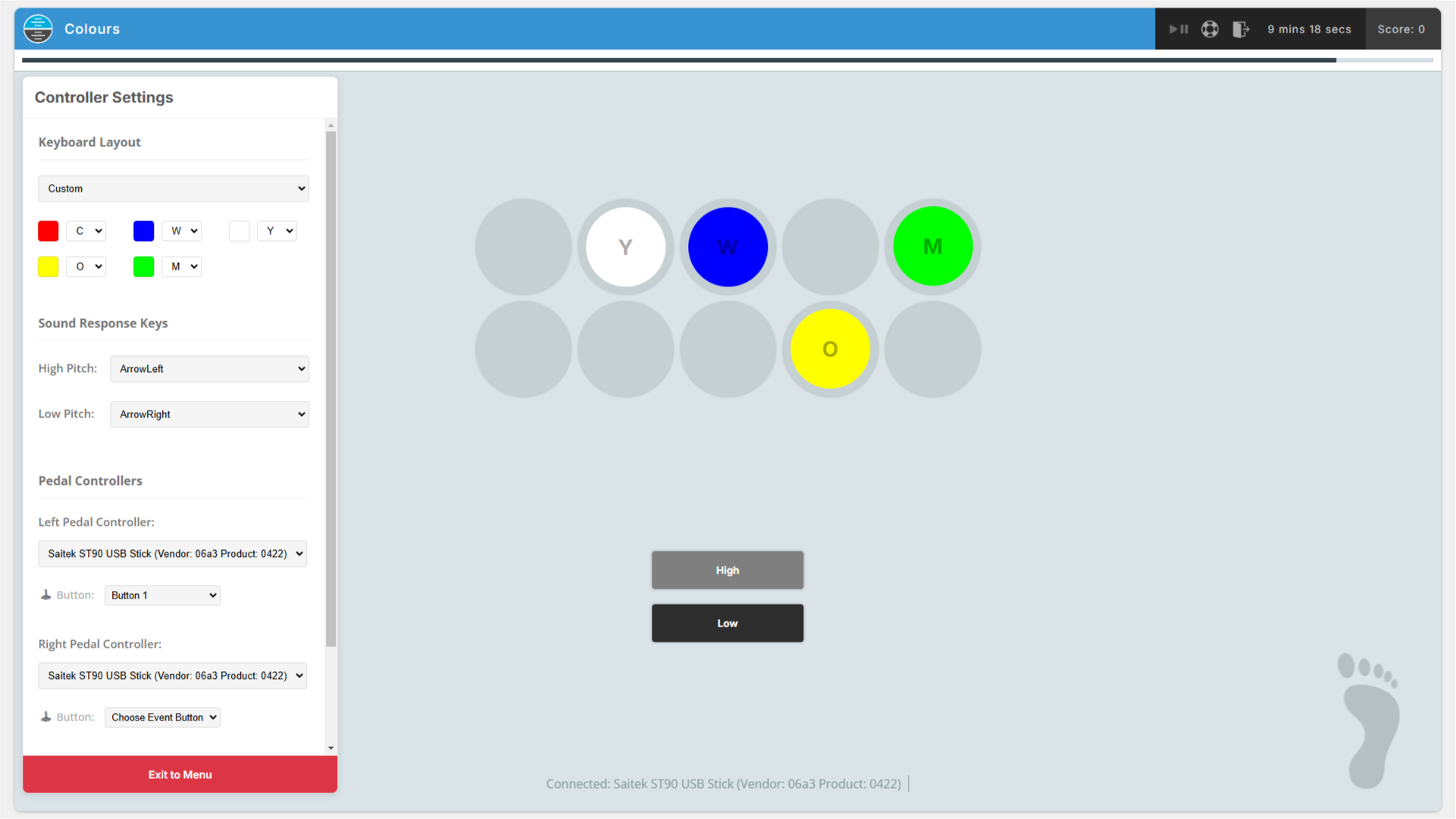
The Vienna Test System Determination Test (DT) presents stimuli across three sensory channels simultaneously for 10 minutes. Coloured circles appear at random intervals across a grid, each requiring a specific key response. High and low-pitched tones are played through headphones, each requiring immediate acknowledgement. Periodically illuminating pedals require prompt physical reactions from the candidate's feet.
The DT module is the most complex reaction time assessment used in pilot aptitude testing. The candidate must maintain readiness to respond across visual, auditory and physical channels, selecting the correct response for each stimulus type whilst managing the pace set by the test. This directly mirrors the cockpit demand of responding to visual warnings, auditory alerts and physical cues (such as control force changes or vibrations) concurrently. The 10-minute duration also incorporates a sustained vigilance component, as the candidate must maintain performance across a longer assessment period.
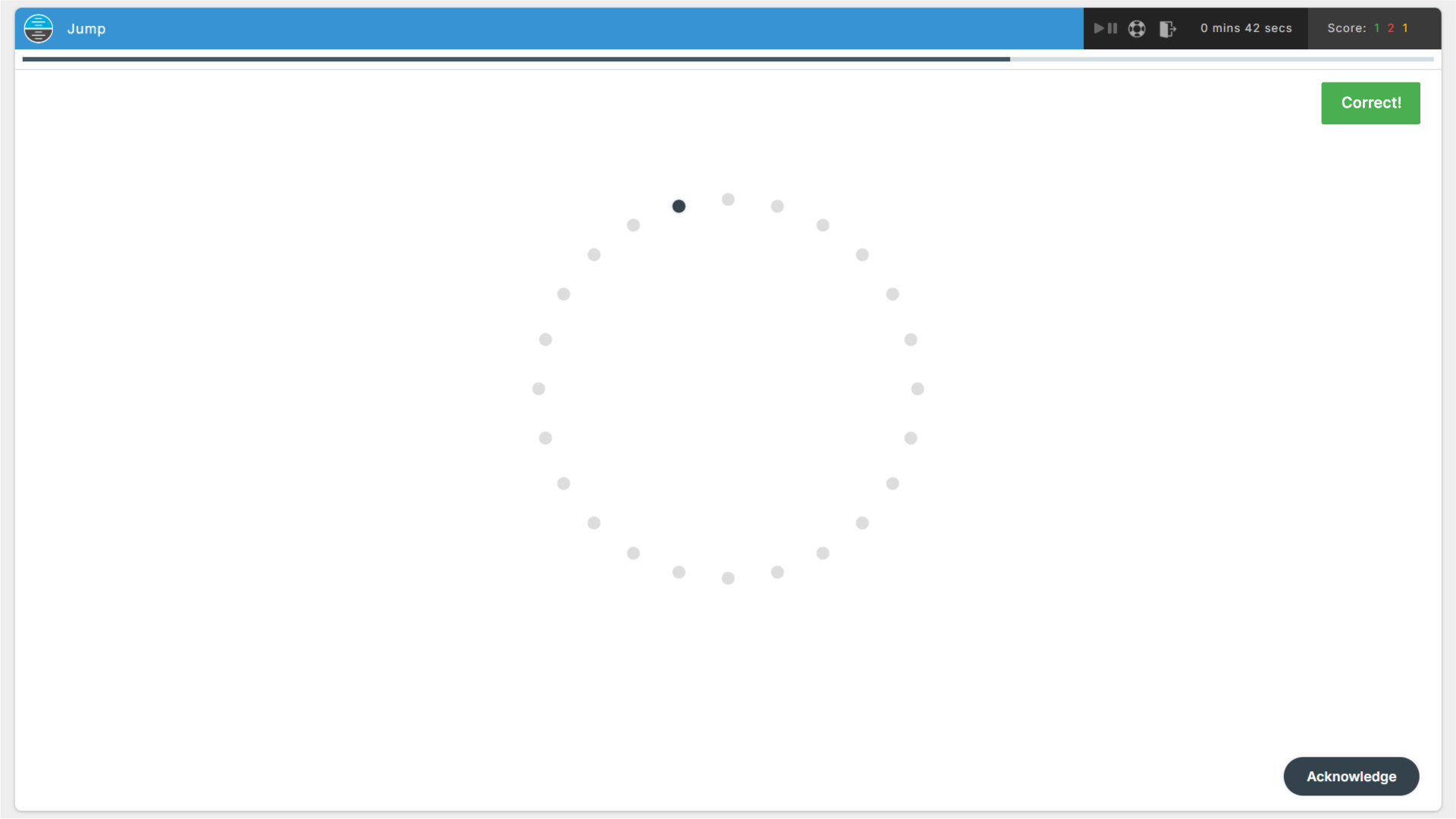
The Vienna Test System Vigilance (VIGIL) module uses an experimental paradigm known as the Mackworth Clock. A dot moves sequentially around the perimeter of a circle, one position at a time. At random intervals, the dot jumps by two positions instead of one, and the candidate must acknowledge this immediately by pressing a button.
The VIGIL module is a pure sustained vigilance task. The stimulus (a double jump) is infrequent and unpredictable, embedded within a continuous, rhythmic sequence that encourages attentional drift. The test can last 5, 15 or 25 minutes depending on the configuration, with longer versions placing greater demand on the candidate's ability to resist vigilance decrement. This paradigm has been used in attention research since the 1940s, when it was originally developed to study the performance of radar operators who needed to detect rare, brief signals over long watches. The parallel with cockpit monitoring during cruise is direct.
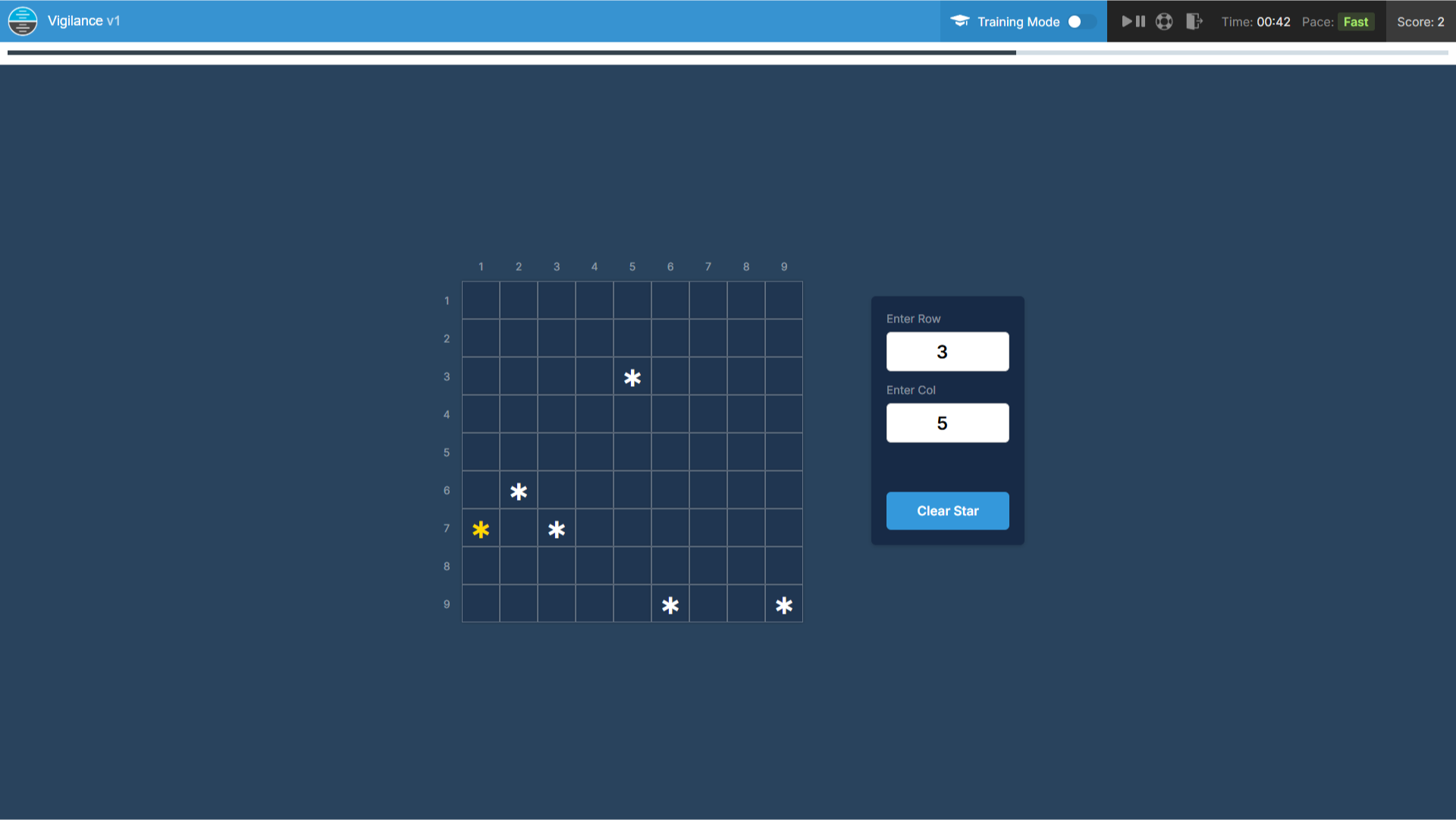
The CBAT Vigilance Test requires the candidate to engage with a coordinate-based system, prioritising and clearing objects as they appear. The candidate must demonstrate sustained vigilance and prompt reaction to effectively manage objects, responding quickly whilst maintaining accurate prioritisation.
This module combines reaction time with a monitoring and prioritisation demand. The candidate must not only react quickly to the appearance of objects but also determine the correct order and method of clearing them. This adds a cognitive layer to the reaction task that goes beyond simple stimulus-response, assessing the candidate's ability to make rapid decisions about priority whilst maintaining response speed.
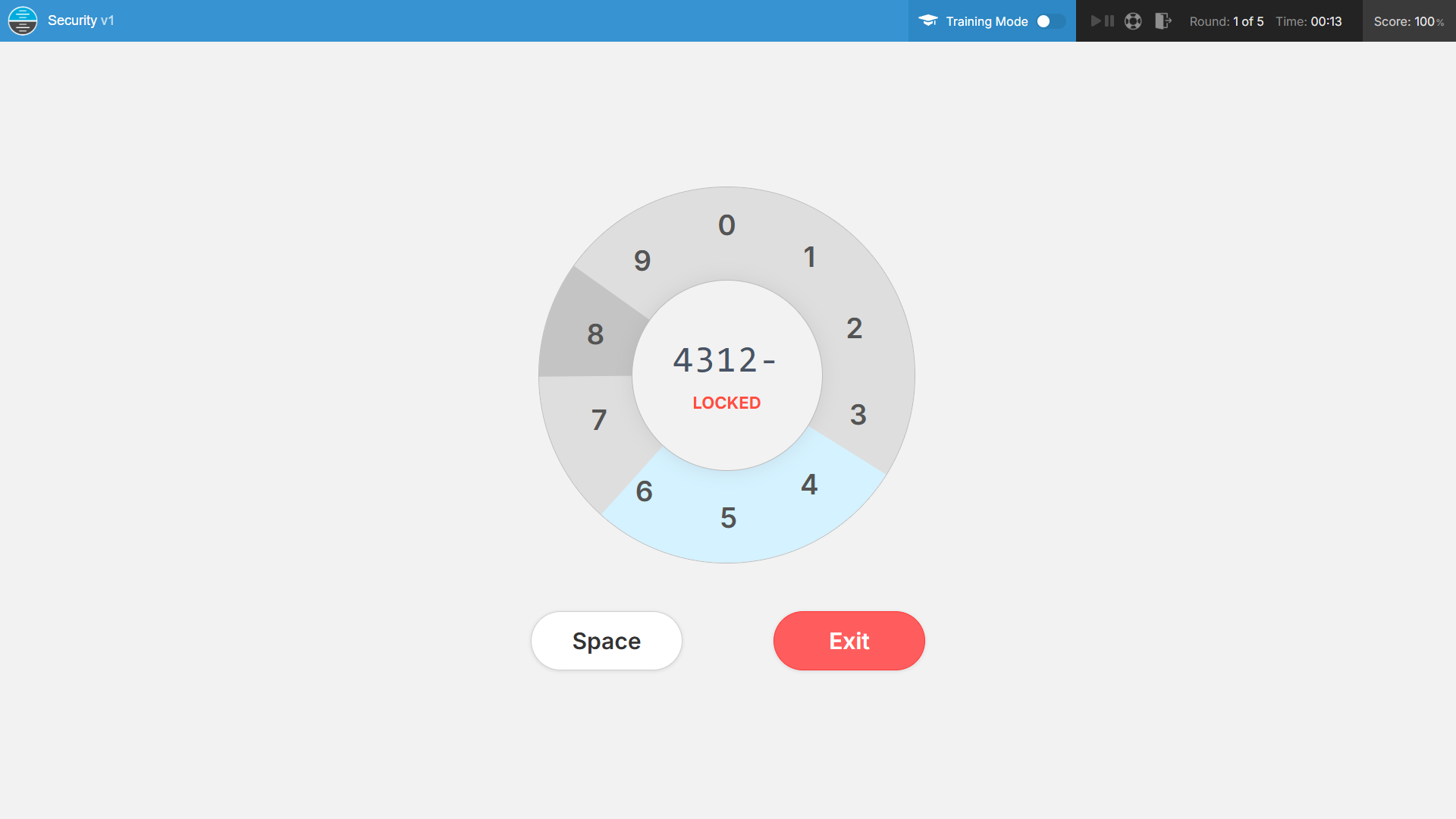
The Arctic Shores Security module requires the candidate to enter digits into a circular lock mechanism by timing their input to a steadily rotating element. As difficulty increases, the candidate is given the option to transition to a new lock mechanism if the risk of failure becomes too severe. Appropriate risk avoidance is rewarded, whilst unnecessary risk aversion incurs penalties.
This module is distinctive in combining reaction time with a risk assessment dimension. The candidate must time their responses precisely (reaction demand) whilst also evaluating whether to continue with the current lock or switch to a new one (risk calibration). This dual demand reflects the operational reality that reaction speed in aviation is not exercised in a vacuum: the pilot must also judge the level of urgency and risk before committing to an action, balancing the speed of response against the consequences of acting too hastily or too cautiously.
Reaction Time is assessed in the following pilot aptitude test systems:
The table below outlines the Reaction Time modules in each assessment, linking each to the relevant preparation activity in our software.
| Assessment | Module | Reaction Type | Format | Activity |
|---|---|---|---|---|
| Aon (Cut-e) | Reaction Time (scales rt) | Choice Reaction | Infinite, 3 min | React |
| CBAT / CFAST / MACTS | Vigilance Test | Vigilance + Prioritisation | TBC | Vigilance |
| Vienna Test System | Determination Test (DT) | Multi-Stimulus | Infinite, 10 min | Colours |
| Vienna Test System | Vigilance (VIGIL) | Sustained Vigilance | Infinite, ~5/15/25 min | Jump |
| Arctic Shores | Security | Risk-Calibrated | 5, 10 or 20 rounds | Security |
Having identified the modules relevant to your assessment, you can navigate directly to the corresponding activities within our software.
Our software organises activities by the type of assessment you are preparing for, the skill being evaluated, and the specific airline, flying school or cadet scheme you are applying to. This means you do not need to manually cross-reference the table above; the relevant Reaction Time activities will already be included in your tailored preparation.
To find the activities relevant to you, navigate to one of the following within the software:
- Activities by Aptitude Test
- If you know which test system your assessment uses. For example, to find Reaction Time activities for Aon (Cut-e), navigate to Activities by Aptitude Test and select Aon (Cut-e).
- Activities by Skill
- If you want to focus specifically on Reaction Time across all test systems. Navigate to Activities by Skill and select Reaction Time to see every relevant activity.
- Activities by Airline, Flying School or Cadet Scheme
- If you know where you are applying but not which test system is used. Navigate to Activities by Airline or Activities by Flying School and select your chosen organisation. The software will include the appropriate Reaction Time activities alongside all other relevant preparation.
If you have created a Preparation Strategy, the relevant Reaction Time activities will already appear in your Focus Activities; no additional navigation is required.
Reaction Time is closely associated with several other competencies assessed in pilot aptitude testing. Candidates preparing for Reaction Time modules may also benefit from developing the following related skills:
Academic Sources referenced in this KB Article
The following academic sources were consulted in the preparation of this article:
[1] Donders, F. C. (1969). On the speed of mental processes. Acta Psychologica, 30, 412-431. (Original work published 1868; translated by W. G. Koster.)
[2] Hick, W. E. (1952). On the rate of gain of information. Quarterly Journal of Experimental Psychology, 4(1), 11-26.
[3] Wickens, C. D., & Hollands, J. G. (2000). Engineering Psychology and Human Performance (3rd ed.). Prentice Hall.
[4] Warm, J. S., Parasuraman, R., & Matthews, G. (2008). Vigilance requires hard mental work and is stressful. Human Factors, 50(3), 433-441.
[5] Wickelgren, W. A. (1977). Speed-accuracy tradeoff and information processing dynamics. Acta Psychologica, 41(1), 67-85.
With a section dedicated to Reaction Time, our one-of-a-kind software represents the ultimate way for you to get prepared.
By leveraging our cutting-edge software, including those unique features and extensive guidance not offered elsewhere, you can immerse yourself in realistic simulations, master those competencies assessed, and familiarise yourself with the methods and mechanisms of assessment.
Our software is backed by our meticulous attention to detail and deep expertise as experienced commercial pilots, empowering pilot applicants to approach their assessments with confidence and helping to propel them to supersonic levels of success.
Start using our incredible preparation software immediately on PC, Mac, iOS and Android by purchasing a subscription:
Buy Preparation SoftwareWith increasing prevalence and awareness of computerised pilot aptitude testing in pilot assessments, it's never been more important to ensure that you can fly past the competition. This is made easy with features unique to our software:












Discover the key advantages of using our cutting-edge software:
How can I prepare for my Reaction Time pilot assessment?
The best way to prepare for your Reaction Time pilot assessment is with our latest industry-leading software, developed over 5 years by experienced airline pilots. With realistic exam simulations, personalised Preparation Strategies which guide you through your preparation, immersive Explainer Videos, customisable Training Modes that manipulate your simulation environments, comprehensive Instruction and Guidance, and extensive performance feedback which incorporates unique features such as Predictive Scoring, a Strength & Weakness Map and Colour Coding, our unique software will help you to accelerate improvement of your problem areas and fly through each part of the Reaction Time assessment. The software runs in a web browser, is compatible with laptop, desktop, tablet and smartphone, and is complimented with extensive support, provided from 9AM to 9PM GMT. To purchase a subscription to our software and start preparing for your Reaction Time pilot assessment, click here!
What is the pass mark for the Reaction Time pilot assessment?
Many pilot aptitude tests do not have a fixed threshold (or pass mark), but rather indicate the pilot candidate's overall performance and suitability using a variety of different methods - many of which are emulated within our software. Rather than worrying about a specific pass mark, the better approach is to focus on comprehensive preparation that maximizes your chances of success within each part of the Reaction Time pilot assessment. Our industry-leading pilot preparation software provides that comprehensive preparation, helping you to develop the essential sklls, familiarity with assessment and confidence needed to perform at your best. If you have any questions about the Reaction Time pilot assessment, please contact us.
How often is your Reaction Time assessment preparation software updated?
Our pilot assessment preparation software is continuously updated, with daily improvements based on feedback from hundreds of monthly users. Developed by experienced airline pilots, the simulations provided within our unique software faithfully reflect the Reaction Time pilot assessment, ensuring that you have the most current and comprehensive preparation. To see the recent updates to our preparation software, please visit our Updates page.
What support is available with your Reaction Time assessment preparation software?
With our own industry experiences, we understand the pressures and stresses that come with preparing for pilot assessments. When you use our software to prepare for your Reaction Time pilot assessment, you'll have access to exceptional support and guidance from our team of experienced airline pilots, provided between 9AM and 9PM GMT. This support sets us apart, helping you to develop the skills, knowledge, and confidence needed to approach your assessment feeling completely ready to demonstrate your true potential and fly past the competition at every stage of the Reaction Time pilot assessment.
How quickly can I prepare for my Reaction Time pilot assessment with this software?
If you'd like to start preparing for the Reaction Time assessment, you may start using our software within as little as a few minutes. We offer access to our preparation software for 7 days, 1 month or 3 months, and provide the opportunity to purchase additional time. This ensures you can work through the comprehensive simulations, and benefit from our guidance at your own pace, with support available whenever you need it. To get started, choose a subscription duration to our preparation software, create an account and complete your purchase - then, login and begin your preparation. The entire process typically takes between 2-3 minutes, with secure payment by credit or debit card securely processed with Stripe or PayPal.
Feature-packed and one-of-a kind preparation software for your assessment.
Regularly updated, realistic and infinite simulations of aptitude tests.
Instant activation, fast support and uniquely in-depth guidance.