

 Maths for Pilots
 Science for Pilots
 English Language for Pilots
 Verbal Reasoning for Pilots
 Numerical Reasoning for Pilots
 Mechanical Reasoning for Pilots
 ATPL Knowledge for Pilots
 WhatsApp
 Facebook Chat
 Email
Email










































If you don't have time to read this article but would like to know whether our software can help - it can. You can buy access to our software and get started immediately, 365 days-a-year.
Buy Preparation SoftwareMechanical Reasoning describes the ability to understand and apply fundamental mechanical and physical principles to solve problems. In pilot aptitude testing, Mechanical Reasoning is assessed as the candidate's capacity to interpret graphical illustrations of mechanical systems and predict how those systems will behave, typically involving concepts such as force, motion, pressure and energy transfer. Mechanical Reasoning questions are presented visually. The candidate is shown a diagram of a mechanical arrangement and must determine the outcome: which direction a gear will turn, which side of a lever will rise, how pressure will change in a hydraulic system, or what effect friction will have on a moving object. The topics assessed across pilot aptitude tests include:
Mechanical Reasoning is distinct from Science, though there is significant cross-over between the two skills. Dedicated Mechanical Reasoning modules (such as the Aon scales mtu and VTS MTA) focus specifically on the behaviour of physical and mechanical systems. However, several test systems assess mechanical reasoning content within broader science or physics modules: the DLR Technical Comprehension, COMPASS Technical Insight, and TestAir360 Physics modules all include questions that require the candidate to interpret mechanical systems and apply the same physical principles.
Further Reading on Mechanical Reasoning as a Cognitive Ability
Understanding Mechanical Systems
Mechanical Reasoning has been studied extensively in cognitive psychology as a component of technical aptitude. Research by Hegarty and colleagues has shown that people solve mechanical reasoning problems using a combination of mental simulation (imagining how a system will move) and rule application (applying learned principles such as "meshing gears turn in opposite directions") [1]. Novices tend to rely more heavily on step-by-step mental simulation, tracing the movement through each component of a system in sequence. With practice and experience, individuals develop internalised rules that allow them to solve problems more quickly without needing to simulate every step.
This distinction is important for preparation. Candidates who are unfamiliar with mechanical concepts will initially need to work through each question carefully, building up an understanding of how different components interact. Over time, this deliberate practice leads to the development of reliable rules and intuitions that allow faster and more confident responses. The goal of preparation is to shift from slow, effortful simulation toward rapid, confident rule application.
Mechanical Reasoning is applied whenever we interact with physical systems and predict how they will behave. Everyday examples include: using a crowbar or wheelbarrow and intuitively understanding that the length of the lever arm determines how much force is needed, adjusting a bicycle's gears and recognising that smaller cogs spin faster but with less torque, understanding why a hydraulic car jack can lift a heavy vehicle with relatively little effort, and predicting which direction water will flow through a system of connected pipes based on differences in pressure.
These everyday interactions build a foundation of mechanical intuition that is directly relevant to pilot aptitude testing. Candidates who have practical experience with tools, machinery, vehicles or DIY tasks often find Mechanical Reasoning questions more intuitive, not because the questions require specialist knowledge, but because hands-on experience develops the kind of mental models that these tests are designed to assess.
Further Reading on Building Mechanical Intuition
From Experience to Mental Models
Research on mechanical reasoning has consistently shown that performance improves with exposure to mechanical systems, whether through formal education, practical experience, or targeted practice [2]. This is because mechanical reasoning relies on mental models: internal representations of how physical systems behave. These models become more accurate and more detailed as a person gains experience with real mechanical systems.
Importantly, the mechanical concepts assessed in pilot aptitude tests do not require engineering-level knowledge. They assess an understanding of fundamental principles (force, motion, pressure, energy) at a level that can be developed through study and practice. Candidates who feel they lack mechanical intuition should not be discouraged; the principles are learnable, and the question formats become predictable with preparation.
Aircraft are complex mechanical systems, and pilots are expected to understand the fundamental principles that govern how those systems function. Mechanical Reasoning underpins a pilot's ability to understand aircraft behaviour, diagnose system malfunctions, and make informed decisions when automated systems fail or behave unexpectedly.
- Flight control systems:
- Aircraft flight controls operate through mechanical linkages, cables, pulleys and hydraulic actuators. A pilot who understands how these components transmit force can better comprehend why controls feel different at different airspeeds (aerodynamic loading on control surfaces), why trim systems reduce control forces (repositioning the neutral point), and what will happen to controllability if a hydraulic system fails (reversion to manual control with significantly increased control forces).
- Hydraulic systems:
- Modern aircraft rely on hydraulic systems to operate flight controls, landing gear, brakes, flaps and spoilers. These systems work on the principle that pressure applied to a confined fluid is transmitted equally in all directions (Pascal's principle). Understanding this principle helps pilots interpret system synoptics, anticipate the consequences of hydraulic failures, and understand why certain backup systems exist. Hydraulic questions are a core component of Mechanical Reasoning assessments.
- Landing gear and braking:
- Landing gear systems involve a combination of hydraulic actuation, mechanical locking mechanisms, springs, dampers and brake assemblies. The retraction and extension sequence relies on hydraulic pressure overcoming mechanical uplocks and downlocks. The braking system converts kinetic energy into heat through friction. A pilot who understands these mechanical principles can better interpret abnormal indications such as gear disagreement warnings and make informed decisions about emergency extension procedures.
- Pressurisation and pneumatics:
- Aircraft pressurisation systems maintain cabin pressure by controlling the balance between air supplied by the engines and air released through outflow valves. Understanding pressure, volume and flow relationships helps pilots interpret pressurisation system behaviour: why cabin altitude rises if an outflow valve fails open, why rate of pressurisation change must be controlled for passenger comfort, and why rapid decompression demands an immediate descent.
Rotary-wing operations present additional mechanical demands:
- Rotor systems and control mechanisms:
- Helicopter rotor systems are among the most mechanically complex assemblies in aviation. The pilot's cyclic and collective inputs are transmitted through push-pull rods, bellcranks, swashplate bearings and pitch change links to alter blade angles. Understanding how these mechanical linkages translate pilot input into rotor response is fundamental to comprehending helicopter handling characteristics, including why there is a delay between control input and aircraft response, and why cross-coupling effects require coordinated inputs on multiple controls simultaneously.
- Transmission and gearbox systems:
- Helicopter transmissions use epicyclic (planetary) gear trains to reduce engine RPM (typically 20,000+ RPM in a turbine) down to main rotor RPM (typically 200-400 RPM). Understanding gear ratios, torque multiplication and the relationship between rotational speed and force is directly relevant both to Mechanical Reasoning test questions and to understanding why transmission limitations (torque limits, temperature limits) constrain helicopter performance.
- Autorotation and energy management:
- In the event of engine failure, a helicopter pilot must manage the conversion of potential and kinetic energy stored in the rotor system to achieve a safe landing. The rotor acts as a store of rotational energy, and the pilot must balance altitude (potential energy), airspeed (kinetic energy) and rotor RPM (rotational energy) throughout the descent. This is a practical application of energy conservation principles assessed in the Gravity and Energy topic of Mechanical Reasoning tests.
- Underslung load behaviour:
- When carrying external loads on a cargo hook, the load behaves as a pendulum suspended beneath the aircraft. Understanding pendulum motion, the effect of cable length on oscillation frequency, and how the pilot's control inputs can either dampen or amplify load swing requires an intuitive grasp of the mechanical principles of gravity, momentum and energy transfer.
Pilot training involves learning a substantial volume of technical material about aircraft systems. During ground school, student pilots study hydraulic systems, pneumatic systems, flight control mechanisms, landing gear operation, engine components and pressurisation systems in detail. A candidate who already possesses a strong foundation in mechanical reasoning will find this material more intuitive and will progress through systems training more efficiently.
Research into pilot selection has consistently identified technical aptitude as a significant predictor of training performance [3]. Candidates who understand how mechanical systems behave can build accurate mental models of aircraft systems more quickly, require less repetition to consolidate their understanding, and are better able to transfer knowledge from one system to another (for example, recognising that the same hydraulic principles apply across different aircraft types).
When aircraft systems malfunction, the pilot must interpret the symptoms, identify the likely cause, and determine the appropriate response. This process relies heavily on an understanding of how mechanical systems work. A pilot who understands that hydraulic systems transmit pressure equally can reason through the consequences of a leak: which services will be affected, how system behaviour will change, and what backup options are available.
Mechanical Reasoning ability supports what is known in human factors research as mental model based reasoning [4]. Rather than relying solely on memorised checklists (which may not cover every possible failure combination), a pilot with strong mechanical reasoning can think through novel situations from first principles. This capacity is particularly valuable when a failure does not match any trained scenario exactly, requiring the pilot to reason about the underlying mechanics to determine the safest course of action.
Whilst only two test systems (Aon and the Vienna Test System) include a dedicated Mechanical Reasoning module, the underlying competency is assessed more broadly than this suggests. The DLR Technical Comprehension module, the COMPASS Technical Insight module, and the TestAir360 Physics module all include a substantial proportion of questions that require the same mechanical reasoning ability: interpreting mechanical systems, applying physical principles, and predicting how components will behave. The concepts assessed (hydraulics, pressure, gears, levers, pulleys, friction, springs, energy) map directly onto the technical content of ATPL ground school and type rating courses, making Mechanical Reasoning one of the most directly training-relevant skills in pilot aptitude testing.
Further Reading on Technical Aptitude in Pilot Selection
Why Mechanical Understanding Predicts Pilot Performance
The inclusion of Mechanical Reasoning in pilot aptitude batteries reflects a well-established finding in aviation psychology: candidates with stronger technical aptitude tend to perform better in training, particularly in the ground school phase where aircraft systems knowledge is assessed through examination [5]. Meta-analyses of pilot selection research have found that technical and mechanical aptitude tests contribute meaningfully to the prediction of training outcomes, even when controlling for general cognitive ability [6].
The reason is that mechanical reasoning is not simply factual knowledge; it reflects an underlying ability to build and manipulate mental models of physical systems. This ability transfers to the aviation context because aircraft systems, despite their complexity, operate according to the same fundamental mechanical principles assessed in aptitude tests. A candidate who can reason about pulleys, gears and hydraulics in a test setting is demonstrating the same cognitive capacity they will need to understand fuel systems, flight control mechanisms and pressurisation controllers during training.
Computerised pilot aptitude tests evaluate Mechanical Reasoning using graphical questions that present the candidate with a diagram of a mechanical system and require them to predict how that system will behave. All Mechanical Reasoning questions are visual: the candidate must interpret an illustration, apply the relevant mechanical principle, and select the correct answer from the available options.
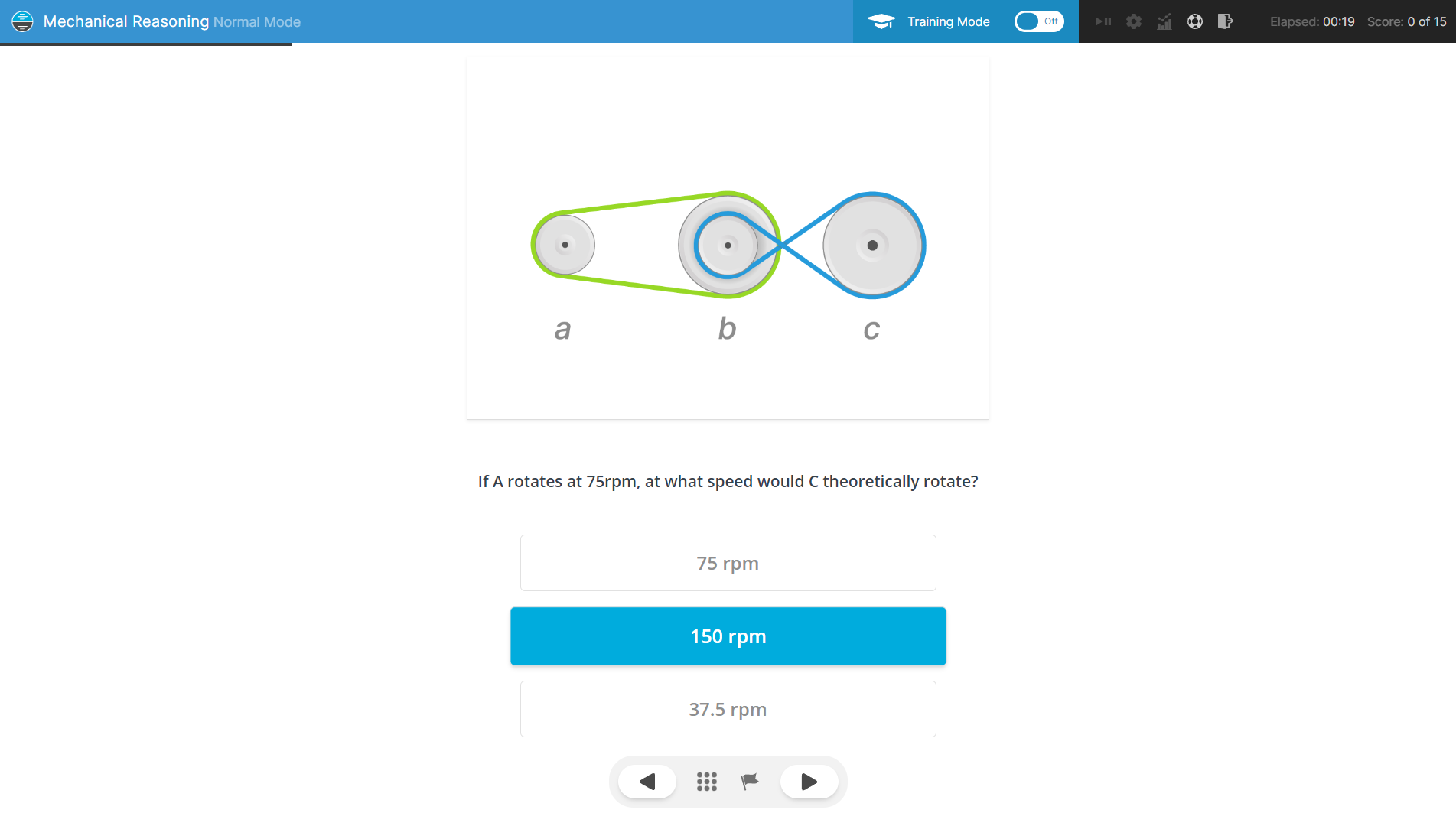
Graphical mechanical problems present the candidate with a technical illustration showing a mechanical arrangement such as a system of gears, a pulley configuration, a lever with weights, a hydraulic circuit, or a spring under load. The candidate must determine the outcome: for example, which direction the final gear in a train will rotate, which end of a lever will move upward, or how the pressure will change at a particular point in a hydraulic system.
These questions require no prior engineering knowledge or mathematical calculation. They assess the candidate's ability to understand and apply fundamental mechanical principles to visual scenarios. The key cognitive demands are interpreting the diagram accurately, identifying which mechanical principle applies, and reasoning through the system step by step to arrive at the correct answer.
The Aon (Cut-e) Mechanical Reasoning (scales mtu) module presents 24 questions in 15 minutes, covering a broad range of mechanical concepts. The Vienna Test System Mechanical-Technical Perceptive Ability (MTA) module presents 10 questions in 5 minutes, focusing on the candidate's understanding of basic technical laws and the behaviour of mechanical systems depicted in technical illustrations.
Mechanical Reasoning questions draw on a defined set of mechanical and physical principles. Understanding these topic areas is key to effective preparation:
Pulleys are used to change the direction of a force or to multiply it. Questions typically present a pulley system and ask the candidate to determine the direction of movement, the force required, or the mechanical advantage gained by the arrangement.
Gears are one of the most commonly tested topics. Questions present meshing gear trains and ask the candidate to determine the direction of rotation, the relative speed, or the number of turns of a specific gear. The core principle is that meshing gears rotate in opposite directions, and the gear ratio determines the relative speed.
Springs questions assess understanding of elasticity and Hooke's law: that the extension of a spring is proportional to the force applied, provided the elastic limit is not exceeded. Questions may ask the candidate to compare the extension of springs under different loads or to predict what happens when springs are arranged in series or parallel.
Levers and balancing scales questions require the candidate to apply the principle of moments: force multiplied by distance from the fulcrum. The candidate must determine which side of a lever or balance will move, or what weight must be placed at a given position to achieve equilibrium.
Gravity and energy questions assess understanding of potential and kinetic energy, energy conservation, and the effect of gravity on objects. Common scenarios include objects on slopes, pendulums, and falling objects.
Hydraulics questions are based on Pascal's principle: pressure applied to a confined fluid is transmitted equally in all directions. Questions typically present hydraulic systems with pistons of different sizes and ask the candidate to determine the force output, the distance moved, or the pressure at a specific point.
Friction questions assess understanding of the resistance that opposes relative motion between surfaces in contact. Scenarios may involve objects on inclined planes, braking systems, or comparisons between different surface types.
Pressure questions assess the relationship between force and area (pressure = force / area), and the behaviour of gases and fluids under varying pressure conditions.
Several other pilot aptitude test modules contain a significant proportion of Mechanical Reasoning content, even though they are not labelled as "Mechanical Reasoning" modules. The DLR Technical Comprehension module, the COMPASS Technical Insight module, and the TestAir360 Physics module all include questions that require candidates to interpret mechanical systems and apply the same physical principles (force, motion, pressure, energy, friction) assessed in dedicated Mechanical Reasoning modules.
The difference is one of scope. Dedicated Mechanical Reasoning modules (Aon scales mtu and VTS MTA) focus exclusively on mechanical and technical illustrations. Science and physics modules combine mechanical reasoning content with broader scientific topics such as electricity, magnetism, radiation and thermodynamics. A candidate preparing for a DLR, COMPASS or TestAir360 assessment should therefore expect to encounter mechanical reasoning questions within their science or physics module, and should prepare for both the mechanical and broader scientific content.
For a full breakdown of the broader scientific content assessed in these modules, see our dedicated Science Knowledgebase Article. Candidates preparing for the mechanical reasoning component of these modules will benefit from our Mechanical Reasoning activity alongside our Science activity.
Mechanical Reasoning is assessed as a dedicated module in the following pilot aptitude test systems:
Additionally, the following test systems include significant mechanical reasoning content within broader science or physics modules:
Candidates preparing for a DLR, COMPASS or TestAir360 assessment should expect to encounter mechanical reasoning questions within their Technical Comprehension, Technical Insight or Physics module respectively, and should prepare using both our Mechanical Reasoning and Science activities.
The table below outlines the Mechanical Reasoning modules and the science/physics modules that contain significant mechanical reasoning content, linking each to the relevant preparation activities in our software.
| Assessment | Module | Scope | Format | Activities |
|---|---|---|---|---|
| Aon (Cut-e) | Mechanical Reasoning (scales mtu) | Dedicated | 24 questions, 15 min | Mechanical Reasoning |
| Vienna Test System | Mechanical-Technical Perceptive Ability (MTA) | Dedicated | 10 questions, 5 min | Mechanical Reasoning |
| DLR | Technical Comprehension * | Cross-over | Multiple choice | Mechanical Reasoning Science |
| COMPASS | Technical Insight * | Cross-over | Multiple choice | Mechanical Reasoning Science |
| TestAir360 | Physics * | Cross-over | Multiple choice | Mechanical Reasoning Science |
* These modules assess a broader range of scientific topics (electricity, magnetism, thermodynamics) alongside mechanical reasoning content. Candidates should prepare using both activities. See our Science Knowledgebase Article for a full breakdown.
Having identified the modules relevant to your assessment, you can navigate directly to the corresponding activities within our software.
Our software organises activities by the type of assessment you are preparing for, the skill being evaluated, and the specific airline, flying school or cadet scheme you are applying to. This means you do not need to manually cross-reference the table above; the relevant Mechanical Reasoning activities will already be included in your tailored preparation.
To find the activities relevant to you, navigate to one of the following within the software:
- Activities by Aptitude Test
- If you know which test system your assessment uses. For example, to find Mechanical Reasoning activities for the Aon (Cut-e), navigate to Activities by Aptitude Test and select Aon (Cut-e).
- Activities by Skill
- If you want to focus specifically on Mechanical Reasoning across all test systems. Navigate to Activities by Skill and select Mechanical Reasoning to see every relevant activity.
- Activities by Airline, Flying School or Cadet Scheme
- If you know where you are applying but not which test system is used. Navigate to Activities by Airline or Activities by Flying School and select your chosen organisation. The software will include the appropriate Mechanical Reasoning activities alongside all other relevant preparation.
If you have created a Preparation Strategy, the relevant Mechanical Reasoning activities will already appear in your Focus Activities; no additional navigation is required.
Mechanical Reasoning is closely associated with several other competencies assessed in pilot aptitude testing. Candidates preparing for Mechanical Reasoning modules may also benefit from developing the following related skills:
Academic Sources referenced in this KB Article
The following academic sources were consulted in the preparation of this article:
[1] Hegarty, M. (2004). Mechanical reasoning by mental simulation. Trends in Cognitive Sciences, 8(6), 280-285.
[2] Hegarty, M., & Sims, V. K. (1994). Individual differences in mental animation during mechanical reasoning. Memory & Cognition, 22(4), 411-430.
[3] Hunter, D. R., & Burke, E. F. (1994). Predicting aircraft pilot-training success: A meta-analysis of published research. The International Journal of Aviation Psychology, 4(4), 297-313.
[4] Gentner, D., & Stevens, A. L. (Eds.). (1983). Mental Models. Lawrence Erlbaum Associates.
[5] Carretta, T. R., & Ree, M. J. (2003). Pilot selection methods. In P. S. Tsang & M. A. Vidulich (Eds.), Principles and Practice of Aviation Psychology. Lawrence Erlbaum Associates.
[6] Martinussen, M. (1996). Psychological measures as predictors of pilot performance: A meta-analysis. The International Journal of Aviation Psychology, 6(1), 1-20.
With a section dedicated to Mechanical Reasoning, our one-of-a-kind software represents the ultimate way for you to get prepared.
By leveraging our cutting-edge software, including those unique features and extensive guidance not offered elsewhere, you can immerse yourself in realistic simulations, master those competencies assessed, and familiarise yourself with the methods and mechanisms of assessment.
Our software is backed by our meticulous attention to detail and deep expertise as experienced commercial pilots, empowering pilot applicants to approach their assessments with confidence and helping to propel them to supersonic levels of success.
Start using our incredible preparation software immediately on PC, Mac, iOS and Android by purchasing a subscription:
Buy Preparation SoftwareWith increasing prevalence and awareness of computerised pilot aptitude testing in pilot assessments, it's never been more important to ensure that you can fly past the competition. This is made easy with features unique to our software:












Discover the key advantages of using our cutting-edge software:
How can I prepare for my Mechanical Reasoning pilot assessment?
The best way to prepare for your Mechanical Reasoning pilot assessment is with our latest industry-leading software, developed over 5 years by experienced airline pilots. With realistic exam simulations, personalised Preparation Strategies which guide you through your preparation, immersive Explainer Videos, customisable Training Modes that manipulate your simulation environments, comprehensive Instruction and Guidance, and extensive performance feedback which incorporates unique features such as Predictive Scoring, a Strength & Weakness Map and Colour Coding, our unique software will help you to accelerate improvement of your problem areas and fly through each part of the Mechanical Reasoning assessment. The software runs in a web browser, is compatible with laptop, desktop, tablet and smartphone, and is complimented with extensive support, provided from 9AM to 9PM GMT. To purchase a subscription to our software and start preparing for your Mechanical Reasoning pilot assessment, click here!
What is the pass mark for the Mechanical Reasoning pilot assessment?
Many pilot aptitude tests do not have a fixed threshold (or pass mark), but rather indicate the pilot candidate's overall performance and suitability using a variety of different methods - many of which are emulated within our software. Rather than worrying about a specific pass mark, the better approach is to focus on comprehensive preparation that maximizes your chances of success within each part of the Mechanical Reasoning pilot assessment. Our industry-leading pilot preparation software provides that comprehensive preparation, helping you to develop the essential sklls, familiarity with assessment and confidence needed to perform at your best. If you have any questions about the Mechanical Reasoning pilot assessment, please contact us.
How often is your Mechanical Reasoning assessment preparation software updated?
Our pilot assessment preparation software is continuously updated, with daily improvements based on feedback from hundreds of monthly users. Developed by experienced airline pilots, the simulations provided within our unique software faithfully reflect the Mechanical Reasoning pilot assessment, ensuring that you have the most current and comprehensive preparation. To see the recent updates to our preparation software, please visit our Updates page.
What support is available with your Mechanical Reasoning assessment preparation software?
With our own industry experiences, we understand the pressures and stresses that come with preparing for pilot assessments. When you use our software to prepare for your Mechanical Reasoning pilot assessment, you'll have access to exceptional support and guidance from our team of experienced airline pilots, provided between 9AM and 9PM GMT. This support sets us apart, helping you to develop the skills, knowledge, and confidence needed to approach your assessment feeling completely ready to demonstrate your true potential and fly past the competition at every stage of the Mechanical Reasoning pilot assessment.
How quickly can I prepare for my Mechanical Reasoning pilot assessment with this software?
If you'd like to start preparing for the Mechanical Reasoning assessment, you may start using our software within as little as a few minutes. We offer access to our preparation software for 7 days, 1 month or 3 months, and provide the opportunity to purchase additional time. This ensures you can work through the comprehensive simulations, and benefit from our guidance at your own pace, with support available whenever you need it. To get started, choose a subscription duration to our preparation software, create an account and complete your purchase - then, login and begin your preparation. The entire process typically takes between 2-3 minutes, with secure payment by credit or debit card securely processed with Stripe or PayPal.
Feature-packed and one-of-a kind preparation software for your assessment.
Regularly updated, realistic and infinite simulations of aptitude tests.
Instant activation, fast support and uniquely in-depth guidance.