

 Maths for Pilots
 Science for Pilots
 English Language for Pilots
 Verbal Reasoning for Pilots
 Numerical Reasoning for Pilots
 Mechanical Reasoning for Pilots
 ATPL Knowledge for Pilots
 WhatsApp
 Facebook Chat
 Email
Email








































If you don't have time to read this article but would like to know whether our software can help - it can. You can buy access to our software and get started immediately, 365 days-a-year.
Buy Preparation SoftwareAbstract Reasoning describes the ability to identify patterns, rules and relationships within visual or symbolic information, and to apply those rules to novel situations. In pilot aptitude testing, Abstract Reasoning is assessed as the candidate's capacity to decode sequences, identify governing rules within sets of images, recognise transformations applied between figures, and determine which elements follow or break an established pattern, all without relying on language, numbers or prior knowledge. Abstract Reasoning is sometimes referred to as non-verbal reasoning or fluid intelligence. It overlaps with Inductive Reasoning (identifying a general rule from specific examples) and Logic (applying structured rules to reach conclusions), but is distinguished by its exclusively visual and symbolic presentation. The candidate must work with shapes, sequences and spatial relationships rather than words or numbers. The specific types of abstract reasoning assessed include:
The central challenge of Abstract Reasoning is that the rules governing each question are never stated. The candidate must discover them by examining the visual information, forming a hypothesis about what connects or transforms the elements, testing that hypothesis against the available examples, and then applying it to identify the correct answer. This process of hypothesis generation and testing from purely visual evidence is what makes abstract reasoning a strong measure of fluid intelligence: the ability to reason in novel situations without relying on learned knowledge [1].
Further Reading on Fluid Intelligence and Abstract Reasoning
Abstract Reasoning as a Measure of Fluid Intelligence
Psychometric research distinguishes between fluid intelligence (the ability to reason in novel situations, independent of acquired knowledge) and crystallised intelligence (the ability to apply learned knowledge and experience) [1]. Abstract reasoning tasks are among the purest measures of fluid intelligence because they present problems that cannot be solved through prior learning or domain-specific knowledge. The candidate must reason from first principles using only the visual information provided.
This distinction is relevant to pilot selection because fluid intelligence predicts how quickly a candidate will learn new material, adapt to unfamiliar situations, and solve problems they have not encountered before [2]. These are precisely the demands of pilot training, where candidates must absorb large volumes of new technical content and apply their understanding to novel operational scenarios. Tests of abstract reasoning therefore serve as an indicator of a candidate's learning capacity, complementing the knowledge-based and skill-specific modules assessed elsewhere in the battery.
Abstract reasoning is exercised whenever you identify a pattern or rule from visual information without being told what to look for. Noticing that the traffic lights at a particular junction follow an unusual phasing sequence and predicting when your lane will get a green signal is an abstract reasoning task: you observe the pattern, form a hypothesis about the rule, and apply it. Assembling a jigsaw puzzle requires a form of abstract reasoning too: you must identify how shapes, colours and edge patterns relate to each other to determine where each piece belongs.
More demanding examples include interpreting an unfamiliar dashboard or control panel for the first time. If you sit in a hire car you have never driven before, you must quickly identify which symbols on the instrument cluster represent which functions, recognise which warning lights share a common colour-coding logic (red for critical, amber for caution), and work out the layout of controls without a manual. You are decoding an unfamiliar visual system by identifying its governing rules. This is the same cognitive process assessed in abstract reasoning tasks, where the candidate must decode an unfamiliar set of visual elements by identifying the rules that connect them.
Although abstract reasoning tests use geometric shapes and symbols rather than aviation-specific content, the underlying cognitive ability they assess is directly relevant to the demands of pilot training and operations. The ability to identify patterns in unfamiliar information, form hypotheses about what is happening, and apply those hypotheses to predict future states is a core component of situational awareness, system management and threat recognition.
- System state pattern recognition:
- Modern aircraft present the pilot with large quantities of information across multiple displays: engine parameters, flight instruments, system synoptic pages and navigation data. Effective monitoring requires the pilot to recognise normal patterns (the "expected picture") and detect deviations from those patterns. This is fundamentally an abstract reasoning task: the pilot learns what the normal state looks like, establishes the rules that define it, and then identifies when an element breaks those rules. A parameter that is trending differently from the others, a system indication that does not match the current phase of flight, or a display element that has changed state unexpectedly all represent pattern violations that the pilot must detect and interpret.
- Weather pattern interpretation:
- Interpreting weather radar displays, satellite imagery and prognostic charts requires the pilot to identify patterns in visual data and extrapolate them forward in time. Recognising that a line of convective activity is moving in a particular direction and predicting where it will be in 30 minutes requires the pilot to identify the governing rule (the movement vector) from the visual pattern (the sequence of radar images) and apply it to a future state. This is the same cognitive process as identifying the next element in an abstract sequence.
- Procedure and checklist logic:
- Standard operating procedures, MEL dispatch conditions, and performance limitation tables all contain conditional logic: "if X, then Y; if not X, then Z." The pilot must identify the structure of the rule, determine which conditions apply, and follow the correct branch. Although this is often presented in text, the underlying reasoning demand is abstract: the pilot must decode the logical structure of the rule system and apply it correctly to the current situation.
- Tactical pattern recognition:
- In operations such as search and rescue, law enforcement support or military tasking, the helicopter pilot must identify patterns in the operational environment: the search area geometry, the behaviour of a moving target, the pattern of weather movement across the operating area, or the relationship between terrain features and wind behaviour. Recognising these patterns and predicting how they will develop requires the same hypothesis-and-test reasoning assessed in abstract reasoning tasks.
- System trend monitoring:
- Helicopter systems (engines, transmissions, hydraulics, electrical) produce continuous parameter data that the pilot must monitor for trends. Detecting that a transmission oil temperature is rising at a rate that differs from the normal pattern for the current power setting, or noticing that two engine parameters are diverging when they should be tracking together, requires the pilot to identify the expected pattern and detect when the current data violates it. The ability to spot the "odd one out" in a set of indications is directly analogous to the odd-one-out identification assessed in abstract reasoning modules.
- Dynamic environment assessment:
- Low-level helicopter operations require rapid assessment of an environment that is continuously changing as the aircraft moves through it. The pilot must identify patterns in terrain, obstacles, and wind indicators, and predict what the environment will look like in the next few seconds. This continuous cycle of pattern recognition, rule extraction, and forward prediction is the operational expression of the abstract reasoning ability assessed in aptitude tests.
Pilot training requires candidates to learn large volumes of unfamiliar material across diverse subjects, from aerodynamics and meteorology to aircraft systems and operational procedures. Abstract reasoning ability predicts how efficiently a candidate will acquire this new knowledge because it measures the capacity to identify structure and rules in unfamiliar information, which is precisely what learning demands [2].
Candidates with stronger abstract reasoning can identify the underlying principles in new material more quickly, connect new information to existing knowledge more effectively, and transfer understanding from one context to another with less instruction. This learning efficiency is particularly valuable in pilot training, where the pace is high and the subject matter is diverse.
Many of the problems a pilot encounters are essentially visual and spatial: interpreting displays, reading charts, understanding system schematics, and monitoring the external environment. Abstract reasoning tests assess the ability to solve problems using visual information alone, without the support of language or numerical data. This non-verbal reasoning capacity underpins the pilot's ability to process the visual information that dominates the cockpit environment.
The visual, non-verbal nature of abstract reasoning tests also makes them relatively culture-fair, which is relevant to the international nature of pilot recruitment. Performance on abstract reasoning tests is less influenced by language proficiency, educational background, or cultural factors than performance on verbal or knowledge-based tests [3].
Airline and flying school assessments that incorporate testing of abstract reasoning will typically extend to testing of other reasoning abilities. The assessment may also include verbal reasoning (evaluating statements against written information), numerical reasoning (interpreting and drawing conclusions from data), and inductive or deductive reasoning tasks. Abstract reasoning forms the non-verbal component of this broader reasoning assessment, and strong performance across all reasoning types indicates a well-rounded cognitive profile suited to the demands of pilot training.
Further Reading on Abstract Reasoning in Pilot Selection
The Role of Fluid Intelligence in Aviation Performance
Meta-analyses of pilot selection research have shown that general cognitive ability, of which fluid intelligence is a major component, is one of the strongest predictors of overall training success [4]. Whilst specific abilities such as spatial awareness and psychomotor coordination predict performance in particular training phases (instrument flying, handling exercises), fluid intelligence predicts performance across all phases because it reflects the candidate's fundamental capacity to learn, adapt, and solve novel problems.
Abstract reasoning tests provide one of the most efficient measures of fluid intelligence in a selection context. They can be administered quickly, do not require domain-specific knowledge, and produce scores that are relatively unaffected by test preparation or coaching compared to knowledge-based tests [5]. This makes them a cost-effective component of a selection battery, providing broad predictive value with minimal administration time.
Abstract Reasoning is assessed through visual tasks that require the candidate to identify patterns, rules and transformations within sets of images, sequences of diagrams, or grids of visual elements. No prior knowledge is required; the challenge lies entirely in decoding the governing rule from the visual information provided and applying it correctly.
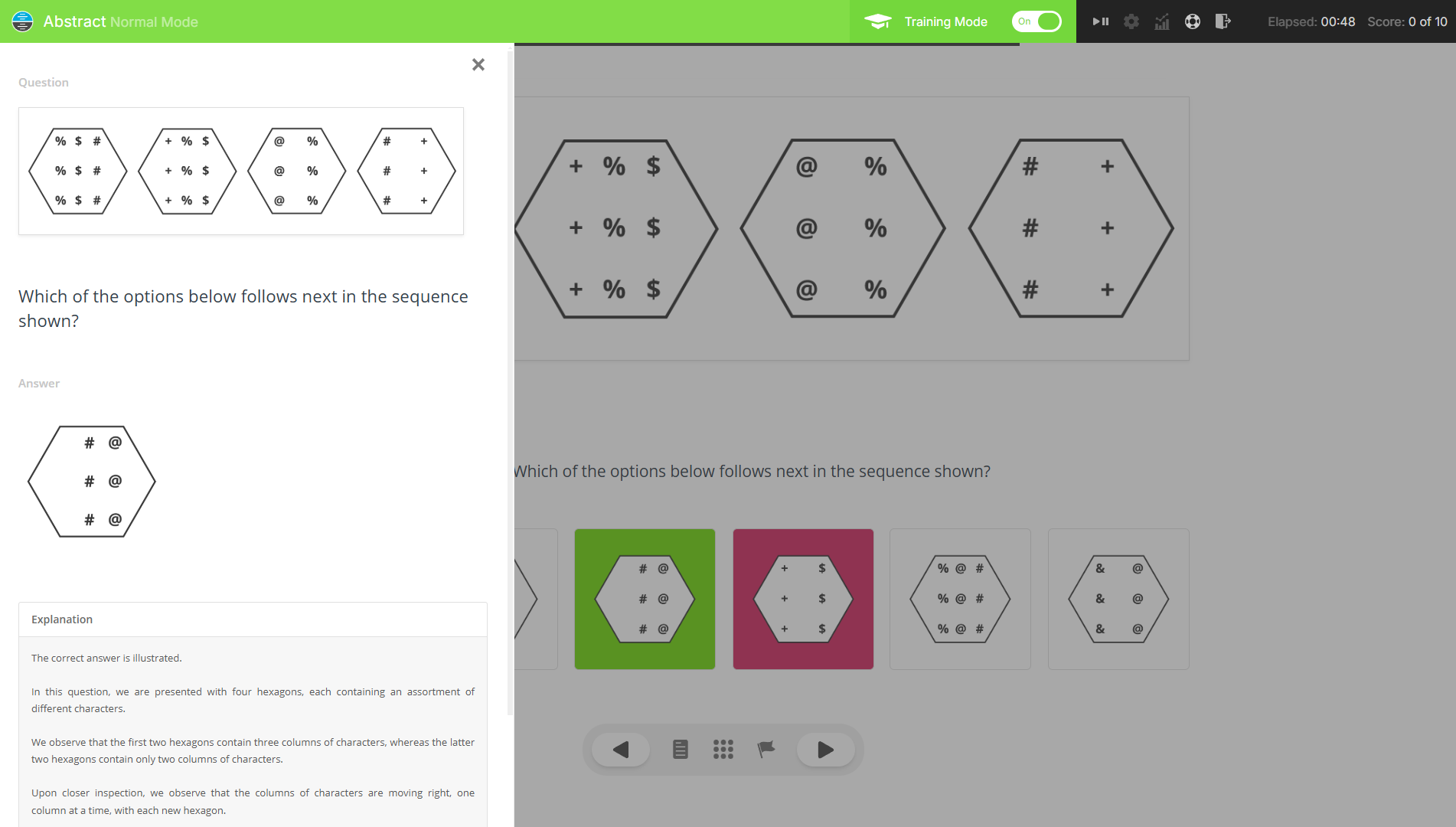
In the Abstract activity, candidates are presented with sequences of diagrams containing geometric elements, symbols and binary states. They must understand how components interact and transform, identify the rules governing the progression of the sequence, and then apply those rules to determine what comes next. The rules can operate on multiple dimensions simultaneously: shape, colour, position, orientation, size and quantity may all change according to different patterns within the same sequence.
This format is the most complex of the abstract reasoning tasks because the candidate must track multiple rules operating in parallel. A sequence might involve shapes that rotate clockwise by 45 degrees in each step, whilst simultaneously changing colour in a repeating cycle and alternating between filled and unfilled states. The candidate must identify all of these concurrent rules and apply them together to select the correct next element.
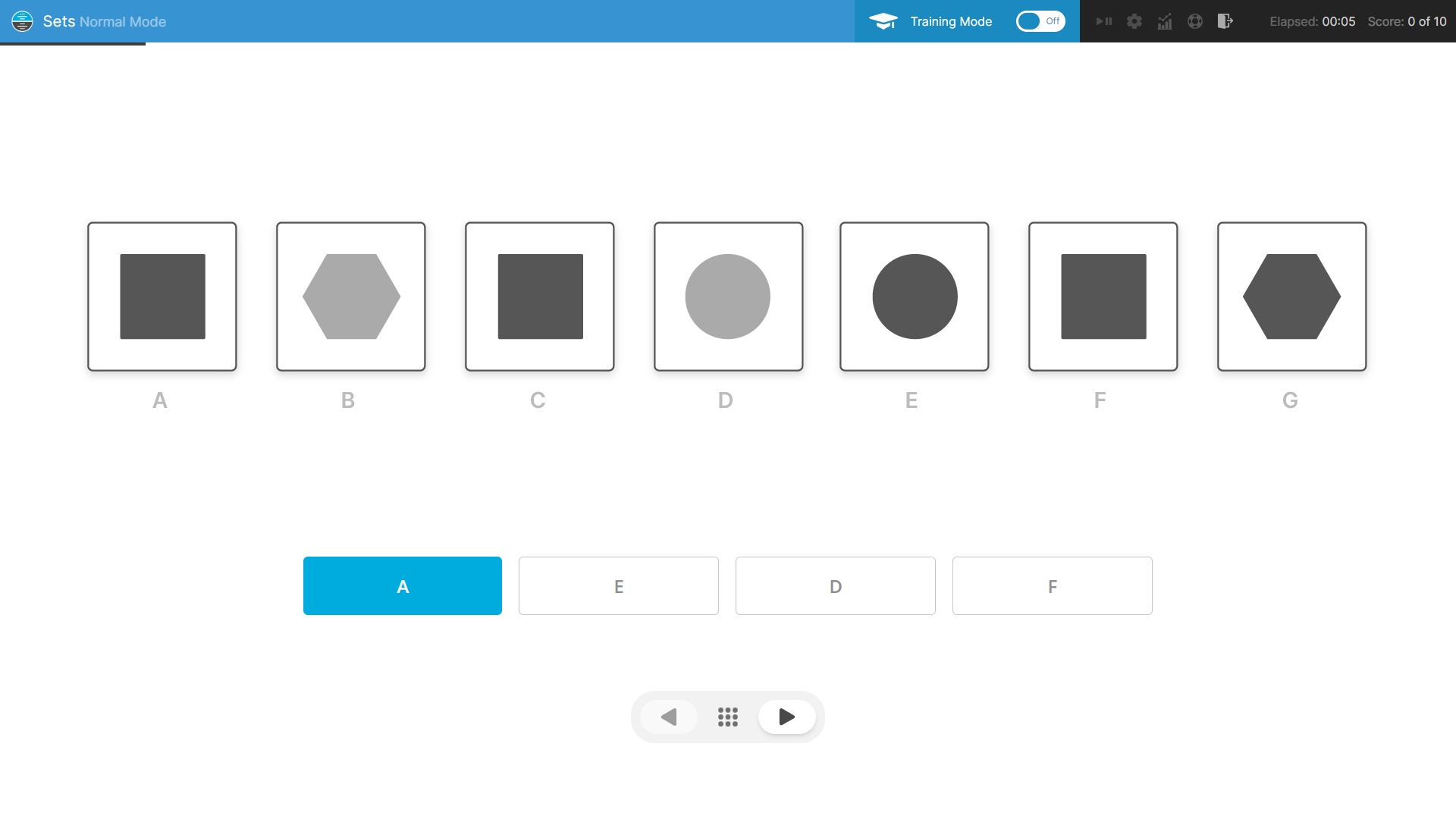
In the Sets activity, candidates examine sets of images and must identify the image within each set that does not follow the rule governing the others. Though this "odd-one-out" format appears simple, the rule governing the images displayed can be tricky to identify. The difficulty lies not in the visual complexity of each individual image but in determining what property or relationship connects the majority and which element violates it.
The rules can be based on obvious visual features (shape, colour, number of sides) or on more subtle properties (symmetry, the relationship between internal and external elements, the direction of a pattern, or a mathematical property such as odd or even counts). The candidate must consider multiple possible rules, test each against the full set, and determine which rule is broken by exactly one element. This process of systematic hypothesis testing is a direct measure of inductive reasoning applied to visual information.
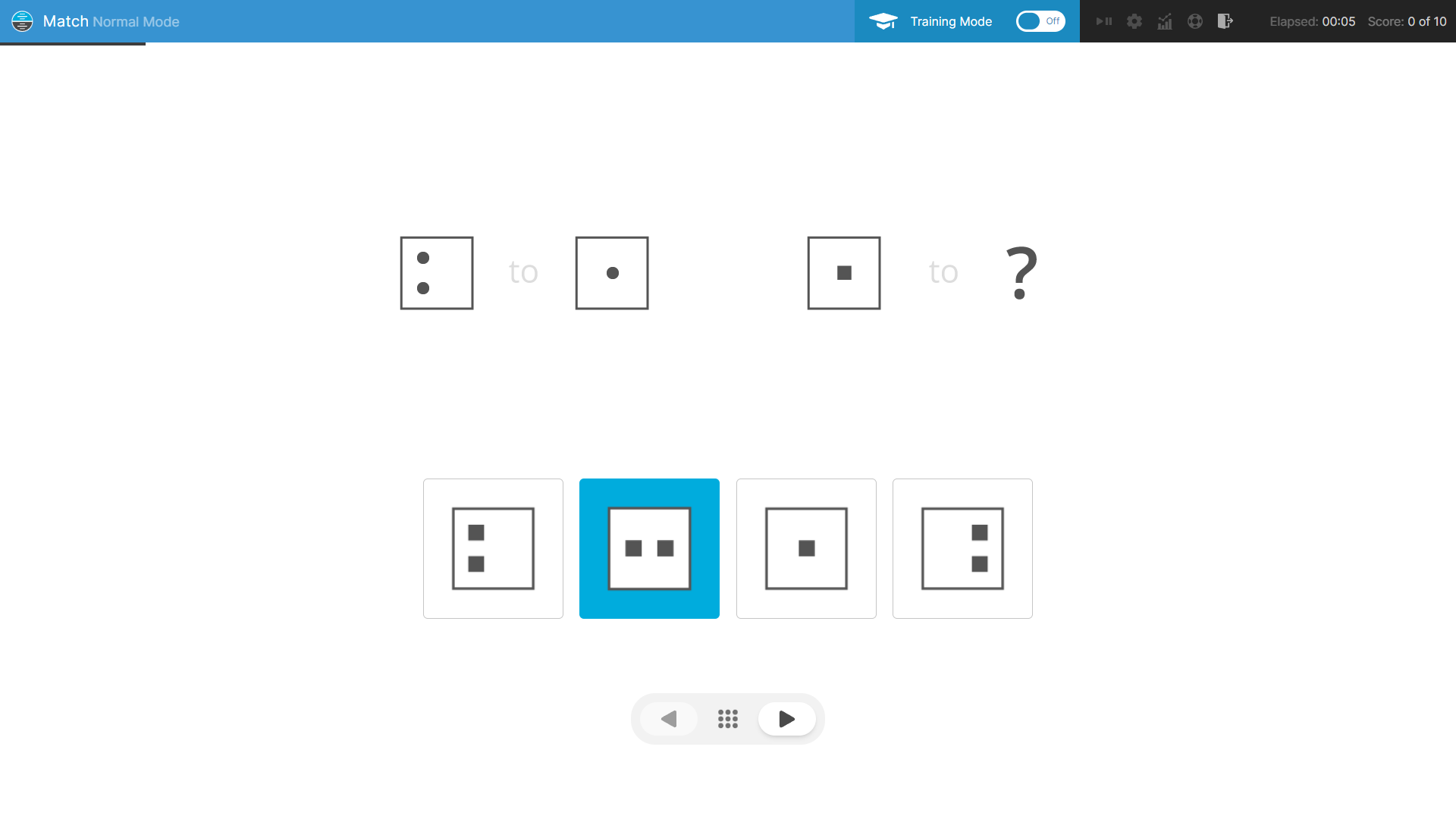
In the Match activity, candidates examine a series of pairs of images and must identify the rule governing the change that occurs between them. Having identified the transformation rule, they must apply the same rule to further pairs of images to determine the correct output.
This format is distinctive because the candidate must identify the transformation (what changes between image A and image B) rather than a static property. The transformation might involve rotation, reflection, colour inversion, element addition or removal, scaling, or a combination of operations. The candidate must determine the rule from the example pairs and then predict the result of applying the same transformation to a new input image. This tests the ability to extract a process (a rule about change) rather than a property (a rule about appearance).
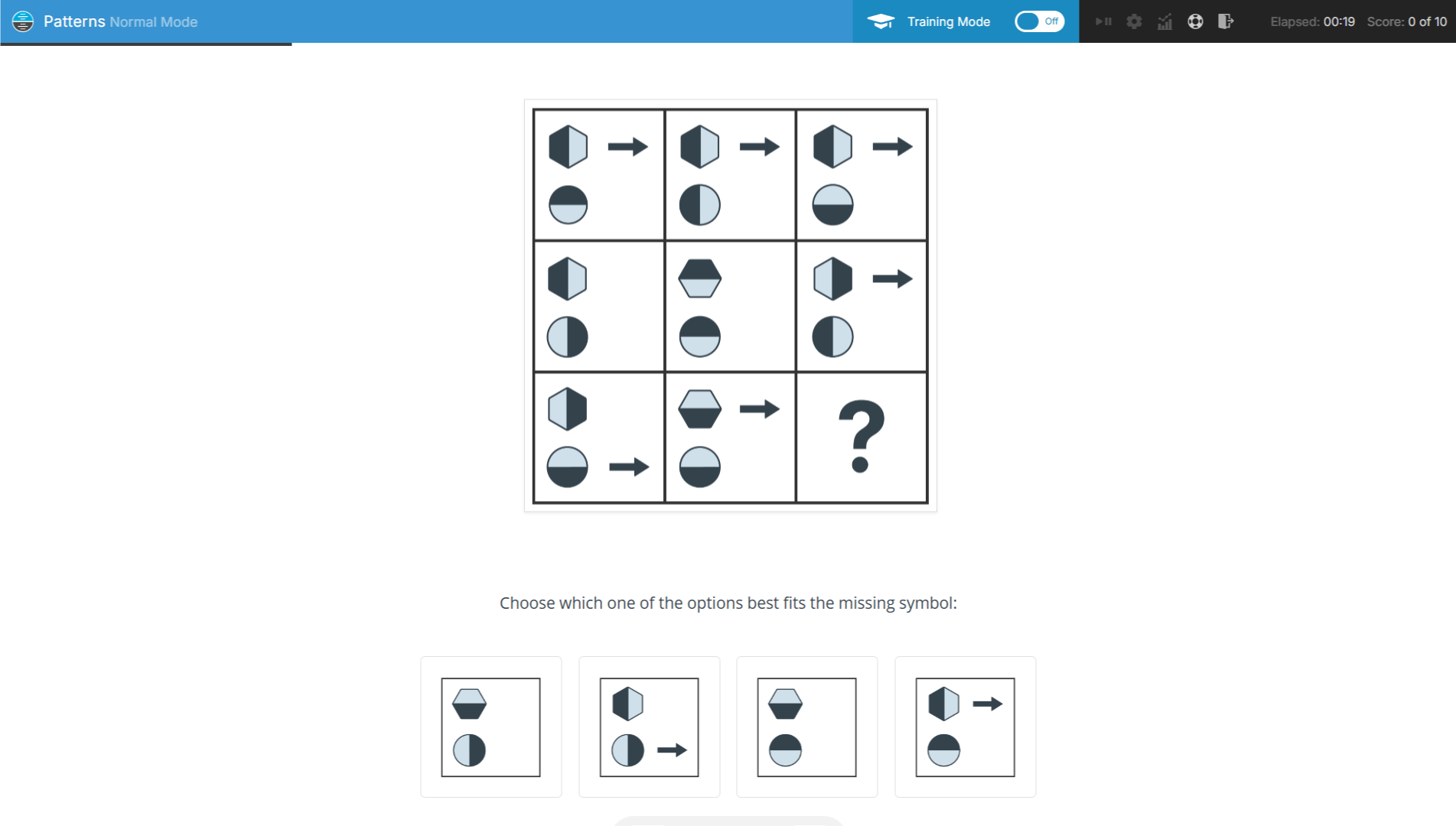
In the Patterns activity, candidates undertake grid-based challenges, each containing diverse visual elements. The task is to decode the positioning and transformative relationships within the grid: how elements relate to each other across rows, columns, or diagonals. Candidates must identify governing rules that vary significantly between questions whilst working within consistent grid formats.
The grid format introduces a structural dimension that the other formats do not: the candidate must determine whether the rules operate across rows, down columns, diagonally, or in some combination. A grid might contain shapes where the rule governing each row is different from the rule governing each column, and the candidate must identify both to determine the missing element. This multi-directional analysis makes grid-based abstract reasoning one of the more demanding formats, requiring the candidate to hold multiple rule hypotheses simultaneously.
Airline and flying school assessments that incorporate abstract reasoning will typically extend to testing of verbal, numerical and other reasoning abilities. Our software includes three additional activities that provide preparation across these broader reasoning areas, each generating infinite questioning:
Mental Ability provides a comprehensive assessment of combined verbal reasoning and numerical reasoning aptitude. Across sixteen question categories (including vocabulary, analogies, number sequences, word problems, and pattern recognition), candidates must demonstrate inductive reasoning and cognitive flexibility by alternating between linguistic and mathematical challenges within a time-constrained environment.
Numerical Ability assesses numerical reasoning and mental arithmetic proficiency through eleven categories of mathematical challenge. Candidates must perform calculations involving percentages, fractions, ratios, and unit conversions, whilst also demonstrating competence in applied scenarios such as speed-distance-time problems and timezone calculations, reflecting the quantitative demands encountered in aviation operations.
Verbal Ability evaluates a candidate's capacity for deductive reasoning and logical analysis. Presented with passages containing multiple constraints and conditions, candidates must draw valid conclusions, evaluate statement veracity, interpret conditional logic, and solve spatial arrangements, developing skills essential for processing complex operational information and making sound judgements under pressure.
Abstract Reasoning appears within pilot aptitude assessments that test broader cognitive and reasoning abilities. The Sova assessment, for example, includes Logical Reasoning as one component of its blended assessment, directly assessing abstract reasoning through visual pattern and sequence tasks. Other test systems assess related abilities through their Inductive Reasoning and Logic modules.
If your assessment includes any form of non-verbal, pattern-based or logical reasoning, preparing for Abstract Reasoning will be beneficial.
The table below outlines the activities available for Abstract Reasoning preparation, organised by reasoning type.
| Activity | Reasoning Type | Task | Questioning |
|---|---|---|---|
| Abstract | Sequence Progression | Decode multi-rule sequences of geometric elements, symbols and binary states | Finite |
| Sets | Odd-One-Out | Identify the image in each set that does not follow the governing rule | Finite |
| Match | Transformation Rule | Identify the change between image pairs and apply the same rule to new pairs | Finite |
| Patterns | Grid-Based Decoding | Decode positioning and transformative relationships within visual grids | Finite |
| Mental Ability | Verbal + Numerical + Inductive | Sixteen categories including analogies, sequences, word problems and pattern recognition | Infinite |
| Numerical Ability | Numerical Reasoning + Arithmetic | Eleven categories including percentages, fractions, ratios, SDT and timezone calculations | Infinite |
| Verbal Ability | Deductive + Logical Analysis | Constraint-based passages requiring conclusions, conditional logic and arrangement reasoning | Infinite |
Having identified the activities relevant to your assessment, you can navigate directly to them within our software.
Our software organises activities by the type of assessment you are preparing for, the skill being evaluated, and the specific airline, flying school or cadet scheme you are applying to. This means the relevant Abstract Reasoning activities will already be included in your tailored preparation.
To find the activities relevant to you, navigate to one of the following within the software:
- Activities by Aptitude Test
- If you know which test system your assessment uses. Navigate to Activities by Aptitude Test and select your assessment to see which Abstract Reasoning activities are included.
- Activities by Skill
- If you want to focus specifically on Abstract Reasoning. Navigate to Activities by Skill and select Abstract Reasoning to see every relevant activity.
- Activities by Airline, Flying School or Cadet Scheme
- If you know where you are applying but not which test system is used. Navigate to Activities by Airline or Activities by Flying School and select your chosen organisation. The software will include the appropriate Abstract Reasoning activities alongside all other relevant preparation.
If you have created a Preparation Strategy, the relevant Abstract Reasoning activities will already appear in your Focus Activities; no additional navigation is required.
Abstract Reasoning is closely associated with several other competencies assessed in pilot aptitude testing. Candidates preparing for Abstract Reasoning will also benefit from developing the following related skills:
Academic Sources referenced in this KB Article
The following academic sources were consulted in the preparation of this article:
[1] Cattell, R. B. (1963). Theory of fluid and crystallized intelligence: A critical experiment. Journal of Educational Psychology, 54(1), 1-22.
[2] Carroll, J. B. (1993). Human Cognitive Abilities: A Survey of Factor-Analytic Studies. Cambridge University Press.
[3] Raven, J. C., Court, J. H., & Raven, J. (1998). Raven's Progressive Matrices and Vocabulary Scales. Oxford Psychologists Press.
[4] Hunter, D. R., & Burke, E. F. (1994). Predicting aircraft pilot-training success: A meta-analysis of published research. The International Journal of Aviation Psychology, 4(4), 297-313.
[5] Lievens, F., & Sackett, P. R. (2006). Video-based versus written situational judgment tests: A comparison in terms of predictive validity. Journal of Applied Psychology, 91(5), 1181-1188.
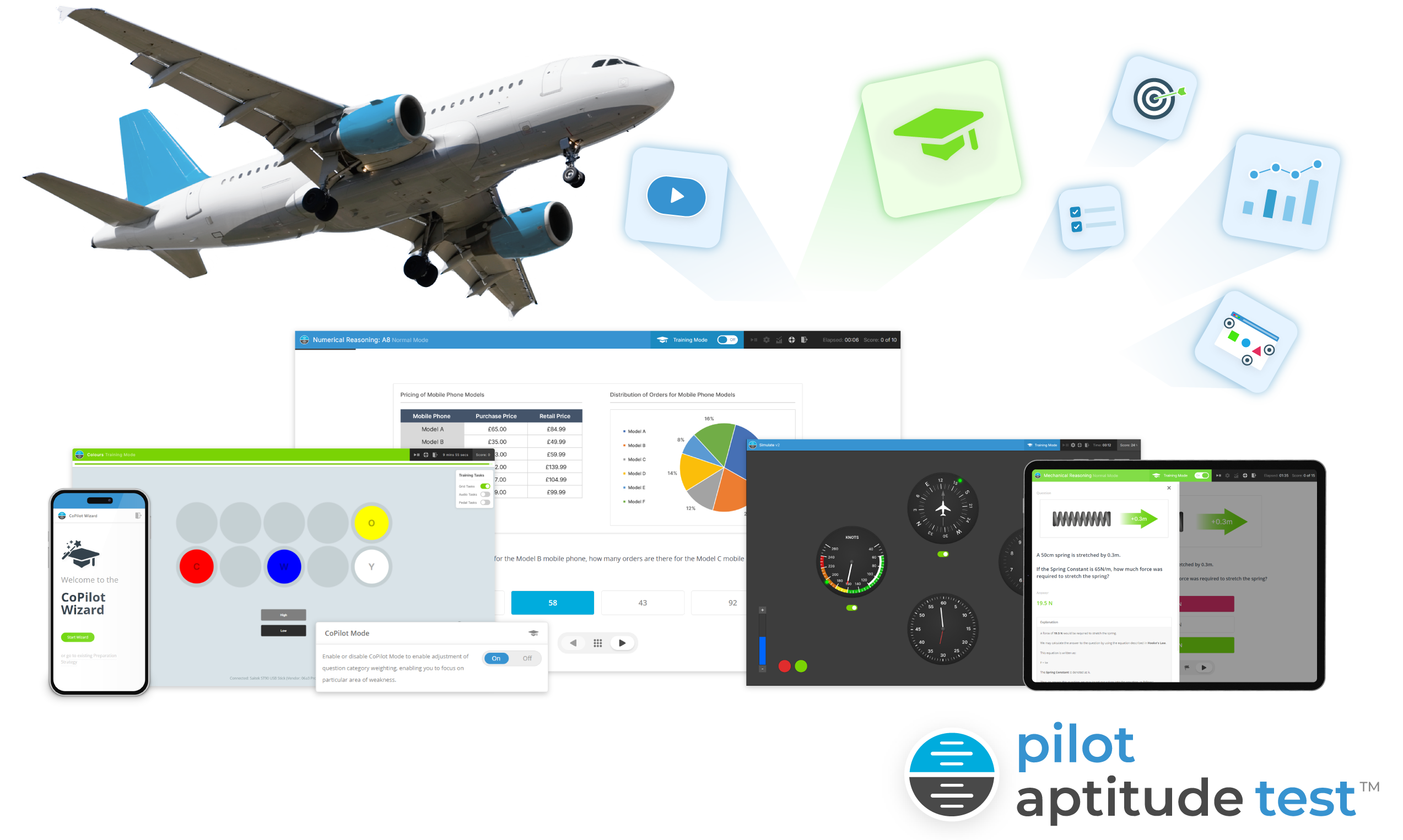
With a section dedicated to Abstract Reasoning, our one-of-a-kind software represents the ultimate way for you to get prepared.
By leveraging our cutting-edge software, including those unique features and extensive guidance not offered elsewhere, you can immerse yourself in realistic simulations, master those competencies assessed, and familiarise yourself with the methods and mechanisms of assessment.
Our software is backed by our meticulous attention to detail and deep expertise as experienced commercial pilots, empowering pilot applicants to approach their assessments with confidence and helping to propel them to supersonic levels of success.
Start using our incredible preparation software immediately on PC, Mac, iOS and Android by purchasing a subscription:
Buy Preparation SoftwareWith increasing prevalence and awareness of computerised pilot aptitude testing in pilot assessments, it's never been more important to ensure that you can fly past the competition. This is made easy with features unique to our software:












Discover the key advantages of using our cutting-edge software:
How can I prepare for my Abstract Reasoning pilot assessment?
The best way to prepare for your Abstract Reasoning pilot assessment is with our latest industry-leading software, developed over 5 years by experienced airline pilots. With realistic exam simulations, personalised Preparation Strategies which guide you through your preparation, immersive Explainer Videos, customisable Training Modes that manipulate your simulation environments, comprehensive Instruction and Guidance, and extensive performance feedback which incorporates unique features such as Predictive Scoring, a Strength & Weakness Map and Colour Coding, our unique software will help you to accelerate improvement of your problem areas and fly through each part of the Abstract Reasoning assessment. The software runs in a web browser, is compatible with laptop, desktop, tablet and smartphone, and is complimented with extensive support, provided from 9AM to 9PM GMT. To purchase a subscription to our software and start preparing for your Abstract Reasoning pilot assessment, click here!
What is the pass mark for the Abstract Reasoning pilot assessment?
Many pilot aptitude tests do not have a fixed threshold (or pass mark), but rather indicate the pilot candidate's overall performance and suitability using a variety of different methods - many of which are emulated within our software. Rather than worrying about a specific pass mark, the better approach is to focus on comprehensive preparation that maximizes your chances of success within each part of the Abstract Reasoning pilot assessment. Our industry-leading pilot preparation software provides that comprehensive preparation, helping you to develop the essential sklls, familiarity with assessment and confidence needed to perform at your best. If you have any questions about the Abstract Reasoning pilot assessment, please contact us.
How often is your Abstract Reasoning assessment preparation software updated?
Our pilot assessment preparation software is continuously updated, with daily improvements based on feedback from hundreds of monthly users. Developed by experienced airline pilots, the simulations provided within our unique software faithfully reflect the Abstract Reasoning pilot assessment, ensuring that you have the most current and comprehensive preparation. To see the recent updates to our preparation software, please visit our Updates page.
What support is available with your Abstract Reasoning assessment preparation software?
With our own industry experiences, we understand the pressures and stresses that come with preparing for pilot assessments. When you use our software to prepare for your Abstract Reasoning pilot assessment, you'll have access to exceptional support and guidance from our team of experienced airline pilots, provided between 9AM and 9PM GMT. This support sets us apart, helping you to develop the skills, knowledge, and confidence needed to approach your assessment feeling completely ready to demonstrate your true potential and fly past the competition at every stage of the Abstract Reasoning pilot assessment.
How quickly can I prepare for my Abstract Reasoning pilot assessment with this software?
If you'd like to start preparing for the Abstract Reasoning assessment, you may start using our software within as little as a few minutes. We offer access to our preparation software for 7 days, 1 month or 3 months, and provide the opportunity to purchase additional time. This ensures you can work through the comprehensive simulations, and benefit from our guidance at your own pace, with support available whenever you need it. To get started, choose a subscription duration to our preparation software, create an account and complete your purchase - then, login and begin your preparation. The entire process typically takes between 2-3 minutes, with secure payment by credit or debit card securely processed with Stripe or PayPal.
Feature-packed and one-of-a kind preparation software for your assessment.
Regularly updated, realistic and infinite simulations of aptitude tests.
Instant activation, fast support and uniquely in-depth guidance.