

 Maths for Pilots
 Science for Pilots
 English Language for Pilots
 Verbal Reasoning for Pilots
 Numerical Reasoning for Pilots
 Mechanical Reasoning for Pilots
 ATPL Knowledge for Pilots
 WhatsApp
 Facebook Chat
 Email
Email








































If you don't have time to read this article but would like to know whether our software can help - it can. You can buy access to our software and get started immediately, 365 days-a-year.
Buy Preparation SoftwareVerbal Reasoning describes the ability to understand, analyse and draw accurate conclusions from written information. In pilot aptitude testing, Verbal Reasoning is assessed as the candidate's capacity to read passages of text, evaluate statements against the information provided, and determine whether those statements are supported, contradicted, or not addressed by the source material. Verbal Reasoning assessments in pilot aptitude testing are not tests of vocabulary, grammar or general knowledge. They evaluate the candidate's ability to reason logically using written information as the evidence base. The specific demands vary between modules, but collectively the types of verbal reasoning assessed include:
The central challenge of Verbal Reasoning is distinguishing between what the text actually says, what it implies, and what it does not address. Candidates must set aside their own knowledge and opinions and reason solely from the information provided. This discipline of evidence-based reasoning, drawing conclusions only from the available data, is directly relevant to aviation decision-making, where pilots must base their actions on the information they have rather than on assumptions.
Further Reading on Verbal Reasoning and Critical Thinking
The True/False/Cannot Say Paradigm
The most common format used in pilot aptitude Verbal Reasoning modules is the True/False/Cannot Say (TFC) paradigm. This format requires the candidate to evaluate a statement against a passage of text and determine whether the statement is True (definitely supported by the passage), False (definitely contradicted by the passage), or Cannot Say (the passage does not provide enough information to determine whether the statement is true or false) [1].
The "Cannot Say" option is what distinguishes this format from a simple comprehension test. It requires the candidate to recognise the limits of the available evidence and resist the temptation to use prior knowledge or common-sense assumptions to fill gaps in the information. Research has shown that the "Cannot Say" option is the most frequently misclassified response, as candidates tend to over-infer from passages, treating plausible but unsupported conclusions as if they were confirmed [2]. This tendency to over-infer is precisely what the format is designed to detect, as it mirrors the operational risk of making assumptions in the cockpit without verifying them against the available data.
Verbal reasoning is exercised whenever you need to evaluate a claim against the evidence available to you. Reading a news article and determining whether a headline accurately reflects the content of the article requires verbal reasoning: you must compare the headline's claim against the information in the text and decide whether it is supported, exaggerated, or misleading. Similarly, reading the terms and conditions of a contract and determining whether a specific scenario is covered requires you to reason from the written text rather than from what you assume the policy should say.
A more demanding example is evaluating competing claims in a discussion. If two people present different interpretations of the same set of facts, verbal reasoning is what allows you to assess which interpretation is supported by the evidence and which goes beyond what the facts actually establish. The discipline of distinguishing between "this is what the information says" and "this is what I think is probably true based on the information" is the core skill that verbal reasoning modules assess.
Written information is a constant presence in aviation. Pilots must read, interpret and act on information from operational documents, technical manuals, weather reports, NOTAMs, SOPs and regulatory publications throughout their careers. The ability to extract accurate meaning from these texts, and to avoid misinterpreting or over-inferring from them, is directly relevant to safe flight operations.
- NOTAM interpretation:
- Notices to Airmen (NOTAMs) provide essential information about changes to aerodrome facilities, airspace restrictions, navigation aid availability, and other operational factors. NOTAMs are written in a standardised but often dense format, and the pilot must extract the operationally relevant information and determine its impact on the planned flight. Misinterpreting a NOTAM (for example, reading a temporary restriction as applying to a different altitude band or time period than stated) can result in an airspace infringement or an approach to a runway with a displaced threshold or restricted facilities.
- Standard Operating Procedures:
- SOPs define the procedures, callouts, and actions that the crew must follow during each phase of flight. These are written documents that must be read, understood, and applied accurately. During training and checking, pilots must demonstrate that they have correctly interpreted the SOPs, and during line operations, they must apply them consistently. The ability to read an SOP and determine exactly what it requires (and what it does not require) is a verbal reasoning task. Ambiguity in SOPs is a known contributor to procedural errors, and pilots with stronger verbal reasoning are better equipped to identify and resolve such ambiguities.
- Weather report analysis:
- METARs, TAFs, SIGMETs and other weather reports use standardised formats to convey meteorological information. The pilot must decode these reports and determine their operational significance: whether the weather at the destination is above approach minima, whether the forecast suggests it will remain so, and whether any significant weather along the route requires a change of plan. This requires both accurate reading of the coded information and the ability to draw appropriate conclusions without over-interpreting the data.
- Technical documentation:
- Aircraft manuals, minimum equipment lists (MELs), and performance charts contain critical information that pilots must interpret accurately. Determining whether a particular equipment defect allows dispatch under the MEL, or whether a specific runway performance limitation applies to the current conditions, requires careful reading and precise reasoning from the stated criteria. Errors in interpreting technical documentation can have direct safety consequences.
- Mission briefing interpretation:
- Helicopter operations frequently involve mission briefings from external agencies (HEMS dispatch, SAR coordination centres, police tasking units). These briefings contain written or verbal information about the task, the location, known hazards, and operational constraints. The pilot must extract the relevant information, identify any gaps or ambiguities, and determine the implications for the flight. Misinterpreting a grid reference, a hazard description, or a tasking constraint can result in the aircraft arriving at the wrong location or operating in an area with unidentified risks.
- Landing site assessment information:
- Information about landing sites may be provided in written site surveys, operational notices, or electronic databases. The pilot must read and interpret this information to determine whether the site is suitable for the current conditions (wind, weight, lighting, obstacles). The information may include specific limitations ("maximum AUW 3,200 kg", "night operations not permitted", "prior permission required from landowner") that must be correctly interpreted and applied. Failure to correctly interpret a site limitation is a verbal reasoning error with potentially serious consequences.
- Regulatory and operational notices:
- The helicopter operating environment involves frequent regulatory updates, safety directives, and operational notices from the operator, the manufacturer, and the aviation authority. The pilot must read these documents, determine their relevance, and identify any required actions. The ability to accurately determine what a notice requires, and equally importantly what it does not require, is a verbal reasoning skill that prevents both non-compliance and unnecessary operational disruption.
Aviation decision-making must be grounded in the available evidence: the instruments, the weather reports, the procedures, the aircraft performance data. The tendency to over-infer, to assume something is true because it seems likely rather than because the evidence confirms it, is a recognised risk factor in aviation incidents. Verbal Reasoning modules specifically assess the candidate's ability to reason from evidence rather than assumption, using the True/False/Cannot Say format to detect those who conflate "probably true" with "confirmed by the text."
This discipline of evidence-based reasoning transfers directly to operational decision-making. A pilot who can accurately distinguish between "the weather report says conditions will be above minima" and "conditions will probably be above minima based on what I can see" is exercising the same cognitive skill assessed in Verbal Reasoning modules.
Pilot training involves a very large volume of written material: theory textbooks, aircraft manuals, operational procedures, regulatory documents, and examination questions. The ability to read, comprehend, and reason from this written material efficiently is a practical prerequisite for successful training. Candidates with stronger verbal reasoning can extract accurate understanding from written sources more quickly, which supports both ground school performance and the self-study that is essential throughout a pilot's career [3].
The ATPL theoretical knowledge examinations, which all airline pilots must pass, are themselves heavily dependent on the ability to read questions carefully, reason from the information provided, and avoid over-interpreting or misreading the question stem. Strong verbal reasoning directly supports examination performance.
Verbal Reasoning is assessed across Aon (Cut-e), CBAT / CFAST / MACTS, COMPASS, Advanced COMPASS and Sova assessments. The most common format is the True/False/Cannot Say paradigm, used by Aon, COMPASS, Advanced COMPASS and Sova. The CBAT Verbal Logic Test uses a logical inference approach with increasing quantities of text, and the CBAT System Logic Test combines verbal comprehension with numerical reasoning, requiring the candidate to interpret information from multiple written and numerical sources. COMPASS and Advanced COMPASS list their Verbal Reasoning modules as optional, meaning they may or may not be included depending on the specific assessment configuration.
Further Reading on Verbal Ability and Pilot Selection
Verbal Ability in Cognitive Selection Batteries
Verbal ability has been a component of pilot selection batteries since the earliest systematic selection programmes. Research has shown that verbal ability contributes to the prediction of training success primarily through its relationship with ground school performance and the acquisition of procedural knowledge [3]. Whilst spatial and psychomotor abilities tend to predict flight training performance more strongly, verbal ability predicts the theoretical and knowledge-based components of training that are prerequisites for reaching the flight phase.
In modern selection, verbal reasoning tests have evolved from simple vocabulary and comprehension measures to the more sophisticated evidence-evaluation formats (such as True/False/Cannot Say) that better capture the kind of critical reasoning required in operational aviation. This evolution reflects a recognition that the relevant verbal skill for pilots is not linguistic fluency per se, but the ability to reason accurately from written information under time pressure [4].
Computerised pilot aptitude tests evaluate Verbal Reasoning by presenting the candidate with written passages and requiring them to evaluate statements, draw conclusions, or synthesise information from multiple sources. The dominant format is the True/False/Cannot Say paradigm, but some modules use logical inference or multi-source synthesis approaches.
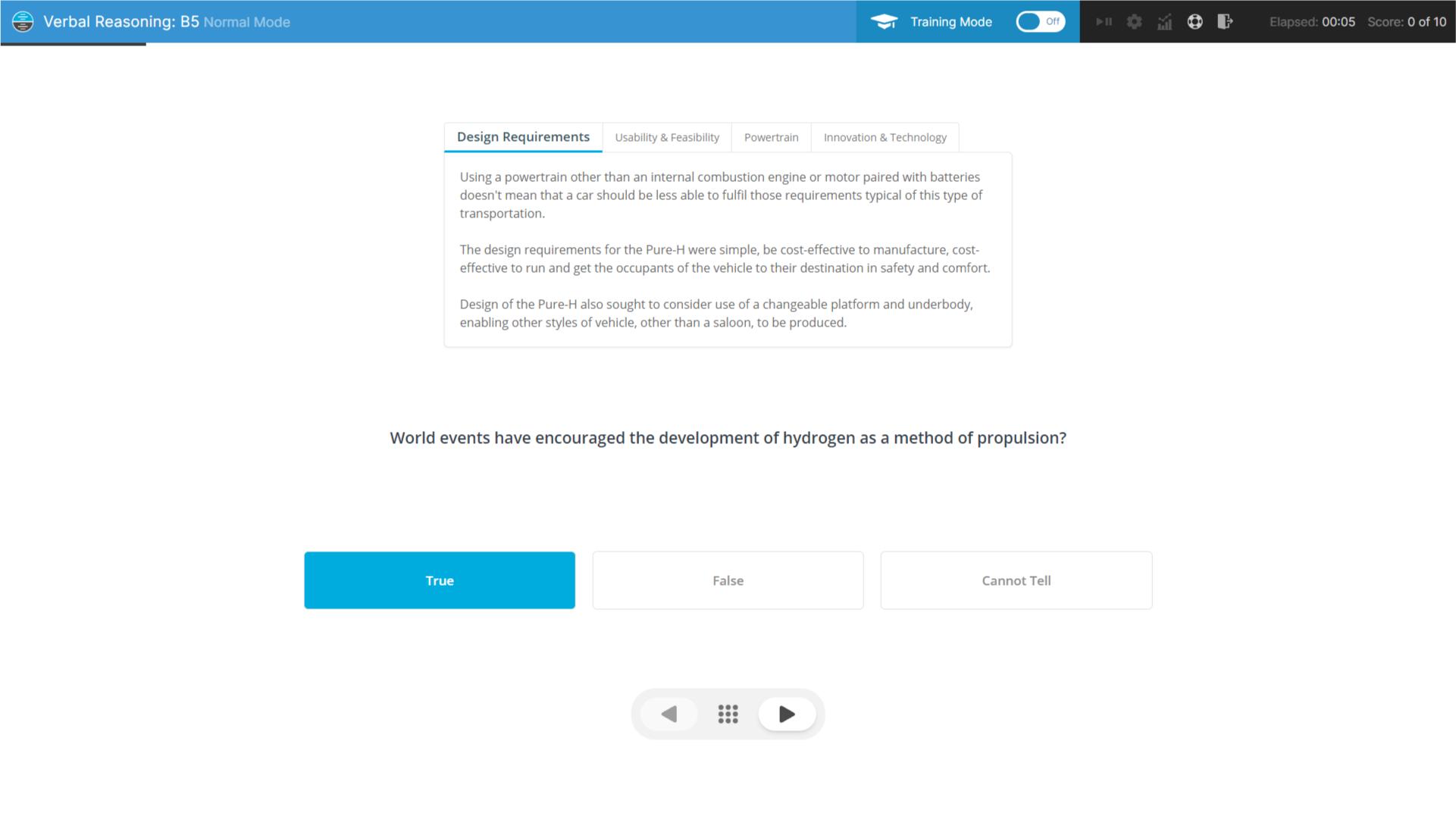
The Aon Verbal Reasoning (scales verbal) module presents text distributed across multiple tabs that the candidate must navigate between. For each statement, the candidate must determine whether it is True (supported by the text), False (contradicted by the text), or Cannot Say (the text does not provide sufficient information to determine the answer). The module contains 42 to 49 questions across 8 to 17 minutes, depending on the variant.
Multiple forms of this module exist, including admin, consumer, industry and instruct variants, with the possibility of any form being used in a pilot assessment. The tabbed format adds a navigation demand: the candidate must locate the relevant information across multiple text sections before evaluating the statement, rather than working from a single visible passage. This information-retrieval component increases the time pressure and rewards efficient reading strategies.
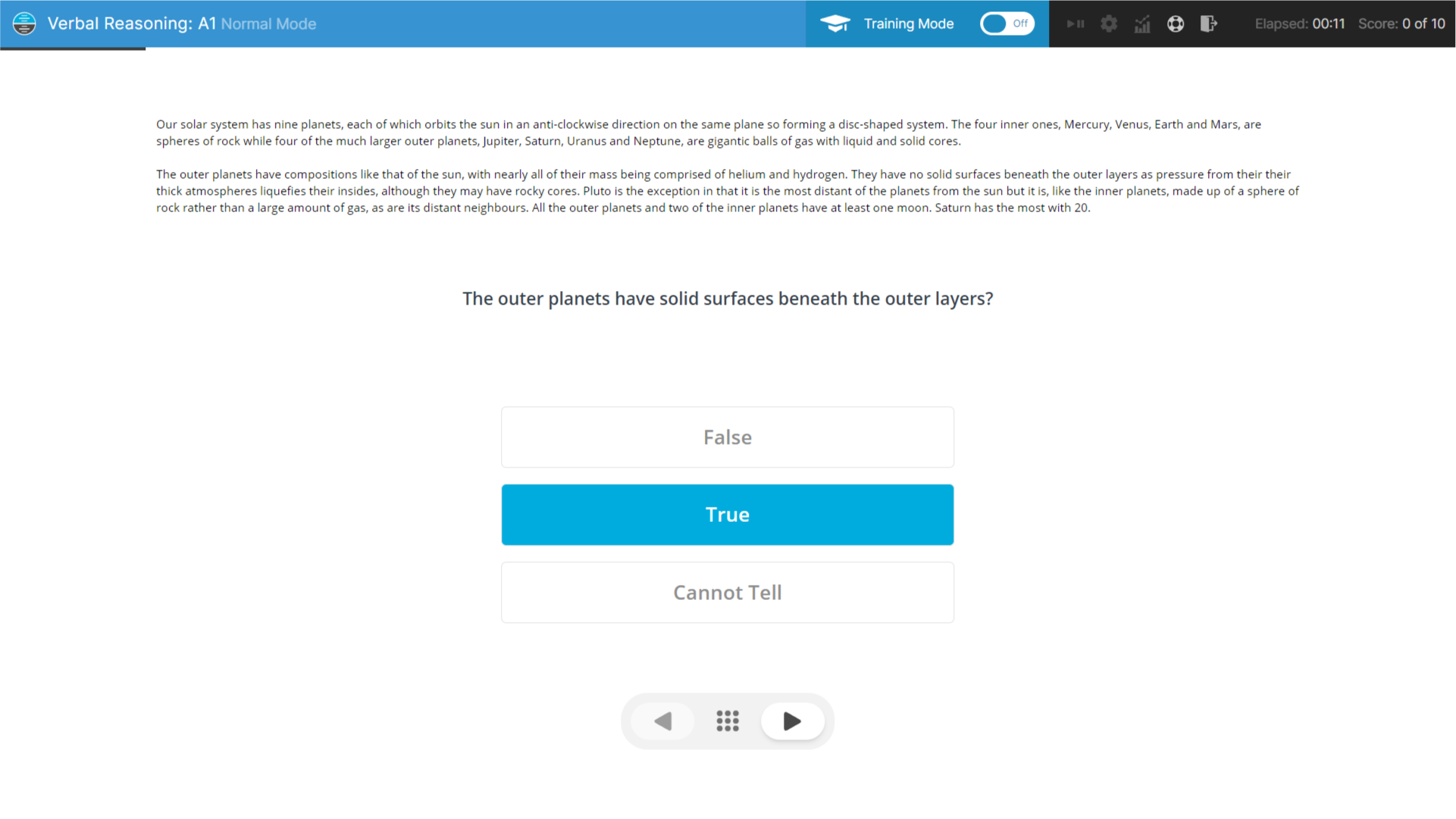
The COMPASS and Advanced COMPASS Verbal Reasoning modules present a passage of text on screen and require the candidate to evaluate an accompanying statement as True, False, or Cannot Say. These modules contain 10 questions with 22 minutes available, giving substantially more time per question than the Aon module. The COMPASS and Advanced COMPASS Verbal Reasoning modules are listed as optional and may not be included in every assessment configuration.
The Sova Verbal Reasoning component uses the same True/False/Cannot Say format. In Sova assessments, Verbal Reasoning is part of a blended assessment that also includes Logical Reasoning, Numerical Reasoning, and Checking & Accuracy, with the full assessment containing between 50 and 80 questions across 25 to 30 minutes.
The passage-based format used by these modules closely mirrors the operational task of reading a document (a NOTAM, an SOP section, a weather report) and determining whether a specific conclusion is supported by its contents. The longer time allowance in COMPASS and Advanced COMPASS modules permits more deliberate reading and analysis, whilst the Sova format requires the candidate to switch between different question types within the same timed assessment.
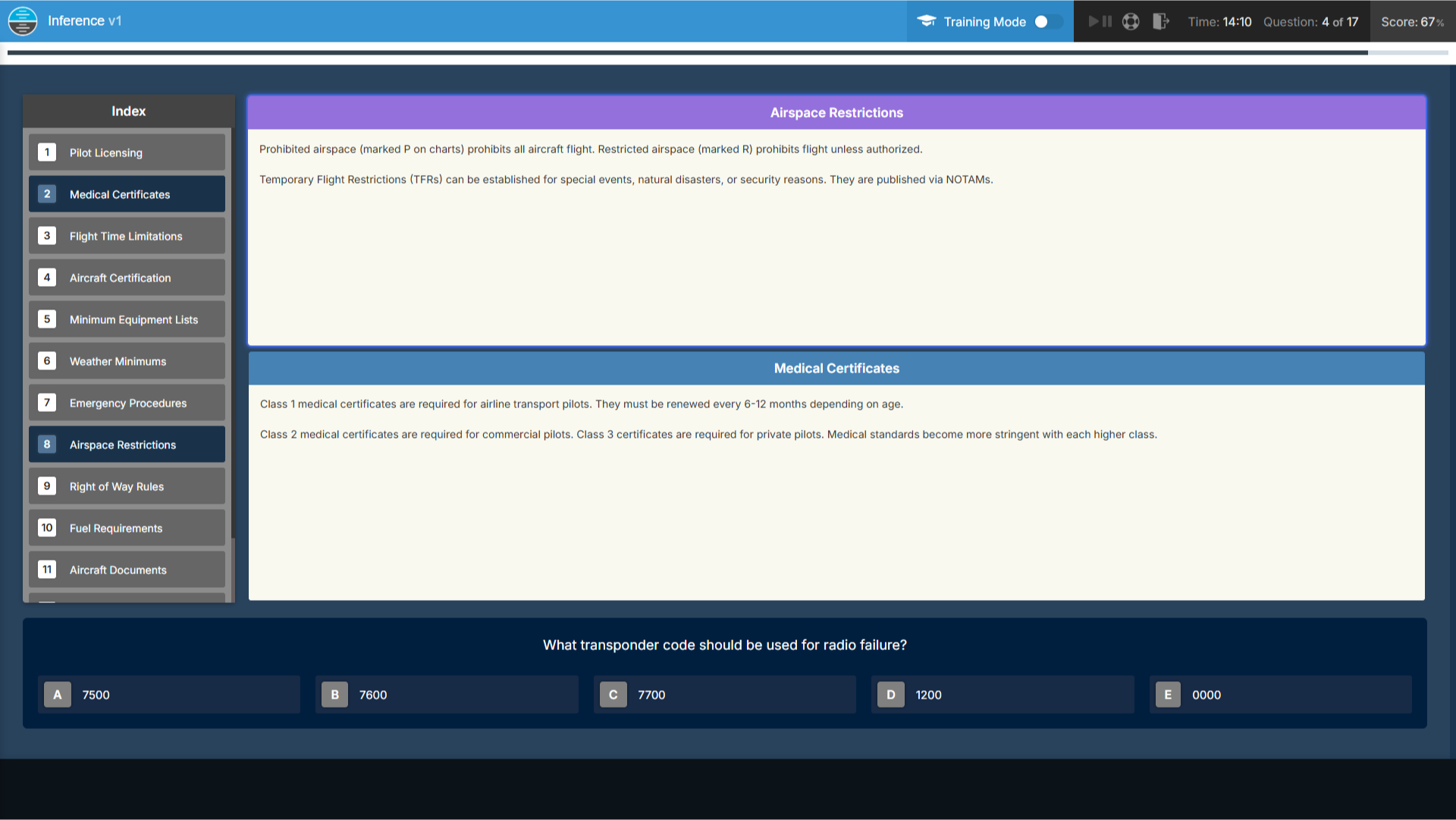
The CBAT Verbal Logic Test (VLT) requires the candidate to draw logical conclusions from increasing quantities of text-based information. Rather than evaluating individual statements as True/False/Cannot Say, the VLT presents progressively longer and more complex passages from which the candidate must deduce the correct answer through logical reasoning.
The increasing quantity of text is a distinctive feature: as the module progresses, the candidate must process more information, identify the relevant details, and apply deductive reasoning to reach conclusions. This format assesses not only comprehension but also the ability to manage increasing cognitive load whilst maintaining reasoning accuracy, which is relevant to the operational demand of processing growing quantities of information during complex or deteriorating situations.
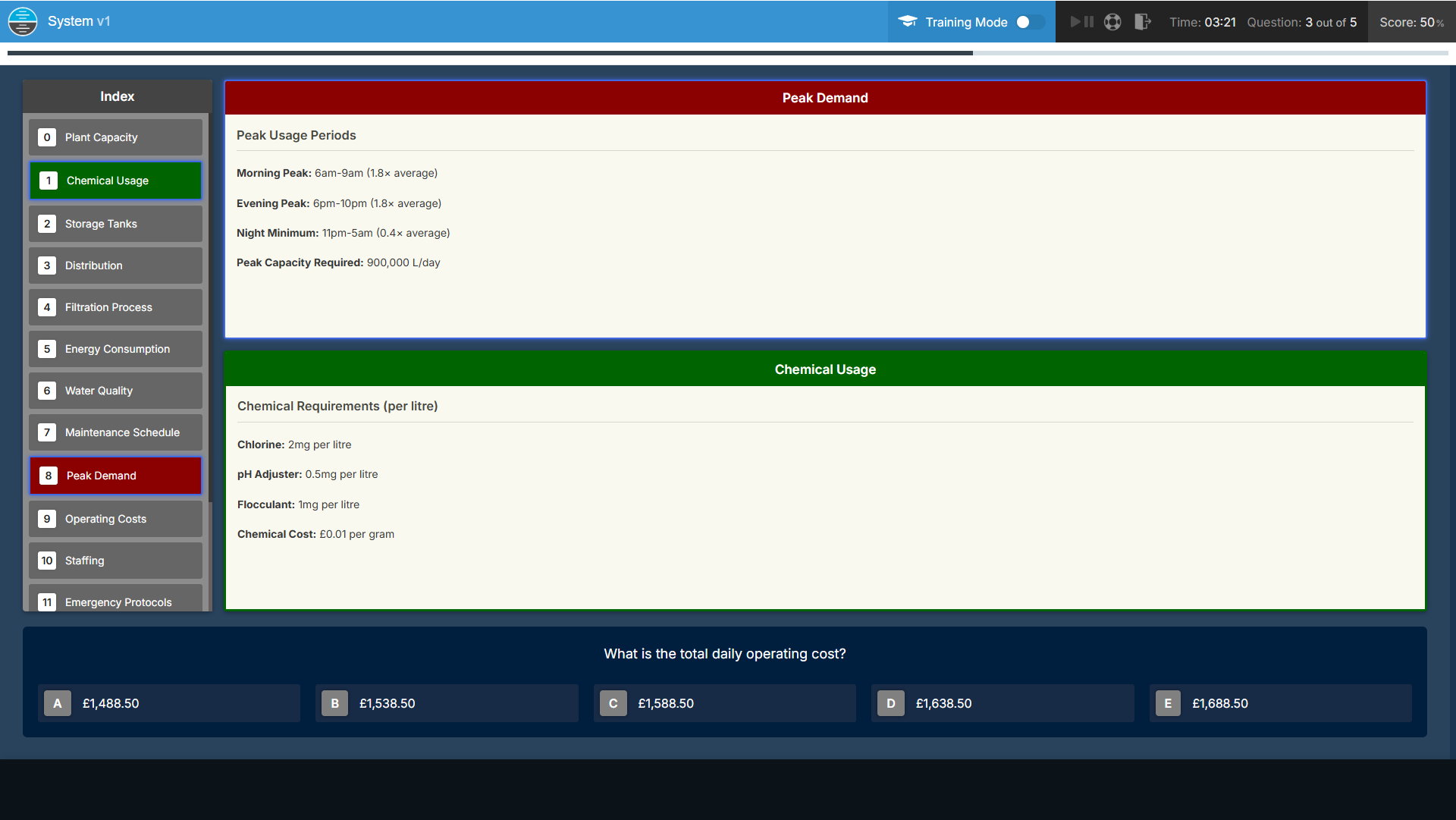
The CBAT System Logic Test (SLT) requires the candidate to examine information and data from a variety of sources to answer questions that combine mathematical and verbal reasoning. The candidate must interpret and synthesise information from multiple written and numerical sources, applying both logical and mathematical reasoning to determine the correct responses.
The SLT is distinctive in combining verbal comprehension with numerical problem-solving. The candidate must first understand what the written information is telling them (verbal reasoning) and then apply mathematical operations to the extracted data (numerical reasoning). This dual demand reflects the operational reality of tasks like performance calculations, where the pilot must first read and interpret the conditions and limitations stated in a manual before applying the numerical formulae.
Verbal Reasoning is assessed in the following pilot aptitude test systems:
The table below outlines the Verbal Reasoning modules in each assessment, linking each to the relevant preparation activity in our software.
| Assessment | Module | Reasoning Type | Format | Activity |
|---|---|---|---|---|
| Aon (Cut-e) | Verbal Reasoning (scales verbal) | Statement Evaluation | 42-49 questions, 8-17 min | VR B-Series |
| CBAT / CFAST / MACTS | Verbal Logic Test (VLT) | Logical Inference | TBC | Inference |
| CBAT / CFAST / MACTS | System Logic Test (SLT) | Verbal + Numerical Synthesis | TBC | System |
| COMPASS | Verbal Reasoning | Statement Evaluation | 10 questions, 22 min | VR A-Series |
| Adv. COMPASS | Verbal Reasoning | Statement Evaluation | 10 questions, 22 min | VR A-Series |
| Sova | Verbal Reasoning | Statement Evaluation | Blended, 25-30 min total | VR A-Series VR B-Series |
Having identified the modules relevant to your assessment, you can navigate directly to the corresponding activities within our software.
Our software organises activities by the type of assessment you are preparing for, the skill being evaluated, and the specific airline, flying school or cadet scheme you are applying to. This means you do not need to manually cross-reference the table above; the relevant Verbal Reasoning activities will already be included in your tailored preparation.
To find the activities relevant to you, navigate to one of the following within the software:
- Activities by Aptitude Test
- If you know which test system your assessment uses. For example, to find Verbal Reasoning activities for COMPASS, navigate to Activities by Aptitude Test and select COMPASS.
- Activities by Skill
- If you want to focus specifically on Verbal Reasoning across all test systems. Navigate to Activities by Skill and select Verbal Reasoning to see every relevant activity.
- Activities by Airline, Flying School or Cadet Scheme
- If you know where you are applying but not which test system is used. Navigate to Activities by Airline or Activities by Flying School and select your chosen organisation. The software will include the appropriate Verbal Reasoning activities alongside all other relevant preparation.
If you have created a Preparation Strategy, the relevant Verbal Reasoning activities will already appear in your Focus Activities; no additional navigation is required.
Verbal Reasoning is closely associated with several other competencies assessed in pilot aptitude testing. Candidates preparing for Verbal Reasoning modules may also benefit from developing the following related skills:
Academic Sources referenced in this KB Article
The following academic sources were consulted in the preparation of this article:
[1] Watson, P., & Glaser, E. M. (1980). Watson-Glaser Critical Thinking Appraisal Manual. The Psychological Corporation.
[2] SHL Group. (2006). Verbal Reasoning Test: Technical Manual. SHL Group Ltd.
[3] Hunter, D. R., & Burke, E. F. (1994). Predicting aircraft pilot-training success: A meta-analysis of published research. The International Journal of Aviation Psychology, 4(4), 297-313.
[4] Carretta, T. R., & Ree, M. J. (1996). Factor structure of the Air Force Officer Qualifying Test: Analysis and comparison. Military Psychology, 8(1), 29-42.
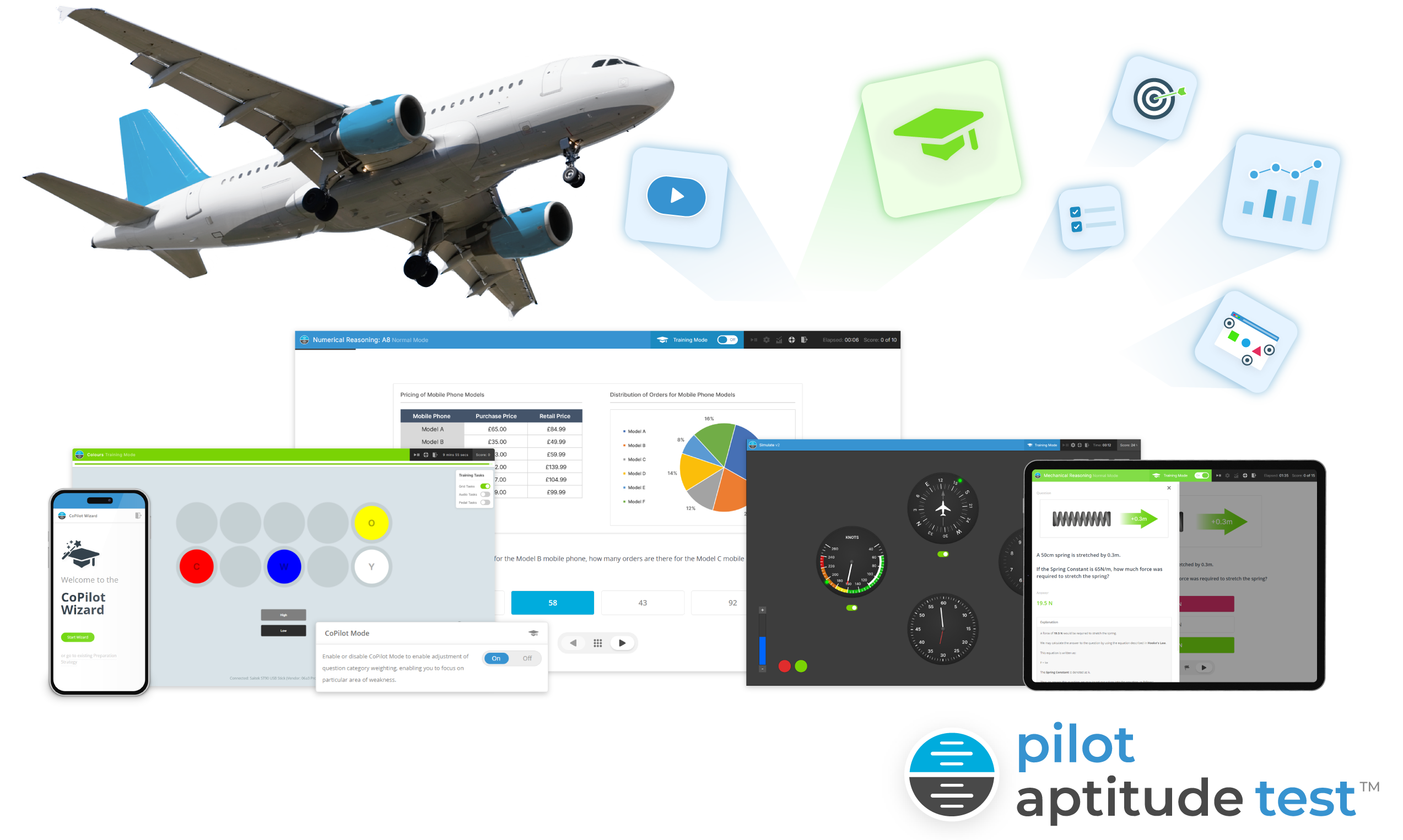
With a section dedicated to Verbal Reasoning, our one-of-a-kind software represents the ultimate way for you to get prepared.
By leveraging our cutting-edge software, including those unique features and extensive guidance not offered elsewhere, you can immerse yourself in realistic simulations, master those competencies assessed, and familiarise yourself with the methods and mechanisms of assessment.
Our software is backed by our meticulous attention to detail and deep expertise as experienced commercial pilots, empowering pilot applicants to approach their assessments with confidence and helping to propel them to supersonic levels of success.
Start using our incredible preparation software immediately on PC, Mac, iOS and Android by purchasing a subscription:
Buy Preparation SoftwareWith increasing prevalence and awareness of computerised pilot aptitude testing in pilot assessments, it's never been more important to ensure that you can fly past the competition. This is made easy with features unique to our software:












Discover the key advantages of using our cutting-edge software:
How can I prepare for my Verbal Reasoning pilot assessment?
The best way to prepare for your Verbal Reasoning pilot assessment is with our latest industry-leading software, developed over 5 years by experienced airline pilots. With realistic exam simulations, personalised Preparation Strategies which guide you through your preparation, immersive Explainer Videos, customisable Training Modes that manipulate your simulation environments, comprehensive Instruction and Guidance, and extensive performance feedback which incorporates unique features such as Predictive Scoring, a Strength & Weakness Map and Colour Coding, our unique software will help you to accelerate improvement of your problem areas and fly through each part of the Verbal Reasoning assessment. The software runs in a web browser, is compatible with laptop, desktop, tablet and smartphone, and is complimented with extensive support, provided from 9AM to 9PM GMT. To purchase a subscription to our software and start preparing for your Verbal Reasoning pilot assessment, click here!
What is the pass mark for the Verbal Reasoning pilot assessment?
Many pilot aptitude tests do not have a fixed threshold (or pass mark), but rather indicate the pilot candidate's overall performance and suitability using a variety of different methods - many of which are emulated within our software. Rather than worrying about a specific pass mark, the better approach is to focus on comprehensive preparation that maximizes your chances of success within each part of the Verbal Reasoning pilot assessment. Our industry-leading pilot preparation software provides that comprehensive preparation, helping you to develop the essential sklls, familiarity with assessment and confidence needed to perform at your best. If you have any questions about the Verbal Reasoning pilot assessment, please contact us.
How often is your Verbal Reasoning assessment preparation software updated?
Our pilot assessment preparation software is continuously updated, with daily improvements based on feedback from hundreds of monthly users. Developed by experienced airline pilots, the simulations provided within our unique software faithfully reflect the Verbal Reasoning pilot assessment, ensuring that you have the most current and comprehensive preparation. To see the recent updates to our preparation software, please visit our Updates page.
What support is available with your Verbal Reasoning assessment preparation software?
With our own industry experiences, we understand the pressures and stresses that come with preparing for pilot assessments. When you use our software to prepare for your Verbal Reasoning pilot assessment, you'll have access to exceptional support and guidance from our team of experienced airline pilots, provided between 9AM and 9PM GMT. This support sets us apart, helping you to develop the skills, knowledge, and confidence needed to approach your assessment feeling completely ready to demonstrate your true potential and fly past the competition at every stage of the Verbal Reasoning pilot assessment.
How quickly can I prepare for my Verbal Reasoning pilot assessment with this software?
If you'd like to start preparing for the Verbal Reasoning assessment, you may start using our software within as little as a few minutes. We offer access to our preparation software for 7 days, 1 month or 3 months, and provide the opportunity to purchase additional time. This ensures you can work through the comprehensive simulations, and benefit from our guidance at your own pace, with support available whenever you need it. To get started, choose a subscription duration to our preparation software, create an account and complete your purchase - then, login and begin your preparation. The entire process typically takes between 2-3 minutes, with secure payment by credit or debit card securely processed with Stripe or PayPal.
Feature-packed and one-of-a kind preparation software for your assessment.
Regularly updated, realistic and infinite simulations of aptitude tests.
Instant activation, fast support and uniquely in-depth guidance.