

 Maths for Pilots
 Science for Pilots
 English Language for Pilots
 Verbal Reasoning for Pilots
 Numerical Reasoning for Pilots
 Mechanical Reasoning for Pilots
 ATPL Knowledge for Pilots
 WhatsApp
 Facebook Chat
 Email
Email









































If you don't have time to read this article but would like to know whether our software can help - it can. You can buy access to our software and get started immediately, 365 days-a-year.
Buy Preparation SoftwareEnglish Language describes the ability to comprehend, interpret and apply the spoken and written international language of aviation. It encompasses not only general fluency in English (grammar, vocabulary, spelling and sentence construction) but also the specific understanding of terminology, phraseology and conventions used in professional aviation communications. In pilot aptitude testing, English Language is assessed as a distinct competency because it is the standardised language of international aviation. Regardless of where a pilot operates or which airline they fly for, all radio communications with air traffic control, all published procedures, technical manuals and regulatory documents, and all flight deck communication in a multi-crew environment are conducted in English. A pilot's ability to use the language accurately, confidently and without ambiguity is not simply an academic requirement; it is an operational safety competency.
English Language assessment in pilot aptitude testing typically evaluates two broad areas: written English (grammar, spelling, vocabulary and comprehension) and spoken or listening comprehension (the ability to extract information from spoken aviation communications). Some test systems assess both areas within a single module, whilst others focus on one or the other.
Further Reading on English as the Language of Aviation
ICAO Language Proficiency Requirements
The adoption of English as the international language of aviation is formalised through the International Civil Aviation Organization (ICAO). Following several high-profile accidents in which language miscommunication was identified as a contributing factor, ICAO introduced Language Proficiency Requirements (LPRs) in 2003, which became mandatory for all member states from 2008 [1].
Under these requirements, all pilots and air traffic controllers engaged in international operations must demonstrate at least ICAO Level 4 (Operational) proficiency in English. This level requires the ability to communicate effectively in routine and unexpected situations, to handle linguistic challenges arising from complications or unexpected events, and to use appropriate strategies to manage misunderstandings. The proficiency scale runs from Level 1 (Pre-elementary) to Level 6 (Expert), and pilots must be re-assessed at intervals determined by their proficiency level.
The ICAO framework evaluates six areas of language competence: pronunciation, structure, vocabulary, fluency, comprehension and interactions. Pilot aptitude tests that assess English Language draw on these same areas, although they typically focus on the written and listening comprehension components rather than spoken production.
Why Language Matters for Safety
The Tenerife airport disaster of 1977, the deadliest accident in aviation history, involved miscommunication between the flight crew and air traffic control as a contributing factor. More recently, ICAO and national investigation authorities have identified language-related communication breakdowns in numerous incidents and accidents worldwide [2].
The challenge is not limited to non-native speakers. Even among native English speakers, the use of non-standard phraseology, ambiguous phrasing, or unfamiliar idiomatic expressions can lead to misunderstandings in high-workload situations. Pilot aptitude tests that assess English Language are designed to identify candidates who possess the linguistic foundation needed to develop the precise, standardised communication skills required in the cockpit.
English Language proficiency in aviation extends beyond everyday conversational ability. The following examples illustrate the specific linguistic competencies that are assessed in pilot aptitude testing and required in professional operations.
- Understanding written instructions precisely:
- Reading a technical manual, a legal contract or a set of assembly instructions requires the reader to interpret each sentence exactly as intended, without adding assumptions or overlooking qualifiers. In aviation, this same precision is required when reading Standard Operating Procedures, NOTAMs (Notices to Air Missions), meteorological reports and regulatory documents. A single misunderstood word or overlooked qualifier can change the meaning of an instruction entirely.
- Extracting key information from spoken communication:
- Listening to a news report, a university lecture or a set of verbal directions and accurately retaining the key details is a skill that translates directly to the cockpit. Pilots must listen to ATC clearances, ATIS broadcasts and crew communications, extract the operationally relevant information, and act on it correctly. The ability to do this reliably, even when the speaker has an unfamiliar accent or the audio quality is poor, is a fundamental operational requirement.
- Identifying and correcting errors in written text:
- Proofreading a document for spelling, grammar and punctuation errors requires careful attention to language rules and conventions. In pilot aptitude testing, this ability is assessed directly through tasks that require candidates to identify and correct errors in sentences or passages. The underlying competency (noticing when something is linguistically wrong and knowing how to fix it) is relevant to the precise, error-free communication expected of professional pilots.
- Matching words with their correct meanings:
- Building a strong vocabulary and understanding the precise meaning of words (including synonyms, antonyms and context-dependent usage) is essential for clear communication. In aviation, specific words carry specific operational meanings. "Hold" means something different from "hold short." "Cleared" has a precise regulatory significance. Pilot aptitude tests assess vocabulary breadth and precision because both are predictive of a candidate's ability to acquire and correctly use aviation-specific terminology during training.
Further Reading on Aviation Phraseology and Plain Language
Aviation communication operates on two levels. Standard phraseology consists of prescribed words and phrases with fixed meanings, used for routine communications. "Roger," "Wilco," "Say again," "Cleared to land" and "Go around" are all examples of standardised phrases that eliminate ambiguity in predictable situations [3].
However, not every situation can be covered by standard phraseology. When non-routine events occur (emergencies, unusual requests, technical problems), pilots and controllers must switch to plain language English to describe the situation, negotiate solutions and coordinate actions. This requires a much broader command of the language than rote memorisation of standard phrases.
It is this plain language requirement that makes general English Language proficiency so important for pilot selection. A candidate who has a strong foundation in grammar, vocabulary and comprehension will be far better equipped to handle the unpredictable linguistic demands of non-routine aviation situations than a candidate who has only learned a set of standard phrases. Pilot aptitude tests assess this broader linguistic foundation, rather than testing aviation phraseology directly (which is taught during training).
The examples above illustrate general linguistic competencies. In aviation, these same competencies are applied in contexts where precision, speed and clarity are critical to safety.
- Radio communications with air traffic control:
- Every phase of flight involves radio communication in English. From requesting start-up clearance to receiving approach instructions, the pilot must understand what is said, read it back correctly, and comply. Misunderstanding a single element of a clearance (an altitude, a heading, a frequency) can result in a separation loss or an airspace infringement. The ability to process spoken English accurately and quickly under operational pressure is a non-negotiable requirement.
- Reading and interpreting technical documentation:
- Aircraft operating manuals, Minimum Equipment Lists (MELs), performance charts, NOTAMs and weather reports are all published in English. Pilots must read, interpret and apply this information correctly during flight planning and in-flight decision making. A misinterpreted limitation or an overlooked restriction in a NOTAM can have serious operational and safety consequences.
- Multi-crew communication:
- On the flight deck, both pilots communicate in English using standardised callouts, challenge-and-response checklists, and plain language discussion during decision-making. The precision and clarity of this communication directly affects crew coordination and situational awareness. Ambiguity, hesitation or misunderstanding between crew members, particularly during high-workload phases such as approach and landing, has been identified as a contributing factor in multiple aviation incidents.
- Written reporting and documentation:
- Pilots are required to complete technical logs, file reports (including mandatory occurrence reports) and communicate in writing with operations departments, maintenance crews and regulatory authorities. All of this is conducted in English. Clear, accurate and grammatically correct written communication is a professional expectation that begins in training and continues throughout a pilot's career.
Rotary-wing operations present additional contexts in which English Language competency is essential:
- Communication in degraded environments:
- Helicopter operations frequently involve communication in noisy environments (rotors, wind, vibration) and over lower-quality radio systems. The ability to understand and be understood in these conditions places a premium on clear pronunciation, precise vocabulary and the ability to extract meaning from partially obscured speech. Pilots with a strong foundation in English comprehension are better equipped to maintain effective communication when audio conditions are poor.
- Coordination with ground personnel:
- Helicopter operations often involve coordination with ground crews, marshals, winch operators and emergency services personnel, many of whom may be non-native English speakers themselves. The pilot must communicate clearly, confirm understanding, and recognise when a miscommunication has occurred. This requires not only linguistic accuracy but also the interactional skills (checking, clarifying, paraphrasing) that are assessed at ICAO Level 4 and above.
- Mission briefing and debriefing:
- Military and emergency services helicopter operations involve detailed mission briefings delivered in English. The pilot must absorb complex information (coordinates, timelines, threat assessments, patient conditions) presented verbally and retain it accurately. The ability to process and retain spoken information efficiently is directly assessed in those pilot aptitude test modules that use listening comprehension formats.
- International and offshore operations:
- Helicopter pilots operating internationally or in offshore environments routinely communicate with personnel from multiple countries and linguistic backgrounds. English serves as the common language, and the pilot's proficiency directly affects the safety and efficiency of operations. A strong command of English is particularly important in emergency situations, where clear and unambiguous communication can be the difference between a successful outcome and a critical failure.
English Language is assessed in pilot aptitude testing because it is the operational language of international aviation. Unlike skills such as motor skills or spatial awareness, which are purely cognitive or psychomotor in nature, English Language proficiency is both a cognitive ability and a practical tool that is used continuously throughout a pilot's career.
Professional pilot training is conducted almost entirely in English. Ground school materials, textbooks, exam papers, flight manuals and simulator briefings are all in English. Candidates who enter training with a strong command of the language are able to focus on learning the aviation content, rather than struggling simultaneously with the language in which it is delivered.
This is particularly relevant for ab initio cadet programmes, which often recruit internationally. A candidate from a non-English-speaking country who has strong general English proficiency will learn faster, make fewer errors in written examinations, and communicate more effectively with instructors than a candidate whose language skills are marginal. Screening for English Language ability at the selection stage reduces the risk of training delays, additional language tuition costs, and ultimately, candidate failure attributable to linguistic rather than aptitude-related difficulties.
The link between language proficiency and aviation safety is well documented. ICAO's introduction of mandatory Language Proficiency Requirements in 2003 was a direct response to accident investigations that identified communication failures as causal or contributing factors [1].
The operational environment demands more than conversational fluency. Pilots must understand complex clearances delivered at speed, interpret written restrictions without error, and communicate unambiguously in high-stress situations. These demands require a linguistic foundation that goes beyond basic fluency: the pilot needs grammatical accuracy (to avoid structural ambiguity), vocabulary breadth (to understand and use precise terminology), and strong listening comprehension (to process information from multiple audio sources simultaneously).
Under ICAO Annex 1 and the corresponding national regulations (such as EASA Part-FCL), pilots engaged in international operations must hold a valid Language Proficiency endorsement on their licence. This endorsement must be renewed at intervals determined by the pilot's assessed level (every three years for Level 4, every six years for Level 5). Failure to achieve or maintain the required level can prevent a pilot from operating internationally.
Whilst the formal ICAO Language Proficiency assessment is conducted separately from pilot aptitude testing, airlines and training organisations use English Language assessment during selection as an early indicator of whether a candidate is likely to meet the regulatory language requirements. A candidate who performs poorly on English Language aptitude testing may struggle to achieve the ICAO Level 4 minimum within the timeframe of their training programme, representing a risk to the training provider's investment.
Further Reading on Language Proficiency Research in Aviation
Communication as a Factor in Aviation Accidents
Research by Cushing (1994) documented over 70 aviation incidents and accidents in which communication failures were identified as contributing factors [2]. These failures included misunderstood clearances, ambiguous phrasing, non-standard phraseology, and breakdown in crew communication. Importantly, many of these events involved native English speakers, demonstrating that the issue is not simply one of second-language proficiency but of linguistic precision and clarity under operational pressure.
More recent research has examined the specific linguistic challenges faced by non-native English speakers in aviation. Estival, Farris and Molesworth (2016) explored the relationship between English proficiency and communication errors in the cockpit, finding that lower proficiency levels were associated with increased communication difficulties, particularly in non-routine situations [4].
The Cognitive Demands of Aviation Communication
Aviation communication is cognitively demanding because it frequently occurs alongside other tasks. A pilot may be listening to an ATC clearance whilst monitoring instruments, configuring the aircraft and coordinating with the other pilot. This multitasking environment means that linguistic processing must be efficient: the pilot cannot afford to devote excessive cognitive resources to understanding the words, because those resources are needed for the operational tasks being performed simultaneously.
Research into cognitive load and language processing suggests that individuals with stronger language proficiency process linguistic input more automatically, freeing cognitive resources for concurrent tasks [5]. This is a key reason why English Language proficiency is assessed at the selection stage: candidates with stronger linguistic foundations will be better able to handle the multi-task communication demands of the cockpit.
Computerised pilot aptitude tests evaluate English Language using tasks that assess either written language competency (grammar, spelling, vocabulary) or listening comprehension (extracting information from spoken aviation communications), or a combination of both. The specific format varies between test systems, but all share the common goal of measuring the candidate's linguistic foundation.
Written language tasks assess the candidate's command of English grammar, spelling, vocabulary and sentence construction. These tasks may take several forms: completing sentences by selecting the grammatically correct word or phrase, matching words with their correct definitions, identifying and correcting spelling errors, or selecting synonyms for given words.
The cognitive demand lies in applying internalised language rules accurately and quickly under time pressure. Candidates with a strong reading habit and broad vocabulary tend to perform well on these tasks because their knowledge of English conventions has been reinforced through extensive exposure. Written language assessment is the primary format used in the Aon Language Skills (scales lt) module and the DLR Aviation English (ENS) module.
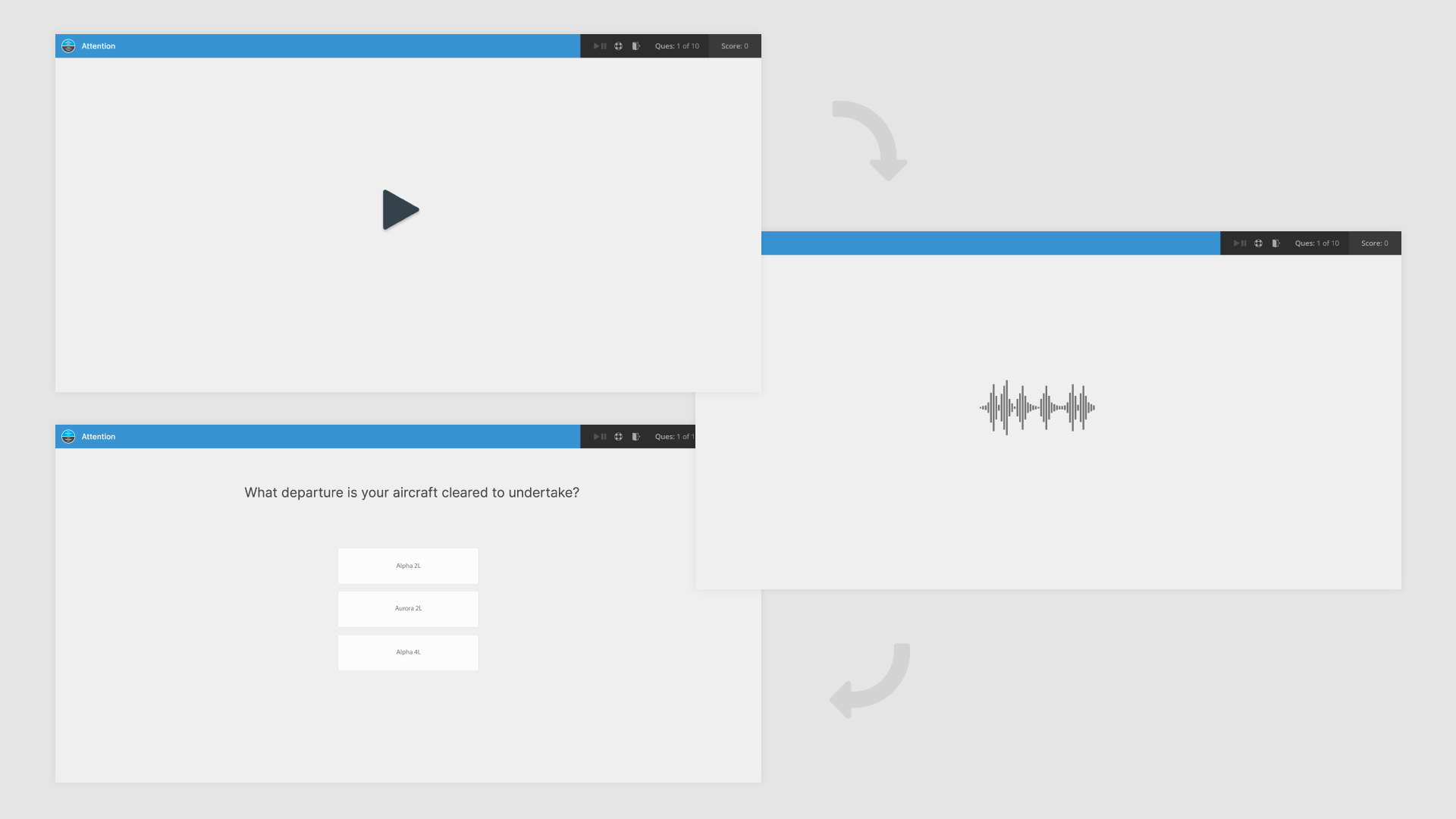
Listening comprehension tasks assess the candidate's ability to extract accurate information from spoken English, typically in an aviation context. The candidate listens to a simulated air traffic control instruction or aviation communication and must then answer questions about the content of what was said.
This format tests several abilities simultaneously: the candidate must process spoken English at normal conversational speed, identify the operationally relevant details (callsigns, altitudes, headings, instructions), retain those details in working memory, and select the correct answer from the options provided. The task is made more challenging by the use of aviation-specific terminology and the fact that the information is presented once, without the opportunity to re-read or re-listen.
Listening comprehension is the primary format used in the COMPASS and Advanced COMPASS Aviation English modules.
Some test systems combine written and listening elements within a single English Language module, or assess English Language alongside related competencies such as verbal reasoning. The DLR Aviation English (ENS) module, for example, assesses grammar, spelling, synonyms and idioms across multiple sections within a single timed test, providing a broad evaluation of written English competency.
Candidates should note that English Language modules assess general linguistic ability, not aviation knowledge. No prior knowledge of aviation terminology or procedures is required to perform well. The tests are designed to measure the candidate's underlying command of English, which is predictive of how quickly and effectively they will acquire aviation-specific language during training.
English Language assessment shares some common ground with Verbal Reasoning, which is assessed as a separate skill in several pilot aptitude test systems. Both require strong reading comprehension and vocabulary. However, they differ in emphasis: English Language modules focus on linguistic accuracy (correct grammar, spelling and word usage), whilst Verbal Reasoning modules focus on the ability to interpret, analyse and draw conclusions from written information.
Candidates preparing for assessments that include both English Language and Verbal Reasoning modules will find that preparation for one supports performance in the other, as both draw on the same underlying linguistic foundation. For a full breakdown of verbal reasoning modules, see our dedicated Verbal Reasoning Knowledgebase Article.
Further Reading on Why Native Speakers Should Not Be Complacent
Native Speaker Performance
A common misconception is that native English speakers will automatically perform well on English Language aptitude tests. In practice, this is not always the case. The tests assess specific competencies (grammatical accuracy, spelling precision, vocabulary breadth, listening comprehension under pressure) that vary significantly between individuals regardless of whether English is their first language.
Many native speakers rely on intuitive language use that is adequate for everyday communication but contains habitual grammatical errors, limited vocabulary, or poor spelling habits that become exposed under test conditions. Conversely, high-proficiency non-native speakers who have studied English formally often outperform native speakers on grammar and vocabulary tasks because they have explicitly learned the rules that native speakers apply (or misapply) unconsciously.
The implication for candidates is clear: regardless of whether English is your first language, targeted preparation for the specific task formats used in your assessment is worthwhile. Familiarity with the question types, practice under timed conditions, and active vocabulary development will all improve performance.
Whilst each pilot aptitude assessment relies on the same underlying principles to evaluate English Language competency, the names and formats of the individual modules differ between test systems.
Effective preparation begins with identifying your assessment, understanding which modules evaluate English Language, and then engaging with targeted practice activities.
English Language is assessed as a dedicated module in a number of pilot aptitude test systems. Its presence in your assessment makes targeted preparation essential, particularly for candidates whose first language is not English.
Select an assessment above to view its dedicated Knowledgebase Article for a full breakdown of all modules, not just those evaluating English Language.
Once you know which assessment you will be undertaking, use the table below to identify the specific modules within that assessment that evaluate English Language.
Each module targets a particular aspect of English Language competency, presented in a different format. The final column indicates which activity or activities within our software correspond to each module.
| Assessment | Module | Task Type | Format | Activity |
|---|---|---|---|---|
| Aon (Cut-e) | Language Skills (scales lt) | Written English | Sentence Completion, Definitions, Spelling | Grammar, Spelling, Vocabulary |
| COMPASS | Aviation English | Listening Comprehension | ATC Instructions / Multiple Choice | Attention |
| Adv. COMPASS | Aviation English | Listening Comprehension | ATC Instructions / Multiple Choice | Attention |
| DLR | Aviation English (ENS) | Written English | Idioms, Synonyms, Spelling, Grammar | Grammar, Spelling, Synonyms, Vocabulary |
Candidates preparing for assessments that also include a Verbal Reasoning module will find that English Language preparation supports performance in that module as well, since both draw on the same underlying linguistic competency.
Having identified the modules relevant to your assessment, you can navigate directly to the corresponding activities within our software.
Our software organises activities by the type of assessment you are preparing for, the skill being evaluated, and the specific airline, flying school or cadet scheme you are applying to. This means you do not need to manually cross-reference the table above; the relevant English Language activities will already be included in your tailored preparation.
In addition to the activities listed in the table above, we also offer a dedicated English Language for Pilots resource, freely available on our website, which provides additional practice material for candidates who wish to supplement their preparation.
To find the activities relevant to you, navigate to one of the following within the software:
- Activities by Aptitude Test
- If you know which test system your assessment uses. For example, to find English Language activities for the DLR, navigate to Activities by Aptitude Test and select DLR.
- Activities by Skill
- If you want to focus specifically on English Language across all test systems. Navigate to Activities by Skill and select English Language to see every relevant activity.
- Activities by Airline, Flying School or Cadet Scheme
- If you know where you are applying but not which test system is used. Navigate to Activities by Airline or Activities by Flying School and select your chosen organisation. The software will include the appropriate English Language activities alongside all other relevant preparation.
If you have created a Preparation Strategy, the relevant English Language activities will already appear in your Focus Activities; no additional navigation is required.
English Language is closely associated with several other competencies assessed in pilot aptitude testing. Candidates preparing for English Language modules may also benefit from developing the following related skills:
Academic Sources referenced in this KB Article
The following academic sources were consulted in the preparation of this article:
[1] International Civil Aviation Organization (2010). Manual on the Implementation of ICAO Language Proficiency Requirements (Doc 9835, 2nd ed.). ICAO.
[2] Cushing, S. (1994). Fatal Words: Communication Clashes and Aircraft Crashes. University of Chicago Press.
[3] International Civil Aviation Organization (2007). Manual of Radiotelephony (Doc 9432, 4th ed.). ICAO.
[4] Estival, D., Farris, C. & Molesworth, B. (2016). Aviation English: A Lingua Franca for Pilots and Air Traffic Controllers. Routledge.
[5] Segalowitz, N. (2010). Cognitive Bases of Second Language Fluency. Routledge.
[6] Morrow, D., Lee, A. & Rodvold, M. (1993). Analysis of Problems in Routine Controller-Pilot Communication. International Journal of Aviation Psychology, 3(4), 285-302.
[7] Tajima, A. (2004). Fatal Miscommunication: English in Aviation Safety. World Englishes, 23(3), 451-470.
[8] Hunter, D.R. & Burke, E.F. (1994). Predicting Aircraft Pilot Training Success: A Meta-Analysis of Published Research. International Journal of Aviation Psychology, 4(4), 297-313.
With a section dedicated to English Language, our one-of-a-kind software represents the ultimate way for you to get prepared.
By leveraging our cutting-edge software, including those unique features and extensive guidance not offered elsewhere, you can immerse yourself in realistic simulations, master those competencies assessed, and familiarise yourself with the methods and mechanisms of assessment.
Our software is backed by our meticulous attention to detail and deep expertise as experienced commercial pilots, empowering pilot applicants to approach their assessments with confidence and helping to propel them to supersonic levels of success.
Start using our incredible preparation software immediately on PC, Mac, iOS and Android by purchasing a subscription:
Buy Preparation SoftwareWith increasing prevalence and awareness of computerised pilot aptitude testing in pilot assessments, it's never been more important to ensure that you can fly past the competition. This is made easy with features unique to our software:












Discover the key advantages of using our cutting-edge software:
How can I prepare for my English Language pilot assessment?
The best way to prepare for your English Language pilot assessment is with our latest industry-leading software, developed over 5 years by experienced airline pilots. With realistic exam simulations, personalised Preparation Strategies which guide you through your preparation, immersive Explainer Videos, customisable Training Modes that manipulate your simulation environments, comprehensive Instruction and Guidance, and extensive performance feedback which incorporates unique features such as Predictive Scoring, a Strength & Weakness Map and Colour Coding, our unique software will help you to accelerate improvement of your problem areas and fly through each part of the English Language assessment. The software runs in a web browser, is compatible with laptop, desktop, tablet and smartphone, and is complimented with extensive support, provided from 9AM to 9PM GMT. To purchase a subscription to our software and start preparing for your English Language pilot assessment, click here!
What is the pass mark for the English Language pilot assessment?
Many pilot aptitude tests do not have a fixed threshold (or pass mark), but rather indicate the pilot candidate's overall performance and suitability using a variety of different methods - many of which are emulated within our software. Rather than worrying about a specific pass mark, the better approach is to focus on comprehensive preparation that maximizes your chances of success within each part of the English Language pilot assessment. Our industry-leading pilot preparation software provides that comprehensive preparation, helping you to develop the essential sklls, familiarity with assessment and confidence needed to perform at your best. If you have any questions about the English Language pilot assessment, please contact us.
How often is your English Language assessment preparation software updated?
Our pilot assessment preparation software is continuously updated, with daily improvements based on feedback from hundreds of monthly users. Developed by experienced airline pilots, the simulations provided within our unique software faithfully reflect the English Language pilot assessment, ensuring that you have the most current and comprehensive preparation. To see the recent updates to our preparation software, please visit our Updates page.
What support is available with your English Language assessment preparation software?
With our own industry experiences, we understand the pressures and stresses that come with preparing for pilot assessments. When you use our software to prepare for your English Language pilot assessment, you'll have access to exceptional support and guidance from our team of experienced airline pilots, provided between 9AM and 9PM GMT. This support sets us apart, helping you to develop the skills, knowledge, and confidence needed to approach your assessment feeling completely ready to demonstrate your true potential and fly past the competition at every stage of the English Language pilot assessment.
How quickly can I prepare for my English Language pilot assessment with this software?
If you'd like to start preparing for the English Language assessment, you may start using our software within as little as a few minutes. We offer access to our preparation software for 7 days, 1 month or 3 months, and provide the opportunity to purchase additional time. This ensures you can work through the comprehensive simulations, and benefit from our guidance at your own pace, with support available whenever you need it. To get started, choose a subscription duration to our preparation software, create an account and complete your purchase - then, login and begin your preparation. The entire process typically takes between 2-3 minutes, with secure payment by credit or debit card securely processed with Stripe or PayPal.
Feature-packed and one-of-a kind preparation software for your assessment.
Regularly updated, realistic and infinite simulations of aptitude tests.
Instant activation, fast support and uniquely in-depth guidance.