

 Maths for Pilots
 Science for Pilots
 English Language for Pilots
 Verbal Reasoning for Pilots
 Numerical Reasoning for Pilots
 Mechanical Reasoning for Pilots
 ATPL Knowledge for Pilots
 WhatsApp
 Facebook Chat
 Email
Email








































If you don't have time to read this article but would like to know whether our software can help - it can. You can buy access to our software and get started immediately, 365 days-a-year.
Buy Preparation SoftwareDeductive Reasoning describes the cognitive ability to draw specific, logically certain conclusions from general premises, rules or known information. It is often characterised as "top-down" reasoning: given a set of established facts or principles, the individual works downward to determine what must necessarily follow. Deductive reasoning is one of two fundamental reasoning types assessed in pilot aptitude testing, the other being Inductive Reasoning (which works in the opposite direction, moving from specific observations to general conclusions). The distinguishing feature of deductive reasoning is that if the premises are true and the logic is valid, the conclusion is guaranteed to be correct. There is no probability or uncertainty involved; the answer follows necessarily from the information given.
In pilot aptitude testing, deductive reasoning is evaluated through tasks that require candidates to apply rules, interpret logical relationships, evaluate risk based on known probabilities, or solve structured problems where the solution must be derived from the information provided. The ability to reason deductively under time pressure is a core competency for professional pilots, who must routinely apply procedural rules, regulations and decision frameworks to reach correct conclusions in operationally demanding environments.
Further Reading on the Structure of Deductive Reasoning
Deductive vs. Inductive Reasoning
The distinction between deductive and inductive reasoning has been studied since Aristotle, but remains central to modern cognitive psychology and occupational testing. In simple terms: deductive reasoning moves from the general to the specific (applying a known rule to reach a guaranteed conclusion), whilst inductive reasoning moves from the specific to the general (observing patterns to form a probable conclusion) [1].
A classic example illustrates the difference. Deductive: "All aircraft require fuel. This is an aircraft. Therefore, it requires fuel." The conclusion is certain. Inductive: "Every aircraft I have seen requires fuel. Therefore, all aircraft probably require fuel." The conclusion is probable but not certain. Pilot aptitude tests that assess deductive reasoning are specifically measuring the candidate's ability to handle the first type of reasoning: drawing guaranteed conclusions from given information.
Mental Models Theory
The dominant psychological theory explaining how humans perform deductive reasoning is Philip Johnson-Laird's Mental Models Theory. Rather than applying formal logical rules (as a logician would), Johnson-Laird proposed that people reason by constructing mental models of the situations described in the premises, and then inspecting those models to determine what conclusions follow [2].
This theory explains why some deductive problems are much harder than others: problems that require multiple mental models to be constructed and compared are more error-prone and take longer to solve than problems that can be resolved with a single model. It also explains why spatial and visual representations can aid deductive reasoning, as they provide external support for the mental modelling process. Several pilot aptitude test modules exploit this by presenting deductive problems in visual or spatial formats rather than purely verbal ones.
Deductive reasoning is used in everyday life whenever a person applies known rules or facts to reach a specific conclusion. The following are common examples that closely relate to the deductive abilities assessed in pilot aptitude testing.
- Following a recipe or assembly instructions:
- When following a recipe, each step provides a rule ("if the mixture has reached 180°C, remove from heat") that must be correctly interpreted and applied. The cook deduces the correct action from the given instruction and the observed state. Missing a step or misapplying a rule leads to a predictable failure. This structured, rule-following process mirrors the procedural compliance assessed in pilot aptitude tests.
- Troubleshooting a technical problem:
- When a device stops working, a systematic troubleshooter applies known rules to eliminate possibilities. "The screen is blank. If the device is charged and the screen is blank, the display may be faulty. The device is charged. Therefore, the display may be faulty." Each step applies a conditional rule to the observed symptoms to narrow down the cause. This process of elimination through applied logic is a core deductive reasoning task.
- Planning a route with constraints:
- If a driver knows that a particular road is closed on weekdays, and today is a weekday, they deduce that the road is closed and plan an alternative route. The conclusion follows necessarily from the two premises. More complex route planning involves multiple such deductions applied in sequence, each building on the conclusions of the last. In aviation, this same reasoning applies to route planning with airspace restrictions, weather constraints and fuel limitations.
- Interpreting rules in games or sport:
- Board games, card games and sports all require the player to apply rules to specific situations. "If a piece reaches the far side of the board, it becomes a queen." The player observes the piece's position, applies the rule, and deduces the outcome. The speed and accuracy with which a person can apply game rules under time pressure is closely analogous to the deductive reasoning tasks used in pilot aptitude testing, where candidates must apply logical rules to novel stimuli quickly and correctly.
Further Reading on Dual Process Theory and Reasoning Errors
Research into human reasoning has consistently demonstrated that people are prone to systematic errors in deductive reasoning, even when they are intelligent and motivated to get the answer right. The psychologist Daniel Kahneman, building on earlier work with Amos Tversky, popularised the concept of Dual Process Theory: the idea that human thinking operates through two distinct systems [3].
System 1 is fast, automatic and intuitive. It produces quick answers based on pattern recognition and heuristics. System 2 is slow, deliberate and analytical. It is the system responsible for genuine deductive reasoning, but it requires effort and is easily overridden by System 1's faster, less accurate responses.
In the context of pilot aptitude testing, this distinction is highly relevant. Many deductive reasoning modules are designed to present problems where the intuitive, System 1 answer is wrong. The candidate must engage System 2 (effortful, deliberate reasoning) to override the instinctive response and arrive at the logically correct conclusion. Candidates who are aware of this tendency, and who habitually check their intuitive responses against the logical structure of the problem, tend to perform significantly better on deductive reasoning tasks.
The everyday examples above share a common structure: a set of known rules or facts is applied to a specific situation to reach a conclusion that must be correct. In aviation, this process is not optional. Pilots are required to apply rules, procedures and regulations to specific operational situations continuously, and the consequences of reasoning incorrectly are severe.
- Applying Standard Operating Procedures (SOPs):
- SOPs are structured as conditional rules: "If the airspeed exceeds Vfe, retract flaps." "If the cabin altitude exceeds 10,000 feet, don oxygen masks." Pilots must continuously match the current state of the aircraft and its environment to the relevant procedure and deduce the correct action. The ability to apply the right rule at the right time, without hesitation or error, is a direct application of deductive reasoning under operational pressure.
- Weather-related decision making:
- Aviation weather minimums are expressed as rules: "If visibility is below 550 metres and the decision altitude has been reached without visual reference, execute a go-around." The pilot must observe the conditions, compare them against the published criteria, and deduce whether to continue or discontinue the approach. The reasoning is deductive because the conclusion follows necessarily from the premises: the rule is fixed, and the observed conditions either satisfy the rule or they do not.
- Fuel planning and diversion decisions:
- Fuel regulations require pilots to carry specified reserves. During flight, the pilot continuously deduces whether the remaining fuel is sufficient to continue to the destination with required reserves, or whether a diversion is necessary. This involves applying regulatory rules to calculated fuel figures, accounting for contingencies, and reaching a binary conclusion: continue or divert. The reasoning must be methodical and accurate, as an incorrect deduction can have serious consequences.
- Emergency and abnormal procedures:
- When a system fails, pilots follow structured checklists that operate on deductive logic. "If the engine fire warning illuminates and the engine is confirmed to be on fire, shut down the engine and discharge the extinguisher." Each step requires the pilot to verify a condition and deduce the appropriate response. The ability to follow this logical chain quickly, accurately and without skipping steps under the stress of an emergency is a critical safety competency.
Rotary-wing operations present additional contexts in which deductive reasoning is exercised:
- Performance planning:
- Helicopter performance is acutely sensitive to temperature, altitude and weight. Before every flight, the pilot must apply performance charts and formulae to the specific conditions of the day to deduce whether the planned operation is within limits. If the temperature is above a certain value at a given altitude, the helicopter may not be able to hover out of ground effect, and the mission must be modified. The reasoning is entirely deductive: known performance rules applied to specific conditions yield a definitive conclusion.
- Mission rule application:
- Military and emergency helicopter operations are governed by mission-specific rules of engagement or operating procedures. The pilot must continuously apply these rules to the evolving tactical or operational situation, deducing the correct course of action as conditions change. A search and rescue pilot, for example, must apply crew duty time regulations, weather minimums, and fuel requirements simultaneously to determine whether a mission can continue or must be aborted.
- Load calculations and rigging:
- Underslung load operations require the pilot to apply weight, balance and rigging rules to specific cargo configurations. If the load exceeds the maximum permissible mass for the given conditions, or if the rigging configuration does not meet the specified criteria, the lift cannot proceed. Each decision is deductive: the rules are fixed, the parameters are measured, and the conclusion follows necessarily.
- Airspace and procedural compliance:
- Helicopter operations frequently involve complex airspace environments with overlapping restrictions. The pilot must apply airspace rules to their specific position, altitude and intentions to deduce whether they are permitted to enter a particular area, what clearances are required, and what communication procedures must be followed. Incorrect deductions can result in airspace infringements with serious safety and regulatory consequences.
Deductive reasoning is assessed in pilot aptitude testing because the professional pilot role fundamentally depends on the ability to apply rules and procedures to specific situations and reach correct conclusions. Although it appears in fewer dedicated test modules than some other skills, its importance to pilot performance is well established.
Professional pilot training is heavily rule-based. From the earliest stages of ground school through to advanced type rating courses, candidates must absorb, retain and correctly apply large volumes of regulatory and procedural information. Candidates with strong deductive reasoning abilities are better equipped to understand the logical structure underlying aviation rules and procedures, rather than simply memorising them by rote.
This matters because aviation regulations are not arbitrary; they follow logical principles. A candidate who understands why a rule exists (because it follows logically from physical, operational or safety principles) will apply it more reliably and adapt more effectively when encountering novel situations not explicitly covered by a specific procedure. Screening for deductive reasoning ability at the selection stage helps to identify candidates who will learn efficiently and apply their learning accurately.
In operational flying, deductive reasoning errors can have immediate and serious consequences. Misapplying a fuel rule, incorrectly interpreting a weather minimum, or failing to follow the logical steps of an emergency checklist can all lead to unsafe outcomes. The ability to reason deductively under pressure, fatigue and time constraints is not a theoretical nicety; it is a daily operational requirement.
Research into aviation accidents and incidents has repeatedly identified failures of procedural compliance and decision-making as contributing factors [4]. Whilst not all such failures are attributable to poor deductive reasoning (some result from fatigue, distraction or social pressure), the underlying cognitive ability to apply rules correctly to specific situations is a necessary foundation for safe decision-making in the cockpit.
Deductive reasoning ability reflects a combination of innate cognitive capacity and learned reasoning strategies. Whilst the specific rules of aviation must be learned through training, the underlying ability to apply rules accurately and efficiently to novel situations is a cognitive aptitude that varies between individuals.
Aptitude testing measures this underlying ability by presenting candidates with logical problems that do not require any aviation knowledge to solve. The candidate's performance on these abstract reasoning tasks is predictive of how effectively they will learn and apply the rule-based procedures that dominate professional pilot training and operations. Preparation should focus on developing familiarity with the specific task formats used in each assessment, and on strengthening the habit of systematic, deliberate reasoning rather than relying on intuition.
Further Reading on Reasoning and Pilot Selection Research
Cognitive Ability as a Predictor
Meta-analytic research into pilot selection has consistently identified cognitive ability measures, including reasoning tests, as significant predictors of training success. Hunter and Burke's (1994) meta-analysis of published pilot selection research found that cognitive tests (encompassing both deductive and inductive reasoning measures) contributed meaningfully to the prediction of pilot training outcomes, particularly when combined with psychomotor and perceptual measures [5].
Martinussen's (1996) European meta-analysis confirmed these findings, reporting that cognitive ability measures showed significant validity for predicting pilot training performance across multiple samples and selection systems [6]. Whilst these meta-analyses do not isolate deductive reasoning as a separate predictor (it is typically assessed alongside other cognitive abilities), they establish that the broader cognitive domain to which deductive reasoning belongs is robustly predictive of pilot performance.
The Tower of London and Executive Planning
The Tower of London task, which features in the Vienna Test System as the TOL-F module, was originally developed by Tim Shallice (1982) as a measure of executive planning ability [7]. The task requires the participant to rearrange coloured balls across pegs to match a goal configuration in the minimum number of moves. It is classified as a deductive reasoning task because the participant must work backward from the goal state, applying the constraints of the task (peg heights, movement rules) to deduce the optimal sequence of moves.
Research using the Tower of London has demonstrated that performance on this task correlates with broader measures of executive function, planning ability and fluid intelligence. Its inclusion in pilot aptitude test batteries reflects the recognition that the ability to plan a sequence of actions under constraints, predicting the outcome of each move before executing it, is directly relevant to the planning demands of flight operations.
Computerised pilot aptitude tests evaluate deductive reasoning using tasks that require candidates to apply rules, identify logical relationships, or solve structured problems where the correct answer must be derived from the information given. Although fewer dedicated modules assess this skill compared to broader competencies such as motor skills or multitasking, the modules that do exist target distinct and important facets of deductive ability.

Rule application tasks present the candidate with a grid or arrangement of shapes governed by one or more rules, along with a missing element. The candidate must identify the rules governing the arrangement and deduce which element correctly completes it. Unlike inductive reasoning tasks (where the candidate must discover the rule from examples), deductive reasoning tasks typically require the candidate to verify whether a proposed solution satisfies all the given constraints.
The cognitive demand lies in holding multiple rules in mind simultaneously and systematically testing candidate solutions against each rule until the correct answer is confirmed. This mirrors the operational demand of verifying that a planned action satisfies all applicable procedures, regulations and constraints before executing it.
Rule application is the primary deductive ability evaluated in the Aon Scales lst module.

Risk assessment tasks require the candidate to evaluate known probabilities and make decisions that balance risk against reward. In these tasks, the candidate must deduce the optimal course of action based on the available information: the probability of a negative outcome, the potential reward for continued engagement, and the cost of failure.
This form of deductive reasoning is directly relevant to aviation, where pilots routinely make decisions under conditions of quantified risk. Fuel decisions, weather assessments and go/no-go calls all involve weighing known probabilities against operational constraints to deduce the correct course of action. The ability to reason clearly about risk, rather than relying on gut feeling, is a critical safety competency.
Risk assessment is the primary deductive ability evaluated in the Arctic Shores Balloons module.
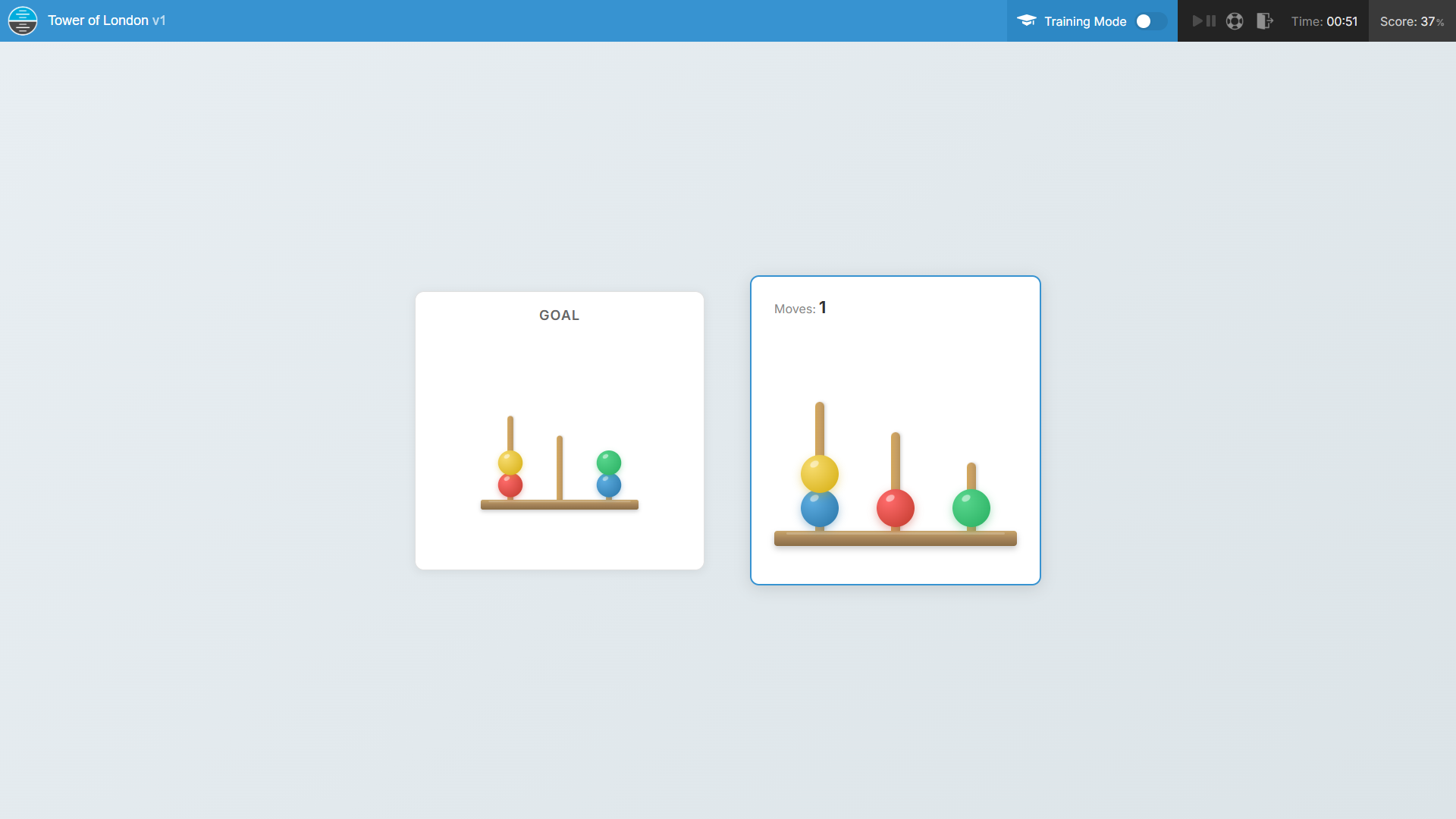
Planning tasks present the candidate with a defined goal state and a set of constraints, and require them to deduce the optimal sequence of actions to reach that goal. These tasks demand forward planning: the candidate must mentally simulate each possible move, predict its consequences, and evaluate whether it brings them closer to or further from the solution.
The cognitive demand is substantial because each move changes the problem state, requiring the candidate to update their mental model and re-evaluate the available options. Problems that require more moves are exponentially harder because the number of possible paths increases rapidly. This type of reasoning is directly analogous to flight planning, where pilots must sequence actions (routing, altitude changes, speed adjustments) to achieve an objective whilst operating within procedural and physical constraints.
Planning and sequential problem-solving is evaluated in the VTS Tower of London (TOL-F) module, which uses a ball-and-peg rearrangement task originally developed as a measure of executive planning ability.
Deductive reasoning shares significant common ground with the broader skill of Logic, which is assessed as a separate competency across several pilot aptitude test systems. Modules categorised under Logic frequently require the application of deductive reasoning principles, particularly where candidates must observe declared rules and apply them to respond correctly to stimuli over extended periods.
Candidates preparing for assessments that include logic-based modules (such as the DLR Triangles (SKT), Dials (OWT) and Signal Processing (DRT), or the Sova Logical Reasoning and Arctic Shores Order modules) will find that strengthening their deductive reasoning ability provides a strong foundation for these tasks. For a full breakdown of logic-specific modules, see our dedicated Logic Knowledgebase Article.
Further Reading on Abstract vs. Concrete Reasoning Formats
Why Tests Use Abstract Problems
Candidates sometimes question why deductive reasoning is assessed using abstract puzzles (grids of shapes, coloured balls on pegs) rather than aviation-specific scenarios. The reason is fundamental to the purpose of aptitude testing: the goal is to measure the candidate's reasoning ability, not their aviation knowledge.
If deductive reasoning were assessed using aviation scenarios, candidates with prior aviation experience would have an unfair advantage, not because they reason better, but because they already know the rules being applied. Abstract tasks ensure a level playing field: every candidate encounters the same novel problem and must apply the same fundamental reasoning processes to solve it. Research has consistently demonstrated that performance on abstract reasoning tasks is predictive of performance on domain-specific reasoning tasks encountered later in training [8], which is precisely why they are used in selection.
The implication for candidates is that preparation should focus on developing comfort and speed with abstract problem formats, rather than attempting to learn aviation-specific content in advance of a reasoning test.
Whilst each pilot aptitude assessment relies on the same underlying principles to evaluate deductive reasoning, the names and formats of the individual modules differ between test systems.
Effective preparation begins with identifying your assessment, understanding which modules evaluate deductive reasoning, and then engaging with targeted practice activities.
Deductive reasoning is assessed in a smaller number of pilot aptitude test systems than some other skills, but its presence in these assessments makes targeted preparation essential for candidates facing them.
Select an assessment above to view its dedicated Knowledgebase Article for a full breakdown of all modules, not just those evaluating deductive reasoning.
Candidates preparing for the DLR or Sova assessments should also see our Logic Knowledgebase Article, as several modules within these test systems assess closely related logical reasoning abilities.
Once you know which assessment you will be undertaking, use the table below to identify the specific modules within that assessment that evaluate deductive reasoning.
Each module targets a particular aspect of deductive ability, presented in a different format. The final column indicates which activity within our software corresponds to each module.
| Assessment | Module | Task Type | Format | Activity |
|---|---|---|---|---|
| Aon (Cut-e) | Scales lst | Rule Application | Grid Puzzle | Logic |
| Vienna Test System | Tower of London (TOL-F) | Planning & Sequencing | Ball Rearrangement | Tower of London |
| Arctic Shores | Balloons | Risk Assessment | Gamified / Probability | Balloons |
Modules categorised under Logic (including the DLR Triangles, Dials and Signal Processing modules, and the Sova Logical Reasoning and Arctic Shores Order modules) also draw significantly on deductive reasoning ability. See our Logic article for a full breakdown.
Having identified the modules relevant to your assessment, you can navigate directly to the corresponding activities within our software.
Our software organises activities by the type of assessment you are preparing for, the skill being evaluated, and the specific airline, flying school or cadet scheme you are applying to. This means you do not need to manually cross-reference the table above; the relevant deductive reasoning activities will already be included in your tailored preparation.
To find the activities relevant to you, navigate to one of the following within the software:
- Activities by Aptitude Test
- If you know which test system your assessment uses. For example, to find deductive reasoning activities for the Vienna Test System, navigate to Activities by Aptitude Test and select Vienna Test System.
- Activities by Skill
- If you want to focus specifically on deductive reasoning across all test systems. Navigate to Activities by Skill and select Deductive Reasoning to see every relevant activity.
- Activities by Airline, Flying School or Cadet Scheme
- If you know where you are applying but not which test system is used. Navigate to Activities by Airline or Activities by Flying School and select your chosen organisation. The software will include the appropriate deductive reasoning activities alongside all other relevant preparation.
If you have created a Preparation Strategy, the relevant deductive reasoning activities will already appear in your Focus Activities; no additional navigation is required.
Deductive reasoning is closely associated with several other competencies assessed in pilot aptitude testing. Candidates preparing for deductive reasoning modules may also benefit from developing the following related skills:
Academic Sources referenced in this KB Article
The following academic sources were consulted in the preparation of this article:
[1] Evans, J.St.B.T. (2002). Logic and Human Reasoning: An Assessment of the Deduction Paradigm. Psychological Bulletin, 128(6), 978-996.
[2] Johnson-Laird, P.N. (1999). Deductive Reasoning. Annual Review of Psychology, 50, 109-135.
[3] Kahneman, D. (2011). Thinking, Fast and Slow. Farrar, Straus and Giroux.
[4] Reason, J. (1990). Human Error. Cambridge University Press.
[5] Hunter, D.R. & Burke, E.F. (1994). Predicting Aircraft Pilot Training Success: A Meta-Analysis of Published Research. International Journal of Aviation Psychology, 4(4), 297-313.
[6] Martinussen, M. (1996). Psychological Measures as Predictors of Pilot Performance: A Meta-Analysis. International Journal of Aviation Psychology, 6(1), 1-20.
[7] Shallice, T. (1982). Specific Impairments of Planning. Philosophical Transactions of the Royal Society of London. Series B, Biological Sciences, 298(1089), 199-209.
[8] Stanovich, K.E. & West, R.F. (2000). Individual Differences in Reasoning: Implications for the Rationality Debate? Behavioral and Brain Sciences, 23(5), 645-665.
With a section dedicated to Deductive Reasoning, our one-of-a-kind software represents the ultimate way for you to get prepared.
By leveraging our cutting-edge software, including those unique features and extensive guidance not offered elsewhere, you can immerse yourself in realistic simulations, master those competencies assessed, and familiarise yourself with the methods and mechanisms of assessment.
Our software is backed by our meticulous attention to detail and deep expertise as experienced commercial pilots, empowering pilot applicants to approach their assessments with confidence and helping to propel them to supersonic levels of success.
Start using our incredible preparation software immediately on PC, Mac, iOS and Android by purchasing a subscription:
Buy Preparation SoftwareWith increasing prevalence and awareness of computerised pilot aptitude testing in pilot assessments, it's never been more important to ensure that you can fly past the competition. This is made easy with features unique to our software:












Discover the key advantages of using our cutting-edge software:
How can I prepare for my Deductive Reasoning pilot assessment?
The best way to prepare for your Deductive Reasoning pilot assessment is with our latest industry-leading software, developed over 5 years by experienced airline pilots. With realistic exam simulations, personalised Preparation Strategies which guide you through your preparation, immersive Explainer Videos, customisable Training Modes that manipulate your simulation environments, comprehensive Instruction and Guidance, and extensive performance feedback which incorporates unique features such as Predictive Scoring, a Strength & Weakness Map and Colour Coding, our unique software will help you to accelerate improvement of your problem areas and fly through each part of the Deductive Reasoning assessment. The software runs in a web browser, is compatible with laptop, desktop, tablet and smartphone, and is complimented with extensive support, provided from 9AM to 9PM GMT. To purchase a subscription to our software and start preparing for your Deductive Reasoning pilot assessment, click here!
What is the pass mark for the Deductive Reasoning pilot assessment?
Many pilot aptitude tests do not have a fixed threshold (or pass mark), but rather indicate the pilot candidate's overall performance and suitability using a variety of different methods - many of which are emulated within our software. Rather than worrying about a specific pass mark, the better approach is to focus on comprehensive preparation that maximizes your chances of success within each part of the Deductive Reasoning pilot assessment. Our industry-leading pilot preparation software provides that comprehensive preparation, helping you to develop the essential sklls, familiarity with assessment and confidence needed to perform at your best. If you have any questions about the Deductive Reasoning pilot assessment, please contact us.
How often is your Deductive Reasoning assessment preparation software updated?
Our pilot assessment preparation software is continuously updated, with daily improvements based on feedback from hundreds of monthly users. Developed by experienced airline pilots, the simulations provided within our unique software faithfully reflect the Deductive Reasoning pilot assessment, ensuring that you have the most current and comprehensive preparation. To see the recent updates to our preparation software, please visit our Updates page.
What support is available with your Deductive Reasoning assessment preparation software?
With our own industry experiences, we understand the pressures and stresses that come with preparing for pilot assessments. When you use our software to prepare for your Deductive Reasoning pilot assessment, you'll have access to exceptional support and guidance from our team of experienced airline pilots, provided between 9AM and 9PM GMT. This support sets us apart, helping you to develop the skills, knowledge, and confidence needed to approach your assessment feeling completely ready to demonstrate your true potential and fly past the competition at every stage of the Deductive Reasoning pilot assessment.
How quickly can I prepare for my Deductive Reasoning pilot assessment with this software?
If you'd like to start preparing for the Deductive Reasoning assessment, you may start using our software within as little as a few minutes. We offer access to our preparation software for 7 days, 1 month or 3 months, and provide the opportunity to purchase additional time. This ensures you can work through the comprehensive simulations, and benefit from our guidance at your own pace, with support available whenever you need it. To get started, choose a subscription duration to our preparation software, create an account and complete your purchase - then, login and begin your preparation. The entire process typically takes between 2-3 minutes, with secure payment by credit or debit card securely processed with Stripe or PayPal.
Feature-packed and one-of-a kind preparation software for your assessment.
Regularly updated, realistic and infinite simulations of aptitude tests.
Instant activation, fast support and uniquely in-depth guidance.